

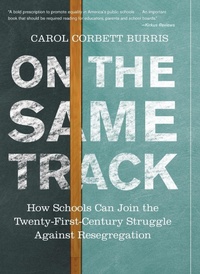
On the Same Track
How Schools Can Join the Twenty-First-Century Struggle against Resegregation
Published on 17. March 2015
Book
Paperback/Softback
208 pages
978-0-8070-3690-7 (ISBN)
Description
A public school principal's account of the courageous leaders who have dismantled the tracking systems in their schools in order to desegregate classrooms
What would happen if a school eliminated the "tracks" that rank students based on their perceived intellectual abilities? Would low-achieving students fall behind and become frustrated? Would their higher-achieving peers suffer from a "watered-down" curriculum? Or is tracking itself the problem? A growing body of research shows that tracking doesn't increase learning for the minority and low-income students who are overrepresented in low-track classrooms. This de facto segregation has led many civil rights advocates to argue that tracking is turning back the clock on equal education.
As a principal at a New York high school, Carol Corbett Burris believed that the curriculum for the best students was the best curriculum for all. She helped lead a bold plan to eliminate tracking from her school, and the results couldn't have been further from the doom-and-gloom scenarios of tracking proponents. Instead, there was a dramatic improvement in the achievement of all students, across racial and socioeconomic divisions, and a near elimination of the achievement gap. Today, due to those efforts, International Baccalaureate English is the twelfth-grade curriculum for South Side students, and all students take the same challenging courses, together, to prepare them for college.
In On the Same Track, Burris draws on her own experience, on the experiences of other schools, and on the latest research to make an impassioned case for detracking. Not only does the practice of tracking fail to benefit lower-tracked students, as Burris shows, but it also results in the resegregation of classrooms. Furthermore, she argues that many of today's popular reforms emanate from the same "sort and select" mentality that reinforces social stratification based on race and class.
On the Same Track is a rousing, controversial, and yet optimistic account of how we need to change our assumptions and policies if we are to live up to the promise of democratic public education. Only by holding all students to the same high standards can we ensure that all have the same opportunity to live up to their full potential.
What would happen if a school eliminated the "tracks" that rank students based on their perceived intellectual abilities? Would low-achieving students fall behind and become frustrated? Would their higher-achieving peers suffer from a "watered-down" curriculum? Or is tracking itself the problem? A growing body of research shows that tracking doesn't increase learning for the minority and low-income students who are overrepresented in low-track classrooms. This de facto segregation has led many civil rights advocates to argue that tracking is turning back the clock on equal education.
As a principal at a New York high school, Carol Corbett Burris believed that the curriculum for the best students was the best curriculum for all. She helped lead a bold plan to eliminate tracking from her school, and the results couldn't have been further from the doom-and-gloom scenarios of tracking proponents. Instead, there was a dramatic improvement in the achievement of all students, across racial and socioeconomic divisions, and a near elimination of the achievement gap. Today, due to those efforts, International Baccalaureate English is the twelfth-grade curriculum for South Side students, and all students take the same challenging courses, together, to prepare them for college.
In On the Same Track, Burris draws on her own experience, on the experiences of other schools, and on the latest research to make an impassioned case for detracking. Not only does the practice of tracking fail to benefit lower-tracked students, as Burris shows, but it also results in the resegregation of classrooms. Furthermore, she argues that many of today's popular reforms emanate from the same "sort and select" mentality that reinforces social stratification based on race and class.
On the Same Track is a rousing, controversial, and yet optimistic account of how we need to change our assumptions and policies if we are to live up to the promise of democratic public education. Only by holding all students to the same high standards can we ensure that all have the same opportunity to live up to their full potential.
More details
Series
Language
English
Place of publication
Boston, MA
United States
Product notice
Paperback (trade)
Dimensions
Height: 206 mm
Width: 150 mm
Thickness: 13 mm
Weight
310 gr
ISBN-13
978-0-8070-3690-7 (9780807036907)
Copyright in bibliographic data and cover images is held by Nielsen Book Services Limited or by the publishers or by their respective licensors: all rights reserved.
Schweitzer Classification
Other editions
Additional editions
Carol Corbett Burris
On the Same Track
How Schools Can Join the Twenty-First-Century Struggle against Resegregation
E-Book
03/2014
1st Edition
Beacon Press
€20.49
Available for download
Person
Carol Corbett Burris
Content
Contents
Introduction vii
1. The Boy with the Purple Tie 1
2. Keeping Track
Challenging the Status Quo on Grouping Practices 11
3. Tracking and Classroom Segregation 21
4. Tracking and Student Achievement 35
5. The District That Stopped Sorting Students
Rockville Centre 55
6. The Politics of Detracking
When Equity and Fear Collide 78
7. Race and Detracking
The Stories of Two Districts 90
8. Tracking and Leadership 114
9. Lessons Learned and the Reforms of Today 139
Note from the Series Editor 164
Notes 166
Index 185
Introduction vii
1. The Boy with the Purple Tie 1
2. Keeping Track
Challenging the Status Quo on Grouping Practices 11
3. Tracking and Classroom Segregation 21
4. Tracking and Student Achievement 35
5. The District That Stopped Sorting Students
Rockville Centre 55
6. The Politics of Detracking
When Equity and Fear Collide 78
7. Race and Detracking
The Stories of Two Districts 90
8. Tracking and Leadership 114
9. Lessons Learned and the Reforms of Today 139
Note from the Series Editor 164
Notes 166
Index 185