

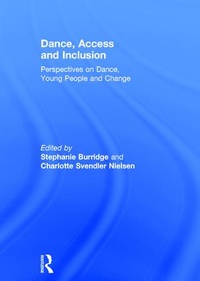
Dance, Access and Inclusion
Perspectives on Dance, Young People and Change
1st Edition
Published on 11. July 2017
Book
Hardback
206 pages
978-1-138-67407-3 (ISBN)
Description
The arts have a crucial role in empowering young people with special needs through diverse dance initiatives. Inclusive pedagogy that integrates all students in rich, equitable and just dance programmes within education frameworks is occurring alongside enabling projects by community groups and in the professional dance world where many high-profile choreographers actively seek opportunities to work across diversity to inspire creativity. Access and inclusion is increasingly the essence of projects for disenfranchised and traumatised youth who find creative expression, freedom and hope through dance. This volume foregrounds dance for young people with special needs and presents best practice scenarios in schools, communities and the professional sphere. International perspectives come from Australia, Brazil, Cambodia, Canada, Denmark, Fiji, Finland, India, Indonesia, Jamaica, Japan, Malaysia, New Zealand, Norway, Papua New Guinea, Portugal, Singapore, South Africa, Spain, Taiwan, Timor Leste, the UK and the USA.
Sections include:
inclusive dance pedagogy
equality, advocacy and policy
changing practice for dance education
community dance initiatives
professional integrated collaborations
Sections include:
inclusive dance pedagogy
equality, advocacy and policy
changing practice for dance education
community dance initiatives
professional integrated collaborations
Reviews / Votes
'A much-needed anthology that will prove invaluable to the dance practitioner who wishes to provide an inclusive environment for all.' - Ann Kipling Brown, Professor Emerita of the University of Regina, Canada'This book can be summed as being about the work that art or dance does, as opposed to the work that art is. The efficacy and the power that dance has to change people's lives is perhaps the most noble of its functions in life. For educators, parents and practitioners, this is a priceless addition to your library and resource material. The book serves its purpose to enlighten and empower, as well as being a timely reminder of why dance has been an integral part of the community, and how everyone can participate in its joy and benefits.' - Joseph Gonzales, Professor at Hong Kong Academy for Performing Arts, Hong Kong
More details
Language
English
Place of publication
London
United Kingdom
Publishing group
Taylor & Francis Ltd
Target group
Professional and scholarly
College/higher education
Illustrations
33 s/w Abbildungen, 31 s/w Photographien bzw. Rasterbilder, 2 s/w Zeichnungen, 2 s/w Tabellen
2 Tables, black and white; 2 Line drawings, black and white; 31 Halftones, black and white; 33 Illustrations, black and white
Dimensions
Height: 246 mm
Width: 174 mm
Weight
540 gr
ISBN-13
978-1-138-67407-3 (9781138674073)
Copyright in bibliographic data and cover images is held by Nielsen Book Services Limited or by the publishers or by their respective licensors: all rights reserved.
Schweitzer Classification
Other editions
Additional editions
Stephanie Burridge | Charlotte Svendler Nielsen
Dance, Access and Inclusion
Perspectives on Dance, Young People and Change
Book
07/2017
1st Edition
Routledge
€72.00
Shipment within 10-20 days
Stephanie Burridge | Charlotte Svendler Nielsen
Dance, Access and Inclusion
Perspectives on Dance, Young People and Change
E-Book
07/2017
Routledge
€55.49
Available for download
Stephanie Burridge | Charlotte Svendler Nielsen
Dance, Access and Inclusion
Perspectives on Dance, Young People and Change
E-Book
07/2017
Routledge
€55.49
Available for download
Persons
Stephanie Burridge lectures at LASALLE College of the Arts and Singapore Management University and is the Series Editor for Celebrating Dance in Asia and the Pacific (Routledge).
Charlotte Svendler Nielsen is Associate Professor and Head of Educational Studies at the Department of Nutrition, Exercise and Sports, research cluster 'Embodiment, Learning and Social Change', University of Copenhagen, Denmark.
Charlotte Svendler Nielsen is Associate Professor and Head of Educational Studies at the Department of Nutrition, Exercise and Sports, research cluster 'Embodiment, Learning and Social Change', University of Copenhagen, Denmark.
Content
Acknowledgements
Contributors
Introduction
Part I Inclusive dance pedagogy
Chapters
1.1 Making no difference: Inclusive dance pedagogy
1.2 Developing inclusive dance pedagogy: Dialogue, activism and aesthetic transformative learning
Case narratives
1.3 Beyond technique: Diversity in dance as a transformative practice
1.4 Exploring the relationship between dance and disability: A personal journey
1.5 'Sowing Dance' body movement for children from six months to three years old: The experience in Mesquita, Brazil
1.6 Dance for children with dyspraxia: The impact of Royal Academy of Dance, London, projects
Part II Equality, advocacy and policy
Chapters
2.1 Values and principles shaping community dance
2.2 The ugly duckling: Stories of dance and disability from Denmark and South Africa
2.3 Dance, education and participation: The 'Planters' project in Girona, Spain
Case narratives
2.4 Building identity through dance: Exploring the influence of dance for individuals with special needs
2.5 Encountering and embodying difference through dance: Reflections on a research project in a primary school in Finland
2.6 New spaces for creativity and action: Recent developments in the Applied Performing Arts in Catalonia
Part III Changing practice for dance education
Chapters
3.1 Supporting change: The identification and development of talented young dancers with disabilities
3.2 Reflections from a/r/tography: Perspectives to review creative activities with special needs children
3.3 Learning in action: Intersecting approaches to teaching dance in Timor-Leste and Australia
Case narratives
3.4 Exploring disability and dance: A Papua New Guinean experience
3.5 ASEAN Para Games 2015: Dancing for inclusivity
3.6 Dancing partners/ dancing peers: A wheelchair dance collaborative
Part IV Community dance initiatives
Chapters
4.1 Dance and affect: Re-connecting minds to bodies of young adult survivors of violence, India
4.2 Digital stories: Three young people's experience in a community dance class
4.3 Community initiatives for special needs dancers: An evolving ecology in Singapore
Case narratives
4.4 Celebrating diversity: A Jamaican story
4.5 "I Can... ": A Cambodian inclusive arts project
4.6 Learning together through dance: Making cultural connections in Indonesia
4.7 From the ground up: A Portuguese dance education collaboration with regional communities
Part V Professional integrated collaborations
Chapters
5.1 Pulling back from being together: An ethnographic consideration of dance, digital technology and Hikikomori in Japan and the UK
5.2 Freefalling with ballet
5.3 Troubling access and inclusion: A phenomenological study of children's learning opportunities in artistic-educational encounters with a professional contemporary dance production
Case narratives
5.4 Dancing in wheelchairs: A Malaysian story
5.5 'Twilight': Connection to place through an intergenerational multi-site dance project
5.6 Navi's story: Access to collective identity through intercultural dance in the Fiji Islands
5.7 The value of an extended dance residency: Restless Dance Theatre in a South Australian school 2014-2015
Contributors
Introduction
Part I Inclusive dance pedagogy
Chapters
1.1 Making no difference: Inclusive dance pedagogy
1.2 Developing inclusive dance pedagogy: Dialogue, activism and aesthetic transformative learning
Case narratives
1.3 Beyond technique: Diversity in dance as a transformative practice
1.4 Exploring the relationship between dance and disability: A personal journey
1.5 'Sowing Dance' body movement for children from six months to three years old: The experience in Mesquita, Brazil
1.6 Dance for children with dyspraxia: The impact of Royal Academy of Dance, London, projects
Part II Equality, advocacy and policy
Chapters
2.1 Values and principles shaping community dance
2.2 The ugly duckling: Stories of dance and disability from Denmark and South Africa
2.3 Dance, education and participation: The 'Planters' project in Girona, Spain
Case narratives
2.4 Building identity through dance: Exploring the influence of dance for individuals with special needs
2.5 Encountering and embodying difference through dance: Reflections on a research project in a primary school in Finland
2.6 New spaces for creativity and action: Recent developments in the Applied Performing Arts in Catalonia
Part III Changing practice for dance education
Chapters
3.1 Supporting change: The identification and development of talented young dancers with disabilities
3.2 Reflections from a/r/tography: Perspectives to review creative activities with special needs children
3.3 Learning in action: Intersecting approaches to teaching dance in Timor-Leste and Australia
Case narratives
3.4 Exploring disability and dance: A Papua New Guinean experience
3.5 ASEAN Para Games 2015: Dancing for inclusivity
3.6 Dancing partners/ dancing peers: A wheelchair dance collaborative
Part IV Community dance initiatives
Chapters
4.1 Dance and affect: Re-connecting minds to bodies of young adult survivors of violence, India
4.2 Digital stories: Three young people's experience in a community dance class
4.3 Community initiatives for special needs dancers: An evolving ecology in Singapore
Case narratives
4.4 Celebrating diversity: A Jamaican story
4.5 "I Can... ": A Cambodian inclusive arts project
4.6 Learning together through dance: Making cultural connections in Indonesia
4.7 From the ground up: A Portuguese dance education collaboration with regional communities
Part V Professional integrated collaborations
Chapters
5.1 Pulling back from being together: An ethnographic consideration of dance, digital technology and Hikikomori in Japan and the UK
5.2 Freefalling with ballet
5.3 Troubling access and inclusion: A phenomenological study of children's learning opportunities in artistic-educational encounters with a professional contemporary dance production
Case narratives
5.4 Dancing in wheelchairs: A Malaysian story
5.5 'Twilight': Connection to place through an intergenerational multi-site dance project
5.6 Navi's story: Access to collective identity through intercultural dance in the Fiji Islands
5.7 The value of an extended dance residency: Restless Dance Theatre in a South Australian school 2014-2015