

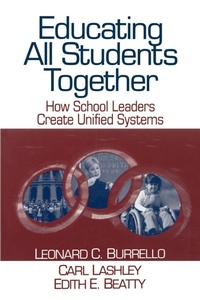
Educating All Students Together
How School Leaders Create Unified Systems
1st Edition
Published on 10. November 2000
Book
Paperback/Softback
264 pages
978-0-7619-7698-1 (ISBN)
Description
"A convincing conceptualization of schools as complex adaptive systems. The authors' recommendations that leaders must "tinker at the margins" and lead in the "zone of complexity" provide sound and practical advice for school leaders faced with creating unified educational systems that will be able to effectively support students with increasingly diverse learning needs."
David W. Peterson, Superintendent
Northern Suburban Special Education District
Highland Park, IL
"Far too long we have failed to acknowledge the large number of students relegated to parallel educational systems. This thought-provoking book provides an important first step in helping us surface the mental models we hold of the teaching and learning of diverse student populations."
Nelda Cambron-McCabe, Department of Educational Leadership
Miami University
Oxford, OH
"An insightful, informative, and thought-provoking book that deals with a topic that concerns every educator."
Kate Kinley, Director of Administrative Training and Staff Development
Clark County School District, NV
Learn to create unified, learner-centered schools where all students learn!
By focusing on student learning as the central goal of school administrators, Burrello, Lashley, and Beatty establish a plan for creating a truly integrated educational system, one that unifies the separate and parallel systems of special and general education.
The authors call for an end to the piecemeal strategy of including students one classroom, one grade level, or one school at a time. Instead, they demonstrate how administrators, school leaders, and the community must work together on decisions to implement personalized education plans, accountable curricular outcomes, and appropriate instructional adaptations.
Some of the key concepts include:
Schools embracing special services personnel
The roles of the community and other stakeholders
Reconceptualizing schools based on learner-centered principles
Program evaluation and incentives
Brain and holographic design as a framework for complex adaptive systems
Collaboration between school administrators and teachers
Adapting curriculum and instruction
In this groundbreaking work of practical application, Burrello, Lashley, and Beatty demonstrate effective leadership strategies that will enable administrators to better manage the cultural imperative of equity and excellence for all students. They further support the plan for unified schools through case studies and a program evaluation of self-study guide. An essential resource for general and special educators, parents, and communities.
David W. Peterson, Superintendent
Northern Suburban Special Education District
Highland Park, IL
"Far too long we have failed to acknowledge the large number of students relegated to parallel educational systems. This thought-provoking book provides an important first step in helping us surface the mental models we hold of the teaching and learning of diverse student populations."
Nelda Cambron-McCabe, Department of Educational Leadership
Miami University
Oxford, OH
"An insightful, informative, and thought-provoking book that deals with a topic that concerns every educator."
Kate Kinley, Director of Administrative Training and Staff Development
Clark County School District, NV
Learn to create unified, learner-centered schools where all students learn!
By focusing on student learning as the central goal of school administrators, Burrello, Lashley, and Beatty establish a plan for creating a truly integrated educational system, one that unifies the separate and parallel systems of special and general education.
The authors call for an end to the piecemeal strategy of including students one classroom, one grade level, or one school at a time. Instead, they demonstrate how administrators, school leaders, and the community must work together on decisions to implement personalized education plans, accountable curricular outcomes, and appropriate instructional adaptations.
Some of the key concepts include:
Schools embracing special services personnel
The roles of the community and other stakeholders
Reconceptualizing schools based on learner-centered principles
Program evaluation and incentives
Brain and holographic design as a framework for complex adaptive systems
Collaboration between school administrators and teachers
Adapting curriculum and instruction
In this groundbreaking work of practical application, Burrello, Lashley, and Beatty demonstrate effective leadership strategies that will enable administrators to better manage the cultural imperative of equity and excellence for all students. They further support the plan for unified schools through case studies and a program evaluation of self-study guide. An essential resource for general and special educators, parents, and communities.
Reviews / Votes
"A convincing conceptualization of schools as complex adaptive systems. The authors' recommendations that leaders must 'tinker at the margins' and lead in the 'zone of complexity' provide sound and practical advice for school leaders faced with creating unified educational systems that will be able to effectively support students with increasingly diverse learning needs." -- David W. Peterson "Far too long we have failed to acknowledge the large number of students relegated to parallel educational systems. This thought-provoking book provides an important first step in helping us surface the mental models we hold of the teaching and learning of diverse student populations." -- Nelda Cambron-McCabe "An insightful, informative, and thought-provoking book that deals with a topic that concerns every educator." -- Kate Kinley, Director of Administrative Training and Staff DevelopmentMore details
Edition
First Edition
Language
English
Place of publication
Thousand Oaks
United States
Target group
Professional and scholarly
Dimensions
Height: 229 mm
Width: 152 mm
Thickness: 16 mm
Weight
434 gr
ISBN-13
978-0-7619-7698-1 (9780761976981)
Copyright in bibliographic data and cover images is held by Nielsen Book Services Limited or by the publishers or by their respective licensors: all rights reserved.
Schweitzer Classification
Other editions
Additional editions
Leonard C. Burrello | Carl A. Lashley | Edith E. Beatty
Educating All Students Together
How School Leaders Create Unified Systems
Book
11/2000
1st Edition
SAGE Publications Inc
€73.80
Shipment within 15-20 days
Persons
Leonard C. Burrello is Professor of Education and Chair of Educational Leadership Program and Executive Director of The Forum on Education at Indiana University. He is currently studying school improvement in rural schools within a distributive leadership framework and consulting with the Gates Initiative on Small Schools for the University of Indianapolis in the Indianapolis Public Schools.
With co-author Lauren Hoffman he completed at three organizational consultation project in Washtenaw County, Michigan where they helped create a new planning framework using the work of Robert Fritz. They are also working with the Illinois Cooperative Leadership project in Illinois to help build more learner-centered schools.
With Lynn Murray, his collaboration began in 1993 in a study of her leadership in a suburban district in Vermont and she has consulted with both authors helping to build a new organizational structure and planning process in a large urban Midwestern school district. He teaches courses on moral and distributive leadership, and organizational change at Indiana University.
With co-author Lauren Hoffman he completed at three organizational consultation project in Washtenaw County, Michigan where they helped create a new planning framework using the work of Robert Fritz. They are also working with the Illinois Cooperative Leadership project in Illinois to help build more learner-centered schools.
With Lynn Murray, his collaboration began in 1993 in a study of her leadership in a suburban district in Vermont and she has consulted with both authors helping to build a new organizational structure and planning process in a large urban Midwestern school district. He teaches courses on moral and distributive leadership, and organizational change at Indiana University.
Content
Preface
About the Authors
1. Students at the Margins
2. Reconceiving the Purposes of Schooling
3. A Transformational Leadership Strategy
Complex Adaptive Systems
4. Incentives as Attractors
Why Things Remain the Same and How to Change Them
5. The Transformation to Learner-Centered
6. The New Work of Leadership in Unified Schools
7. Organizing for Instruction in Unified Schools
8. Delivering Instruction in Unified Schools
9. Thinking Differently about Evaluation
Moving Beyond the Paradox
10. A Reflection on Leadership
Local Leadership Counts
Resource A
Resource B
References
Index
About the Authors
1. Students at the Margins
2. Reconceiving the Purposes of Schooling
3. A Transformational Leadership Strategy
Complex Adaptive Systems
4. Incentives as Attractors
Why Things Remain the Same and How to Change Them
5. The Transformation to Learner-Centered
6. The New Work of Leadership in Unified Schools
7. Organizing for Instruction in Unified Schools
8. Delivering Instruction in Unified Schools
9. Thinking Differently about Evaluation
Moving Beyond the Paradox
10. A Reflection on Leadership
Local Leadership Counts
Resource A
Resource B
References
Index