

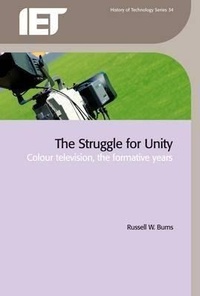
The Struggle for Unity
Colour television, the formative years
Published on 30. November 2008
Book
Paperback/Softback
360 pages
978-0-86341-824-2 (ISBN)
Description
The Struggle for Unity: Colour television, the formative years traces the evolution of colour television from 1928, when rudimentary colour television was demonstrated for the first time, to c.1966, when the NTSC system and its variants, the PAL and SECAM systems, became widely available for the entertainment, education and enlightenment of society. Among the many topics discussed in the book, mention is made of the following: compatibility and non-compatibility; mechanical and all-electronic systems; field, line and dot sequential scanning; bandwidth constraints and band-sharing techniques; the CBS-RCA conflict; the relative merits of the different systems; the attempt to achieve unity of purpose in Europe; standards; and the development of colour cameras and display tubes. The book, which is based predominantly on written primary source material, does not simply provide a chronicle of dates and descriptions of events, devices and systems. Rather, it discusses the essential factors of colour television history from a general, technical and political viewpoint. Great care has been taken to ensure that an unbiased, accurate and balanced history has been written. Numerous references are given at the end of each chapter and the book is profusely illustrated.
More details
Series
Language
English
Place of publication
Stevenage
United Kingdom
Target group
College/higher education
Professional and scholarly
Product notice
Paperback (trade)
Unsewn / adhesive bound
Dimensions
Height: 229 mm
Width: 157 mm
Thickness: 20 mm
Weight
499 gr
ISBN-13
978-0-86341-824-2 (9780863418242)
Copyright in bibliographic data and cover images is held by Nielsen Book Services Limited or by the publishers or by their respective licensors: all rights reserved.
Schweitzer Classification
Other editions
Additional editions
E-Book
02/2009
1st Edition
Institution of Engineering and Technology
€144.89
Available for download
Person
Russell W. Burns BSc, MSc, PhD, physicist, electrical engineer and historian, has been researching and writing on the history of electrical engineering for more than 35 years and has produced books on British Television, Radar Development, World Television, John Logie Baird, A.D. Blumlein and Communications, and is currently writing on Cherwell, Churchill and Science at War. Professor Burns has received the Kraszna-Krausz Prize, a Special IEE Book Award, the IEE SET Divisional Board's Premium and the IEE Maxwell Premium (shared) for his writings. He served on numerous IEE committees and boards for more than 30 years.
Content
Chapter 1: A brief history of colour photography and colour cinematography
Chapter 2: Low-definition colour television
Chapter 3: RCA and pre-war colour television
Chapter 4: EMI and high-definition television
Chapter 5: J.L. Baird and colour television
Chapter 6: CBS, RCA and colour television
Chapter 7: The 1949-50 FCC colour television hearings
Chapter 8: RCA's resolve
Chapter 9: The work of the NTSC
Chapter 10: Colour television broadcasting in the USA, 1953-1966
Chapter 11: British developments, 1949-1962
Chapter 12: Camera tubes for colour television to c. 1967
Chapter 13: The development of display tubes to c. 1967
Chapter 14: An attempt at unity
Chapter 15: Epilogue
Chapter 2: Low-definition colour television
Chapter 3: RCA and pre-war colour television
Chapter 4: EMI and high-definition television
Chapter 5: J.L. Baird and colour television
Chapter 6: CBS, RCA and colour television
Chapter 7: The 1949-50 FCC colour television hearings
Chapter 8: RCA's resolve
Chapter 9: The work of the NTSC
Chapter 10: Colour television broadcasting in the USA, 1953-1966
Chapter 11: British developments, 1949-1962
Chapter 12: Camera tubes for colour television to c. 1967
Chapter 13: The development of display tubes to c. 1967
Chapter 14: An attempt at unity
Chapter 15: Epilogue