

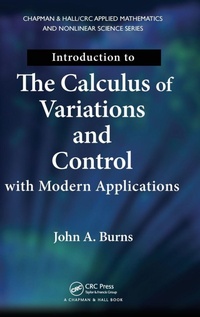
Introduction to the Calculus of Variations and Control with Modern Applications
1st Edition
Published on 28. August 2013
Book
Hardback
562 pages
978-1-4665-7139-6 (ISBN)
Description
Introduction to the Calculus of Variations and Control with Modern Applications provides the fundamental background required to develop rigorous necessary conditions that are the starting points for theoretical and numerical approaches to modern variational calculus and control problems. The book also presents some classical sufficient conditions and discusses the importance of distinguishing between the necessary and sufficient conditions.
In the first part of the text, the author develops the calculus of variations and provides complete proofs of the main results. He explains how the ideas behind the proofs are essential to the development of modern optimization and control theory. Focusing on optimal control problems, the second part shows how optimal control is a natural extension of the classical calculus of variations to more complex problems.
By emphasizing the basic ideas and their mathematical development, this book gives you the foundation to use these mathematical tools to then tackle new problems. The text moves from simple to more complex problems, allowing you to see how the fundamental theory can be modified to address more difficult and advanced challenges. This approach helps you understand how to deal with future problems and applications in a realistic work environment.
In the first part of the text, the author develops the calculus of variations and provides complete proofs of the main results. He explains how the ideas behind the proofs are essential to the development of modern optimization and control theory. Focusing on optimal control problems, the second part shows how optimal control is a natural extension of the classical calculus of variations to more complex problems.
By emphasizing the basic ideas and their mathematical development, this book gives you the foundation to use these mathematical tools to then tackle new problems. The text moves from simple to more complex problems, allowing you to see how the fundamental theory can be modified to address more difficult and advanced challenges. This approach helps you understand how to deal with future problems and applications in a realistic work environment.
More details
Language
English
Place of publication
Bosa Roca
United States
Publishing group
Taylor & Francis Inc
Target group
Professional and scholarly
Academic and Professional Practice & Development
Illustrations
59 s/w Abbildungen
59 Illustrations, black and white
Dimensions
Height: 240 mm
Width: 161 mm
Thickness: 35 mm
Weight
1004 gr
ISBN-13
978-1-4665-7139-6 (9781466571396)
Copyright in bibliographic data and cover images is held by Nielsen Book Services Limited or by the publishers or by their respective licensors: all rights reserved.
Schweitzer Classification
Other editions
Additional editions
Book
09/2019
1st Edition
Chapman & Hall/CRC
€98.50
Shipment within 15-20 days
E-Book
08/2013
1st Edition
Chapman & Hall/CRC
€89.99
Available for download
E-Book
08/2013
Chapman and Hall
€89.99
Available for download
Person
John Burns is the Hatcher Professor of Mathematics, Interdisciplinary Center for Applied Mathematics at Virginia Polytechnic Institute and State University. He is a fellow of the IEEE and SIAM. His research interests include distributed parameter control; approximation, control, identification, and optimization of functional and partial differential equations; aero-elastic control systems; fluid/structural control systems; smart materials; optimal design; and sensitivity analysis.
Content
Calculus of Variations: Historical Notes on the Calculus of Variations. Introduction and Preliminaries. The Simplest Problem in the Calculus of Variations. Necessary Conditions for Local Minima. Sufficient Conditions for the Simplest Problem. Summary for the Simplest Problem. Extensions and Generalizations. Applications. Optimal Control: Optimal Control Problems. Simplest Problem in Optimal Control. Extensions of the Fundamental Maximum Principle. Linear Control Systems.