

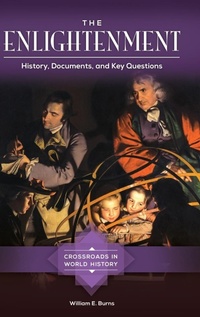
The Enlightenment
History, Documents, and Key Questions
Published on 10. November 2015
Book
Hardback
230 pages
978-1-61069-845-0 (ISBN)
Description
Based on the most recent scholarship, this book provides students and interested lay readers with a basic introduction to key facts and current controversies concerning the Enlightenment.
One of the most significant developments in world history, the Enlightenment transformed Europe by promoting reason over faith and advancing skepticism, the scientific method, and intellectual inquiry. It reshaped political and cultural history and formed the foundation for many of today's institutions. The Enlightenment: History, Documents, and Key Questions is a one-stop reference that serves high school and undergraduate students in learning about the background of the Enlightenment. The book also provides readers with key insights into the distant origins of American democracy and technology-based innovation.
The text's coverage of the Enlightenment from the late 17th century to the late 18th century in both Europe and its American colonies supports Common Core critical thinking skills for English Language Arts/World History and Social Studies. The inclusion of primary source documents and original argumentative essays work in conjunction with secondary material such as topical entries to engage readers' minds and to give them a fuller understanding the myriad factors that led to the Enlightenment as well as its lasting effects.
One of the most significant developments in world history, the Enlightenment transformed Europe by promoting reason over faith and advancing skepticism, the scientific method, and intellectual inquiry. It reshaped political and cultural history and formed the foundation for many of today's institutions. The Enlightenment: History, Documents, and Key Questions is a one-stop reference that serves high school and undergraduate students in learning about the background of the Enlightenment. The book also provides readers with key insights into the distant origins of American democracy and technology-based innovation.
The text's coverage of the Enlightenment from the late 17th century to the late 18th century in both Europe and its American colonies supports Common Core critical thinking skills for English Language Arts/World History and Social Studies. The inclusion of primary source documents and original argumentative essays work in conjunction with secondary material such as topical entries to engage readers' minds and to give them a fuller understanding the myriad factors that led to the Enlightenment as well as its lasting effects.
More details
Series
Language
English
Place of publication
United States
Publishing group
Bloomsbury Publishing Plc
Target group
College/higher education
Professional and scholarly
Dimensions
Height: 240 mm
Width: 161 mm
Thickness: 17 mm
Weight
517 gr
ISBN-13
978-1-61069-845-0 (9781610698450)
Copyright in bibliographic data and cover images is held by Nielsen Book Services Limited or by the publishers or by their respective licensors: all rights reserved.
Schweitzer Classification
Other editions
Additional editions
E-Book
11/2015
1st Edition
ABC-CLIO
€65.99
Available for download
E-Book
11/2015
ABC-CLIO
€65.99
Available for download
Person
William E. Burns is a history teacher in the Washington, DC, area. He is the author of ABC-CLIO's The Scientific Revolution: An Encyclopedia and Science in the Enlightenment: An Encyclopedia.
Content
Alphabetical List of Entries
Topical List of Entries
How to Use This Book
Preface
Timeline
Historical Overview
The Enlightenment: A to Z
Primary Documents
Baruch Spinoza: "On the Nature and Origin of the Emotions," from Ethics (1677)
John Locke: "Of the Beginnings of Political Societies," from Second Treatise on Civil Government (1689)
Gottfried Wilhelm Leibniz: The Leibniz-Clarke Correspondence (1717)
Montesquieu: "On Monarchies," from The Spirit of the Laws (1748)
David Hume: An Enquiry into the Principles of Morals (1751)
Denis Diderot: "Enjoyment" (Jouissance), from the Encyclopedie (1751-1765)
Rousseau: From Discourse on the Origin of Inequality (1755)
Adam Smith: From The Theory of Moral Sentiments (1759)
Voltaire: "Ancients and Moderns," from Philosophical Dictionary (1764)
Cesare Beccaria: From On Crimes and Punishments (1764)
Catherine the Great: From Instructions to the Legislative Commission (1767)
Edward Gibbon: From The Decline and Fall of the Roman Empire (1776)
The Declaration of Independence (1776)
Immanuel Kant: From What Is Enlightenment? (1784)
Thomas Paine: From The Age of Reason, Part II (1795)
Key Questions
Question 1: Was There an Enlightenment for Women?
Question 2: Was the Enlightenment Secular?
Question 3: Was the Enlightenment Democratic?
Selected Annotated Bibliography
Index
About the Author and Contributors
Topical List of Entries
How to Use This Book
Preface
Timeline
Historical Overview
The Enlightenment: A to Z
Primary Documents
Baruch Spinoza: "On the Nature and Origin of the Emotions," from Ethics (1677)
John Locke: "Of the Beginnings of Political Societies," from Second Treatise on Civil Government (1689)
Gottfried Wilhelm Leibniz: The Leibniz-Clarke Correspondence (1717)
Montesquieu: "On Monarchies," from The Spirit of the Laws (1748)
David Hume: An Enquiry into the Principles of Morals (1751)
Denis Diderot: "Enjoyment" (Jouissance), from the Encyclopedie (1751-1765)
Rousseau: From Discourse on the Origin of Inequality (1755)
Adam Smith: From The Theory of Moral Sentiments (1759)
Voltaire: "Ancients and Moderns," from Philosophical Dictionary (1764)
Cesare Beccaria: From On Crimes and Punishments (1764)
Catherine the Great: From Instructions to the Legislative Commission (1767)
Edward Gibbon: From The Decline and Fall of the Roman Empire (1776)
The Declaration of Independence (1776)
Immanuel Kant: From What Is Enlightenment? (1784)
Thomas Paine: From The Age of Reason, Part II (1795)
Key Questions
Question 1: Was There an Enlightenment for Women?
Question 2: Was the Enlightenment Secular?
Question 3: Was the Enlightenment Democratic?
Selected Annotated Bibliography
Index
About the Author and Contributors