

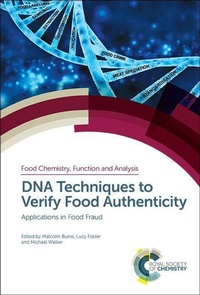
DNA Techniques to Verify Food Authenticity
Applications in Food Fraud
Published on 16. October 2019
Book
Hardback
325 pages
978-1-78801-178-5 (ISBN)
Description
The food supply chain needs to reassure consumers and businesses about the safety and standards of food. Global estimates of the cost of food fraud to economies run into billions of dollars hence a huge surge in interest in food authenticity and means of detecting and preventing food fraud and food crime. Approaches targeting DNA markers have assumed a pre-eminence.
This book is the most comprehensive and timely collection of material from those working at the forefront of DNA techniques applied to food authenticity. Addressing the new field of analytical molecular biology as it combines the quality assurance rigour of analytical chemistry with DNA techniques, it introduces the science behind DNA as a target analyte, its extraction, amplification, detection and quantitation as applied to the detection of food fraud and food crime. Making the link with traditional forensic DNA profiling and describing emerging and cutting-edge techniques such as next generation sequencing, this book presents real-world case studies from a wide perspective including from analytical service providers, industry, enforcement agencies and academics. It will appeal to food testing laboratories worldwide, who are just starting to use these techniques and students of molecular biology, food science and food integrity. Food policy professionals and regulatory organisations who will be using these techniques to back up legislation and regulation will find the text invaluable. Those in the food industry in regulatory and technical roles will want to have this book on their desks.
This book is the most comprehensive and timely collection of material from those working at the forefront of DNA techniques applied to food authenticity. Addressing the new field of analytical molecular biology as it combines the quality assurance rigour of analytical chemistry with DNA techniques, it introduces the science behind DNA as a target analyte, its extraction, amplification, detection and quantitation as applied to the detection of food fraud and food crime. Making the link with traditional forensic DNA profiling and describing emerging and cutting-edge techniques such as next generation sequencing, this book presents real-world case studies from a wide perspective including from analytical service providers, industry, enforcement agencies and academics. It will appeal to food testing laboratories worldwide, who are just starting to use these techniques and students of molecular biology, food science and food integrity. Food policy professionals and regulatory organisations who will be using these techniques to back up legislation and regulation will find the text invaluable. Those in the food industry in regulatory and technical roles will want to have this book on their desks.
Reviews / Votes
This is an ambitious book. The scope ranges from the basic science and history of DNA testing to cutting-edge techniques and case studies. It aims to be the go-to reference for testing laboratories new to the DNA field, for people in food industry technical roles, for students and for regulators; it is likely to be a well-thumbed fixture on their desk. The book achieves its aim of providing something for everyone, over a very wide target audience.Throughout the book, the underlying theme is consistently stressed: that the rigour traditionally applied to analytical quality control must equally be applied to DNA-based methods. * https://doi.org/10.1002/fsat.3401_16.x *More details
Series
Language
English
Place of publication
Cambridge
United Kingdom
Target group
Professional and scholarly
Product notice
Unsewn / adhesive bound
Dimensions
Height: 240 mm
Width: 164 mm
Thickness: 27 mm
Weight
700 gr
ISBN-13
978-1-78801-178-5 (9781788011785)
DOI
10.1039/9781788016025
Copyright in bibliographic data and cover images is held by Nielsen Book Services Limited or by the publishers or by their respective licensors: all rights reserved.
Schweitzer Classification
Other editions
Additional editions
Malcolm Burns | Lucy Foster | Michael Walker
DNA Techniques to Verify Food Authenticity
Applications in Food Fraud
E-Book
10/2019
1st Edition
Royal Society of Chemistry
€203.99
Available for download
Malcolm Burns | Lucy Foster | Michael Walker
DNA Techniques to Verify Food Authenticity
Applications in Food Fraud
E-Book
10/2019
1st Edition
Royal Society of Chemistry
€203.99
Available for download
Persons
The editors possess unrivalled expertise and are keen to describe and foster advances in the key area of DNA techniques applied to food authenticity. Dr Lucy Foster is an experienced food scientist, and head of food research including authenticity research at Defra, for many years commissioning studies of global reach. Dr Malcolm Burns is an internationally recognised molecular biologist and expert in DNA quantitation. Dr Michael Walker was a founder board member of the Food Standards Agency, a subject matter expert to the Elliott Review, is Head of the Office of the Government Chemist, and, with a thriving consulting practice, is an experienced expert witness.
Content
The Role of DNA Analysis in the Determination of Food Authenticity;
Forensic DNA - Criminal and Paternity Methods and Applications - How Can This Help in Verifying Food Authenticity?;
DNA Extraction from Food Matrices;
"DNA Techniques" Case Study: Isothermal Approaches;
Digital Polymerase Chain Reaction (dPCR) - General Aspects and Applications;
UK Food Authenticity Programme - The Analytical Tool Box;
Fitness for Purpose of DNA-based Analytical Methods;
GMO Detection and Identification Using Next-generation Sequencing;
A Perspective on Quantitative DNA Approaches;
DNA in Food and Feed Law;
Case Studies: Harmonising DNA Methods - The GMO Story;
Metrology of DNA Approaches;
The Almond and Mahaleb Allergen Story - PCR Resolution of Live Incident Investigations;
Food Fraud Prevention - Selecting the Right Test, Method, and Sampling Plan;
Meat Speciation;
The Horse Meat Scandal - The European Analytical Response;
Horse Meat: Technical Appeals and Court Action;
Durum Wheat and Pasta Authenticity;
The Authenticity of Basmati Rice - A Case Study;
Horse Meat: The International Collaborative Trial of the Real-time PCR Method for the Quantitation of Horse DNA;
Standardization of DNA-based Methods for Food Authenticity Testing;
Authentication of Chinese Traditional Medicine by DNA Analysis;
DNA Point of Use Applications;
Commercial DNA Testing;
EU Food Integrity and Joining up the Landscape (EU Perspective);
The Food Authenticity Network;
A Vision for the Future
Forensic DNA - Criminal and Paternity Methods and Applications - How Can This Help in Verifying Food Authenticity?;
DNA Extraction from Food Matrices;
"DNA Techniques" Case Study: Isothermal Approaches;
Digital Polymerase Chain Reaction (dPCR) - General Aspects and Applications;
UK Food Authenticity Programme - The Analytical Tool Box;
Fitness for Purpose of DNA-based Analytical Methods;
GMO Detection and Identification Using Next-generation Sequencing;
A Perspective on Quantitative DNA Approaches;
DNA in Food and Feed Law;
Case Studies: Harmonising DNA Methods - The GMO Story;
Metrology of DNA Approaches;
The Almond and Mahaleb Allergen Story - PCR Resolution of Live Incident Investigations;
Food Fraud Prevention - Selecting the Right Test, Method, and Sampling Plan;
Meat Speciation;
The Horse Meat Scandal - The European Analytical Response;
Horse Meat: Technical Appeals and Court Action;
Durum Wheat and Pasta Authenticity;
The Authenticity of Basmati Rice - A Case Study;
Horse Meat: The International Collaborative Trial of the Real-time PCR Method for the Quantitation of Horse DNA;
Standardization of DNA-based Methods for Food Authenticity Testing;
Authentication of Chinese Traditional Medicine by DNA Analysis;
DNA Point of Use Applications;
Commercial DNA Testing;
EU Food Integrity and Joining up the Landscape (EU Perspective);
The Food Authenticity Network;
A Vision for the Future