

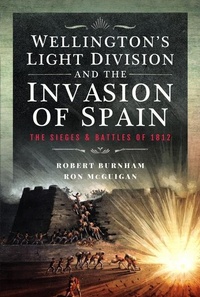
Wellington's Light Division and the Invasion of Spain
The Sieges and Battles of 1812
Published on 29. October 2025
Book
Hardback
296 pages
978-1-3990-3688-7 (ISBN)
Description
After evicting the French from Portugal in 1811, the Duke of Wellington went on the offensive, having decided to attack into Spain and liberate the country. To do this, however, he first had to capture the key border fortresses of Ciudad Rodrigo and Badajoz. By doing this he would secure the main routes into Portugal and protect his supply lines.
By mid-April in 1812, Wellington's forces had captured both fortresses and he began planning to move into central Spain to liberate Madrid. Then, by late July, he fought and effectively destroyed the French Army of Portugal at the Battle of Salamanca and a month later was welcomed by the population of Madrid as its liberator. However, September saw the offensive stall and a gathering of French forces. By October, the order came to abandon Madrid and withdraw back to Portugal.
Wellington's army had to move quickly to avoid being cut off and its line of communication with Lisbon severed. The retreat soon turned into a grueling slog in miserable weather with little food, all the while the British troops were pursued by a relentless enemy hard on their heels. It would be late November before the army reached the safety of the Portuguese border.
As in previous years the Light Division was in the thick of the fighting. It was part of the assault force at both the storming of Ciudad Rodrigo and of Badajoz. It led the army into Spain and was on the left flank at Salamanca. It was one of the first units to march into Madrid and during the retreat it was part of the rear guard.
By the end of November 1812, the division was back in its cantonments around Ciudad Rodrigo. It had, however, taken horrendous casualties at all levels over the past eleven months, and it was only a shadow of itself. Packed with first-hand accounts and previously unpublished material, these new sources, especially the diaries, permit us to check the movements and locations of the regiments, the impact of over-extended supply lines, and the arrival of reinforcements and new commanders as never before revealed.
By mid-April in 1812, Wellington's forces had captured both fortresses and he began planning to move into central Spain to liberate Madrid. Then, by late July, he fought and effectively destroyed the French Army of Portugal at the Battle of Salamanca and a month later was welcomed by the population of Madrid as its liberator. However, September saw the offensive stall and a gathering of French forces. By October, the order came to abandon Madrid and withdraw back to Portugal.
Wellington's army had to move quickly to avoid being cut off and its line of communication with Lisbon severed. The retreat soon turned into a grueling slog in miserable weather with little food, all the while the British troops were pursued by a relentless enemy hard on their heels. It would be late November before the army reached the safety of the Portuguese border.
As in previous years the Light Division was in the thick of the fighting. It was part of the assault force at both the storming of Ciudad Rodrigo and of Badajoz. It led the army into Spain and was on the left flank at Salamanca. It was one of the first units to march into Madrid and during the retreat it was part of the rear guard.
By the end of November 1812, the division was back in its cantonments around Ciudad Rodrigo. It had, however, taken horrendous casualties at all levels over the past eleven months, and it was only a shadow of itself. Packed with first-hand accounts and previously unpublished material, these new sources, especially the diaries, permit us to check the movements and locations of the regiments, the impact of over-extended supply lines, and the arrival of reinforcements and new commanders as never before revealed.
More details
Language
English
Place of publication
Barnsley
United Kingdom
Publishing group
Pen & Sword Books Ltd
Product notice
sewn/stitched
Cloth over boards
Illustrations
16 mono illustrations
Dimensions
Height: 240 mm
Width: 160 mm
Thickness: 26 mm
Weight
249 gr
ISBN-13
978-1-3990-3688-7 (9781399036887)
Copyright in bibliographic data and cover images is held by Nielsen Book Services Limited or by the publishers or by their respective licensors: all rights reserved.
Schweitzer Classification
Persons
ROBERT BURNHAM, a retired army officer, has written scores of articles and five books on the Napoleonic Wars. He has recently stepped down after twenty-two years as the editor of the Napoleon Series, a fascinating and all-embracing website, the largest of its kind. It is a 'must' for anyone interested in the Napoleonic era. It can be accessed at: www.napoleon-series.org