

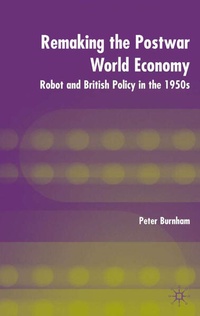
Remaking the Postwar World Economy
Robot and British Policy in the 1950s
Published on 2. September 2003
Book
Hardback
VIII, 236 pages
978-0-333-55725-9 (ISBN)
Description
Peter Burnham presents a detailed, archive-based account of the keys aspects of international monetary relations in the 1950s focusing in particular on Anglo-American policy surrounding the restoration of sterling convertibility. He argues that in 1952 the British government had a unique opportunity to take an almost revolutionary step in the external field to transform the international political economy (through the abolition of the fixed rate system, the International Monetary Fund, and the European Payments Union) and restructure Britain's domestic economy to tackle longstanding productivity, export and labour market problems.
More details
Edition
2003 edition
Language
English
Place of publication
London
United Kingdom
Target group
Professional and scholarly
Product notice
sewn/stitched
Cloth over boards
With dust jacket
Illustrations
VIII, 236 p.
Dimensions
Height: 230 mm
Width: 142 mm
Thickness: 18 mm
Weight
422 gr
ISBN-13
978-0-333-55725-9 (9780333557259)
DOI
10.1057/9780230375239
Schweitzer Classification
Other editions
Additional editions
E-Book
09/2003
Palgrave Macmillan
€96.29
Available for download
Person
PETER BURNHAM is Reader in Politics and International Studies at the University of Warwick. He teaches in the areas of British politics and international political economy. Previous publications include
The Political Economy of Postwar Reconstruction
.
Content
Britain, Bretton Woods and the Crisis of the World Economy, 1945-51 Emergency Action and the Route to Floating Rate Convertibility Operation Robot: Restructuring the Domestic and the World Economy The Battle over Robot Robot Walks Again The Collective Approach to Free Trade and Currencies Anglo-American Negotiations and a New Bank Route to Convertibility From Suez to Operation Unicorn Conclusion: Bretton Woods and British Decline