


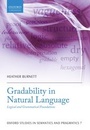
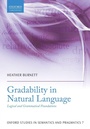
Gradability in Natural Language
Logical and Grammatical Foundations
Published on 8. December 2016
Book
Hardback
240 pages
978-0-19-872479-7 (ISBN)
Description
This book presents a new theory of the relationship between vagueness, context-sensitivity, gradability, and scale structure in natural language. Heather Burnett argues that it is possible to distinguish between particular subclasses of adjectival predicates-relative adjectives like tall, total adjectives like dry, partial adjectives like wet, and non-scalar adjectives like hexagonal-on the basis of how their criteria of application vary depending on the context; how they display the characteristic properties of vague language; and what the properties of their associated orders are. It has been known for a long time that there exist empirical connections between context-sensitivity, vagueness, and scale structure; however, a formal system that expresses these connections had yet to be developed.
This volume sets out a new logical system, called DelTCS, that brings together insights from the Delineation Semantics framework and from the Tolerant, Classical, Strict non-classical framework, to arrive at a full theory of gradability and scale structure in the adjectival domain. The analysis is further extended to examine vagueness and gradability associated with particular classes of determiner phrases, showing that the correspondences that exist between the major adjectival scale structure classes and subclasses of determiner phrases can also be captured within the DelTCS system.
This volume sets out a new logical system, called DelTCS, that brings together insights from the Delineation Semantics framework and from the Tolerant, Classical, Strict non-classical framework, to arrive at a full theory of gradability and scale structure in the adjectival domain. The analysis is further extended to examine vagueness and gradability associated with particular classes of determiner phrases, showing that the correspondences that exist between the major adjectival scale structure classes and subclasses of determiner phrases can also be captured within the DelTCS system.
More details
Series
Language
English
Place of publication
Oxford
United Kingdom
Target group
College/higher education
Dimensions
Height: 250 mm
Width: 175 mm
Thickness: 18 mm
Weight
600 gr
ISBN-13
978-0-19-872479-7 (9780198724797)
Copyright in bibliographic data and cover images is held by Nielsen Book Services Limited or by the publishers or by their respective licensors: all rights reserved.
Schweitzer Classification
Other editions
Additional editions
E-Book
02/2017
1st Edition
OUP eBook
€22.99
Available for download
Book
12/2016
Oxford University Press
€59.90
Shipment within 15-20 days
Person
Heather Burnett is a CNRS researcher in the Laboratoire de Linguistique Formelle at l'Universite Paris 7-Denis Diderot. In 2012, she completed her PhD thesis in the Department of Linguistics at the University of California, Los Angeles under the supervision of Edward Keenan and Dominique Sportiche. From 2012-2014, she was a SSHRC postdoctoral fellow at l'Universite de Montreal; from 2014-2015, she was a CNRS postdoctoral researcher at l'Universite de Toulouse 2-Jean Jaures; and in 2015, she was a Banting postdoctoral fellow at the University of Toronto. Her work on formal semantics, formal syntax, and language variation and change has appeared in Linguistic Variation, Linguistics and Philosophy, and Journal of Semantics.
Content
1: Introduction
2: Vagueness and linguistic analysis
3: Context-sensitivity and vagueness patterns
4: The Delineation TCS framework
5: Scale structure in Delineation Semantics
6: Beyond Delineation Semantics
7: Beyond the adjectival domain
8: Conclusion
2: Vagueness and linguistic analysis
3: Context-sensitivity and vagueness patterns
4: The Delineation TCS framework
5: Scale structure in Delineation Semantics
6: Beyond Delineation Semantics
7: Beyond the adjectival domain
8: Conclusion