

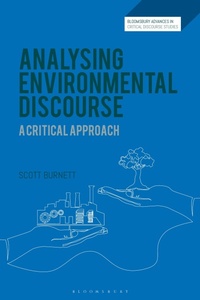
Analysing Environmental Discourse
A Critical Approach
Will be published approx. on 22. January 2026
Book
Hardback
320 pages
978-1-350-36029-7 (ISBN)
Description
The sheer scale of global ecosystem devastation and the crescendo of the climate crisis may serve as good reasons for scholars and commentators to welcome any social mobilization that tries to save the earth. And yet not all environmentalisms are good environmentalisms. From eco-fascism to greenwashing and neoliberal conservation, not all 'green' action has a positive value. Offering a critical framework for discourse analysts to get to the heart of this specific complexity, this book is a study of the key discursive moves in environmentalist discourses that perpetuate social inequality, putting forward an alternate socioecological approach to avoiding these pitfalls.
While debates over the social visions and implications of environmentalist discourse have been raging for decades, they have yet to receive focused attention within critical discourse studies. This book addresses this gap, building on critiques from feminist, queer, anti-racist, Indigenous, and decolonial scholars across fields such as political ecology, environmental sociology, indigenous studies, human geography, literary theory, environmental communication, and others, in which the tropes, strategies, and structures perpetuated within strands of environmentalism are identified. In doing so, it brings forward new case studies, focused discourse analysis, and a socioecological normative framework to map out discursive formations. Special attention is paid to the whiteness and/or coloniality of ecological futures articulated as utopian social visions, and it is argued that only when combined with a radical vision for social justice are these environmental utopias desirable, attainable, or workable.
While debates over the social visions and implications of environmentalist discourse have been raging for decades, they have yet to receive focused attention within critical discourse studies. This book addresses this gap, building on critiques from feminist, queer, anti-racist, Indigenous, and decolonial scholars across fields such as political ecology, environmental sociology, indigenous studies, human geography, literary theory, environmental communication, and others, in which the tropes, strategies, and structures perpetuated within strands of environmentalism are identified. In doing so, it brings forward new case studies, focused discourse analysis, and a socioecological normative framework to map out discursive formations. Special attention is paid to the whiteness and/or coloniality of ecological futures articulated as utopian social visions, and it is argued that only when combined with a radical vision for social justice are these environmental utopias desirable, attainable, or workable.
Reviews / Votes
Scott Burnett's highly readable and powerful new book paves the way for further integrating critical discourse studies and political ecology. The robust conversations he envisages between these fields are not only vital to understanding our harrowing planetary socio-ecological condition but in fact necessary to kindle what he calls 'critical hope'. * Bram Buescher, Wageningen University, the Netherlands *More details
Series
Language
English
Place of publication
London
United Kingdom
Publishing group
Bloomsbury Publishing PLC
Target group
Professional and scholarly
Illustrations
40 bw illus
Dimensions
Height: 240 mm
Width: 161 mm
Thickness: 22 mm
Weight
649 gr
ISBN-13
978-1-350-36029-7 (9781350360297)
Copyright in bibliographic data and cover images is held by Nielsen Book Services Limited or by the publishers or by their respective licensors: all rights reserved.
Schweitzer Classification
Other editions
Additional editions
E-Book
01/2026
1st Edition
Bloomsbury Academic
€105.99
Available for download
E-Book
01/2026
1st Edition
Bloomsbury Academic
€105.99
Available for download
Person
Scott Burnett is Assistant Professor of African Studies and Women's, Gender, and Sexuality Studies at the Pennsylvania State University, USA and a research affiliate at the Wits Centre for Diversity Studies, University of the Witwatersrand, Johannesburg, South Africa.
Content
List of Figures
List of Tables
Introduction: Intersectionality and Ecological Crisis
1. Critique and Discourses of the Earth
2. Ecointersectional Discourse Analysis
3. Green Capitalism and the Conscientious Consumer
4. 'Barbarian Hordes': Overpopulation and the Climate Migrant
5. Colonial Conservation: Green Violence at the Wild Frontier
6. Race, Nature, Nation: Econationalism
Conclusion: Critique, Despair, and Critical Hope
References
Index
List of Tables
Introduction: Intersectionality and Ecological Crisis
1. Critique and Discourses of the Earth
2. Ecointersectional Discourse Analysis
3. Green Capitalism and the Conscientious Consumer
4. 'Barbarian Hordes': Overpopulation and the Climate Migrant
5. Colonial Conservation: Green Violence at the Wild Frontier
6. Race, Nature, Nation: Econationalism
Conclusion: Critique, Despair, and Critical Hope
References
Index