

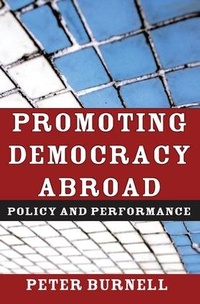
Promoting Democracy Abroad
Policy and Performance
1st Edition
Published on 15. August 2011
Book
Hardback
338 pages
978-1-4128-1842-1 (ISBN)
Description
Promoting democracy has grown from a small, little- known activity to a high-profile endeavor. It now involves academia, think tanks, and the popular media. The number of countries and organizations, inter-governmental, non-governmental, as well as governmental involved in supporting the spread of democracy is now legion. Countries touched by these efforts include a majority of all the world's states and some independent territories that are not yet fully sovereign.
The definitional boundaries between promoting democracy and international advocacy and defense of human rights and "good governance" are not precise. Similarly, the concept of promoting democracy itself is not uniformly accepted. It has become a slogan that attracts both fervent support and grave condemnation. For Burnell, promoting democracy refers to a wide range of non-coercive attempts to spread democracy abroad for whatever reason. At its heart, it is political intervention in the domestic affairs of other countries that seeks to affect the distribution of power, whether by patient and non-violent involvement or more urgent action, democracy assistance projects form a core activity.
Burnell holds that participation in the democracy assistance industry will continue to grow. However, the industry's progress up until now has in part been contingent on the progress of democratization itself. The slowdown that is currently happening in the advance of freedom and democracy around the world, and the strength shown by leading authoritarian or semi-authoritarian regimes, must raise questions about the outlook for democracy promotion. If democracy promotion and assistance are to be fit for the future, then the need for a broadly based, appropriately contextualized examination of the policy and the performance is greater now than at any time in the past.
The definitional boundaries between promoting democracy and international advocacy and defense of human rights and "good governance" are not precise. Similarly, the concept of promoting democracy itself is not uniformly accepted. It has become a slogan that attracts both fervent support and grave condemnation. For Burnell, promoting democracy refers to a wide range of non-coercive attempts to spread democracy abroad for whatever reason. At its heart, it is political intervention in the domestic affairs of other countries that seeks to affect the distribution of power, whether by patient and non-violent involvement or more urgent action, democracy assistance projects form a core activity.
Burnell holds that participation in the democracy assistance industry will continue to grow. However, the industry's progress up until now has in part been contingent on the progress of democratization itself. The slowdown that is currently happening in the advance of freedom and democracy around the world, and the strength shown by leading authoritarian or semi-authoritarian regimes, must raise questions about the outlook for democracy promotion. If democracy promotion and assistance are to be fit for the future, then the need for a broadly based, appropriately contextualized examination of the policy and the performance is greater now than at any time in the past.
More details
Language
English
Place of publication
New York
United States
Publishing group
Taylor & Francis Inc
Target group
College/higher education
Dimensions
Height: 229 mm
Width: 152 mm
Weight
790 gr
ISBN-13
978-1-4128-1842-1 (9781412818421)
Copyright in bibliographic data and cover images is held by Nielsen Book Services Limited or by the publishers or by their respective licensors: all rights reserved.
Schweitzer Classification
Other editions
Additional editions
Book
09/2017
1st Edition
Routledge
€77.03
Shipment within 10-20 days
E-Book
09/2017
Routledge
€64.49
Available for download
E-Book
09/2017
Routledge
€64.49
Available for download
Person
Peter Burnell
Content
1: Promoting Democracy Abroad: Introduction; 2: The Domestic Political Impact of Foreign Aid: Recalibrating the Research Agenda; 3: Democracy Promotion: The Elusive Quest for Grand Strategies; 4: Political Strategies of External Support for Democratization; 5: Autocratic Opening to Democracy: Why Legitimacy MattersAutocratic Opening to Democracy: Why Legitimacy Matters; 6: Does International Democracy Promotion Work?; 7: From Evaluating Democracy Assistance to Appraising Democracy Promotion; 8: International Democracy Promotion: A Role for Public Goods Theory?; 9: Legislative Strengthening Meets Party Support in International Assistance: A Closer Relationship?; 10: Promoting Democracy Backwards?; 11: Is There a New Autocracy Promotion?; 12: Promoting Democracy and Promoting Autocracy:Towards a Comparative Evaluation; 13: Conclusion: The Future of Democracy Promotion