

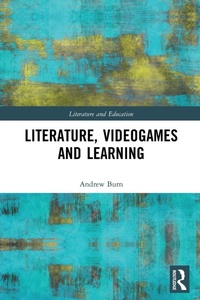
Literature, Videogames and Learning
1st Edition
Published on 9. January 2023
Book
Paperback/Softback
218 pages
978-1-032-02452-3 (ISBN)
Description
This innovative book explores links between literature and videogames, and how designing and playing games can transform our understanding of literature. It shows how studying literature through the lens of videogames can provide new insights into narrative and creative engagement with the text.
The book sets out theories of narrative aesthetics and multimodality in literature and videogames, alongside models of literacy needed for such cultural and creative engagement. It goes on to examine game adaptations of children's literature; and a series of videogames made by students based on Beowulf and Macbeth. In each case, the book considers ways in which the original text has been transformed by the process of game design, and what fresh light this casts on the literary narrative. It also considers what kind of learning, creative production, and cultural engagement is apparent in the game designs and emphasises the importance of treating games as a narrative medium in their own right.
With a unique approach to the aesthetics of narrative in literature and videogames, the book will be of great interest to researchers, academics, and post-graduate students in the fields of literature, pedagogy, and game studies.
The book sets out theories of narrative aesthetics and multimodality in literature and videogames, alongside models of literacy needed for such cultural and creative engagement. It goes on to examine game adaptations of children's literature; and a series of videogames made by students based on Beowulf and Macbeth. In each case, the book considers ways in which the original text has been transformed by the process of game design, and what fresh light this casts on the literary narrative. It also considers what kind of learning, creative production, and cultural engagement is apparent in the game designs and emphasises the importance of treating games as a narrative medium in their own right.
With a unique approach to the aesthetics of narrative in literature and videogames, the book will be of great interest to researchers, academics, and post-graduate students in the fields of literature, pedagogy, and game studies.
Reviews / Votes
"Andrew Burn's rich and nuanced new book offers a meditation on the relationship between games and literature, considering what gets learned when students interpret classic works such as Beowulf and Macbeth through computer games. Along the way, he maps an ambitious and eclectic conceptual framework from multimodal analysis. This book makes valuable contributions to our understanding of the nature of literacies (old and new)."Henry Jenkins, Provost Professor of Communication, Journalism, and Cinematic Arts, University of Southern California.
"The most innovative proposal for reforming English classrooms yet proposed. We have tended to think of literature as content and games as activities. Andrew Burn shows us how to make literature come alive not just as words but as playful deeds and design. In the act, he is creating a whole new field."
James Paul Gee, Mary Lou Fulton Presidential Professor of Literacy Studies; Regents' Professor, Arizona State University (retired)
"Scholars, creators, critics, and consumers of media divide their attention into categories that feel natural-film, book, game. But the walls between them are also arbitrary. In this book, Andrew Burn demolishes and rebuilds them, showing how all media are made of play, and play can become a new lens for teaching, understanding, and enjoying them."
Ian Bogost, Ivan Allen College of Liberal Arts Distinguished Chair in Media Studies, Georgia Institute of Technology.
"This book brings into focus profound and important insights into powerful links between the seemingly antithetical worlds of Literature and videogames. Grounded in deep knowledge of both, and of young people, pedagogy and curriculum, this book brings together decades of research with schools and major cultural institutions. It shows in practice how games and literature can work together, with students as active makers in creative and productive ways. A major contribution from Andrew Burn, the foremost figure in this field, it presents a rich vision of the future of Subject English, and contemporary forms of communication, imagination and play."
Catherine Beavis, Professor Emerita of Education, Deakin University, Australia
More details
Series
Language
English
Place of publication
London
United Kingdom
Publishing group
Taylor & Francis Ltd
Target group
College/higher education
Postgraduate
Illustrations
30 s/w Abbildungen, 30 s/w Photographien bzw. Rasterbilder
30 Halftones, black and white; 30 Illustrations, black and white
Dimensions
Height: 234 mm
Width: 156 mm
Thickness: 13 mm
Weight
363 gr
ISBN-13
978-1-032-02452-3 (9781032024523)
Copyright in bibliographic data and cover images is held by Nielsen Book Services Limited or by the publishers or by their respective licensors: all rights reserved.
Schweitzer Classification
Other editions
Additional editions
Andrew Burn
Literature, Videogames and Learning
Book
07/2021
1st Edition
Routledge
€192.07
Shipment within 15-20 days
Andrew Burn
Literature, Videogames and Learning
E-Book
06/2021
1st Edition
Routledge
€52.49
Available for download
Andrew Burn
Literature, Videogames and Learning
E-Book
06/2021
1st Edition
Routledge
€52.49
Available for download
Person
Andrew Burn is Professor of English, Media and Drama at the UCL Institute of Education, UK. He has directed a range of research projects on young people's literature-based game designs.
Content
Chapter 1. Ludo-Literary Encounters
Chapter 2. Ludo-Literary Aesthetics
Chapter 3. Multimodality in Literature and Game
Chapter 4. Ludic Literacies
Chapter 5. Games and Children's Literature I: The Northern Lights
Chapter 6. Games and Children's Literature II: The Case of Harry Potter
Chapter 7. Playing Beowulf I: Ludic Rhapsodies
Chapter 8. Playing Beowulf II: Of Monsters and Manuscripts
Chapter 9. Playing Macbeth I: Coding and Creativity
Chapter 10. Playing Macbeth II: From Character to Avatar
Chapter 11. Playing Macbeth III: Blue Dragons, Murderers and the Endless Run
Chapter 12. Epilogue
Chapter 2. Ludo-Literary Aesthetics
Chapter 3. Multimodality in Literature and Game
Chapter 4. Ludic Literacies
Chapter 5. Games and Children's Literature I: The Northern Lights
Chapter 6. Games and Children's Literature II: The Case of Harry Potter
Chapter 7. Playing Beowulf I: Ludic Rhapsodies
Chapter 8. Playing Beowulf II: Of Monsters and Manuscripts
Chapter 9. Playing Macbeth I: Coding and Creativity
Chapter 10. Playing Macbeth II: From Character to Avatar
Chapter 11. Playing Macbeth III: Blue Dragons, Murderers and the Endless Run
Chapter 12. Epilogue