

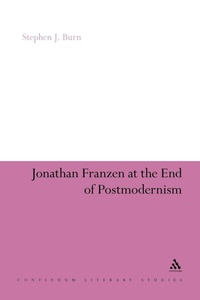
Jonathan Franzen at the End of Postmodernism
Published on 29. December 2011
Book
Paperback/Softback
176 pages
978-1-4411-9100-7 (ISBN)
Description
Jonathan Franzen is one of the most influential, critically-significant and popular contemporary American novelists. This book is the first full-length study of his work and attempts to articulate where American fiction is headed after postmodernism. Stephen Burn provides a comprehensive analysis of each of Franzen's novels - from his early work to the major success of The Corrections - identifying key sources, delineating important narrative strategies, and revealing how Franzen's themes are reinforced by each novel's structure. Supplementing this analysis with comparisons to key contemporaries, David Foster Wallace and Richard Powers, Burn suggests how Franzen's work is indicative of the direction of experimental American fiction in the wake of the so-called end of postmodernism.
Reviews / Votes
"Burn's book is a model first study of a contemporary novelist--rigorous, learned, thorough, inventive, and lucidly written. Jonathan Franzen at the End of Postmodernism is also the best commentary I know on the successors of Gaddis, Pynchon, and DeLillo--Powers, Wallace, Vollmann, and, of course, Franzen." (Tom LeClair, Nathaniel Ropes Professor of English, University of Cincinnati, USA) Mention - Chronicle of Higher Education, April 3, 200 'Unsurprisingly, Burn spends most time and space on The Corrections, the novel to which Franzen most owes his current fame.His argument here is that previous critics have not appreciated the book's careful narrative construction and the challenges it offers to conventional ways of understanding literary character in particular.Given that Franzen's novel was heralded by many as a return to character in contemporary writing, Burn's intervention here is significant, and his section on "Fictions of the Self" is probably the most valuable piece of Corrections criticism yet...Matching close reading with literary-historical breadth, Burn has exploited a large range of scholarly methods and techniques, and in doing so has created an impressively twenty-first century critical study of a twenty-first-century author.' (Journal of American Studies, 2009) 'Burn's analysis is a fine, illuminative and perhaps even provocative study not only of Franzen's fiction but that of his post-postmodern contemporaries, as well as the literature of the preceding generation of writers.' (European journal of American studies, 5th July 2010) 'Burn's study produces a fascinating case study of how difficult it has become to brand one's self as a "literary" author in an age in which literature has become another kind of multinational capitalist product.' (American Literary History, 5th July 2010) "A very fine, and the very first, book-length study of Franzen." (Ty Hawkins, "Assessing the Promise of Jonathan Franzen's First Three Novels: A Rejection of "Refuge" " College Literature 37.4 (2010): 61-87)"More details
Series
Edition
NIPPOD
Language
English
Place of publication
New York
United States
Target group
College/higher education
Dimensions
Height: 234 mm
Width: 156 mm
Thickness: 10 mm
Weight
278 gr
ISBN-13
978-1-4411-9100-7 (9781441191007)
Copyright in bibliographic data and cover images is held by Nielsen Book Services Limited or by the publishers or by their respective licensors: all rights reserved.
Schweitzer Classification
Other editions
Additional editions
Stephen J. Burn
Jonathan Franzen at the End of Postmodernism
E-Book
10/2011
1st Edition
Bloomsbury Continuum
€42.99
Available for download
Stephen J. Burn
Jonathan Franzen at the End of Postmodernism
E-Book
12/2008
1st Edition
Continuum Publishing Corporation
€42.99
Available for download
Person
Stephen J. Burn is Associate Professor at Northern Michigan University, USA. He is author of David Foster Wallace's Infinite Jest (Continuum 2003) and co-editor of Intersections: Essays on Richard Powers (Dalkey Archive Press, 2008).
Content
1. Jonathan Franzen and the End of Postmodernism; 2. In the Concrete Waste Land: The Twenty-Seventh City; 3. Midnight in the System Rooms: Strong Motion; 4. Millenial Fictions: The Corrections; Conclusion; Bibliography; Index.