

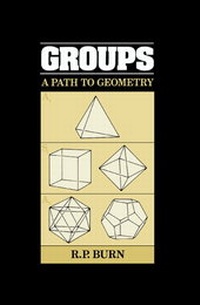
Groups
A Path to Geometry
Published on 5. September 1985
Book
Hardback
254 pages
978-0-521-30037-7 (ISBN)
Description
This book follows the same successful approach as Dr Burn's previous book on number theory. It consists of a carefully constructed sequence of questions which will enable the reader, through his or her own participation, to generate all the group theory covered by a conventional first university course. An introduction to vector spaces, leading to the study of linear groups, and an introduction to complex numbers, leading to the study of Moebius transformations and stereographic projection, are also included. Quaternions and their relationship to three-dimensional isometries are covered, and the climax of the book is a study of crystallographic groups, with a complete analysis of these groups in two dimensions.
Reviews / Votes
'There is much here of value both for students and for those who are seeking a refresher course in modern group theory.' The Times Higher Education Supplement '... the author is encouraging throughout and patiently leads his audience to an understanding of the interplay between group theory and the classical geometry of two and three dimensions ... the author is a knowledgeable and considerate guide.' Mathematical GazetteMore details
Language
English
Place of publication
Cambridge
United Kingdom
Target group
College/higher education
Dimensions
Height: 228 mm
Width: 152 mm
Weight
485 gr
ISBN-13
978-0-521-30037-7 (9780521300377)
Copyright in bibliographic data and cover images is held by Nielsen Book Services Limited or by the publishers or by their respective licensors: all rights reserved.
Schweitzer Classification
Other editions
Content
Preface; Acknowledgements; 1. Functions; 2. Permutations of a finite set; 3. Groups of permutations of R and C; 4. The Moebius group; 5. The regular solids; 6. Abstract groups; 7. Inversions of the Moebius plane and stereographic projection; 8. Equivalence relations; 9. Cosets; 10. Direct product; 11. Fields and vector spaces; 12. Linear transformations; 13. The general linear group GL(2, F); 14. The vector space V3 (F); 15. Eigenvectors and eigenvalues; 16. Homomorphisms; 17. Conjugacy; 18. Linear fractional groups; 19. Quaternions and rotations; 20. Affine groups; 21. Orthogonal groups; 22. Discrete groups fixing a line; 23. Wallpaper groups; Bibliography; Index.