

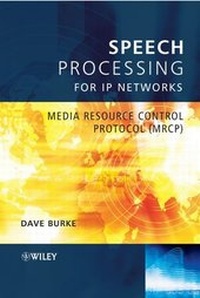
Speech Processing for IP Networks
Media Resource Control Protocol (MRCP)
Published on 2. March 2007
Book
Hardback
368 pages
978-0-470-02834-6 (ISBN)
Description
Media Resource Control Protocol (MRCP) is a new IETF protocol, providing a key enabling technology that eases the integration of speech technologies into network equipment and accelerates their adoption resulting in exciting and compelling interactive services to be delivered over the telephone. MRCP leverages IP telephony and Web technologies such as SIP (Session Intiation Protocol), HTTP (Hypertext Transfer Protocol), and XML (Extensible Markup Language) to deliver an open standard, vendor-independent, and versatile interface to speech engines.
Speech Processing for IP Networks brings these technologies together into a single volume, giving the reader a solid technical understanding of the principles of MRCP, how it leverages other protocols and specifications for its operation, and how it is applied in modern IP-based telecommunication networks. Focusing on the MRCPv2 standard developed by the IETF SpeechSC Working Group, this book will also provide an overview of its precursor, MRCPv1.
Speech Processing for IP Networks:
* Gives a complete background on the technologies required by MRCP to function, including SIP, RTP (Real-time Transport Protocol), and HTTP.
* Covers relevant W3C data representation formats including Speech Synthesis Markup Language (SSML), Speech Recognition Grammar Specification (SRGS), Semantic Interpretation for Speech Recognition (SISR), and Pronunciation Lexicon Specification (PLS).
* Describes VoiceXML - the leading approach for programming cutting-edge speech applications and a key driver to the development of many of MRCP's features.
* Explains advanced topics such as VoiceXML and MRCP interworking.
This text will be an invaluable resource for technical managers, product managers, software developers, and technical marketing professionals working for network equipment manufacturers, speech engine vendors, and network operators. Advanced students on computer science and engineering courses will also find this to be an excellent guide to the topic.
More details
Product info
gebunden
Edition
1. Auflage
Language
English
Place of publication
New York
United States
Target group
Professional and scholarly
Product notice
sewn/stitched
Paper over boards
Dimensions
Height: 249 mm
Width: 174 mm
Thickness: 26 mm
Weight
844 gr
ISBN-13
978-0-470-02834-6 (9780470028346)
Schweitzer Classification
Other editions
Additional editions
E-Book
03/2007
Wiley
€98.99
Available for download
Person
David Burke is Chief Technology Officer and co-founder of Voxpilot Ltd, UK. David led Voxpilot to its current position as a leader in VoiceXML interactive services platform technology. His management duties at Voxpilot include executive management and counsel, product vision, direction and management, responsibility for all R&D activities including budgeting, engineering team selection and mentoring, and architecture and design.
He is also member of the World Wide Web Consortium (W3C) Voice Browser Working Group and of the Internet Engineering Task Force (IETF) Speech SC Working Group.
Content
PART I. BACKGROUND.
1. Introduction.
1.1 Introduction to Speech Applications.
1.2 The MRCP Value Proposition.
1.3 History of MRCP Standardisation.
1.4 Summary.
2. Basic Principles of Speech Processing.
2.1 Human Speech Production.
2.2 Speech Recognition.
2.3 Speaker Verification and Identification.
2.4 Speech Synthesis.
2.5 Summary.
3. Overview of MRCP.
3.1 Architecture.
3.2 Media Resource Types.
3.3 Network Scenarios.
3.4 Protocol Operation.
3.5 Security.
3.6 Summary.
PART II. MEDIA AND CONTROL SESSIONS.
4. Session Initiation Protocol.
4.1 Introduction.
4.2 Walkthrough Example.
4.3 SIP URIs.
4.4 Transport.
4.5 Media Negotiation.
4.6 SIP Servers.
4.7 SIP Extensions.
4.8 Security.
4.9 Summary.
5. Session Initiation in MRCP.
5.1 Introduction.
5.2 Initiating the Media Session.
5.3 Initiating the Control Session.
5.4 Session Initiation Examples.
5.5 Locating Media Resource Servers.
5.6 Security.
5.7 Summary.
6. The Media Session.
6.1 Media Encoding.
6.2 Media Transport.
6.3 Security.
6.4 Summary.
7. The Control Session.
7.1 Message Structure.
7.2 Generic Methods.
7.3 Generic Headers.
7.4 Security.
7.5 Summary.
PART III. DATA REPRESENTATION FORMATS.
8. Speech Synthesis Markup Language (SSML).
8.1 Introduction.
8.2 Document Structure.
8.3 Recorded Audio.
8.4 Pronunciation.
8.5 Prosody.
8.6 Markers.
8.7 Metadata.
8.8 Summary.
9. Speech Recognition Grammar Specification (SRGS).
9.1 Introduction.
9.2 Document Structure.
9.3 Rules, Tokens, and Sequences.
9.4 Alternatives.
9.5 Rule References.
9.6 Repeats.
9.7 DTMF Grammars.
9.8 Semantic Interpretation.
9.9 Summary.
10. Natural Language Semantics Markup Language (NLSML).
10.1 Introduction.
10.2 Document Structure.
10.3 Speech Recognition Results.
10.4 Voice Enrollment Results.
10.5 Speaker Verification Results.
10.6 Summary.
11. Pronunciation Lexicon Specification (PLS).
11.1 Introduction.
11.2 Document Structure.
11.3 Lexical Entries.
11.4 Abbreviations and Acronyms.
11.5 Multiple Orthographies.
11.6 Multiple Pronunciations.
11.7 Summary.
PART IV. MEDIA RESOURCES.
12. Speech Synthesiser Resource.
12.1 Overview.
12.2 Methods.
12.3 Events.
12.4 Headers.
12.5 Summary.
13. Speech Recogniser Resource.
13.1 Overview.
13.2 Recognition Methods.
13.3 Enrollment Methods.
13.4 Events.
13.5 Recognition Headers.
13.6 Enrollment Headers.
13.7 Summary.
14. Recorder Resource.
14.1 Overview.
14.2 Methods.
14.3 Events.
14.4 Headers.
14.5 Summary.
15. Speaker Verification Resource.
15.1 Overview.
15.2 Methods.
15.3 Events.
15.4 Headers.
15.5 Summary.
PART V. PROGRAMMING SPEECH APPLICATIONS.
16. Voice eXtensible Markup Language (VoiceXML).
16.1 Introduction.
16.2 Document Structure.
16.3 Dialogs.
16.4 Media Playback.
16.5 Media Recording.
16.6 Speech and DTMF Recognition.
16.7 Flow Control.
16.8 Resource Fetching.
16.9 Call Transfer.
16.10 Summary.
17. VoiceXML and MRCP Interworking.
17.1 Introduction.
17.2 Interworking Fundamentals.
17.3 Application Example.
17.4 Summary.
Appendix A. MRCP Version 1.
A.1 Overview.
A.2 Session Management and Message Transport.
A.3 General Protocol Details.
A.4 Speech Synthesiser Resource.
A.5 Speech Recogniser Resource.
Appendix B. XML Primer.
B.1 Background.
B.2 Basic Concepts.
B.3 Namespaces.
B.4 Document Schemas.
Appendix C. HTTP Primer.
C.1 Background.
C.2 Basic Concepts.
C.3 Caching.
C.4 Cookies.
C.5 Security.
References.
Index.
Acronyms.