

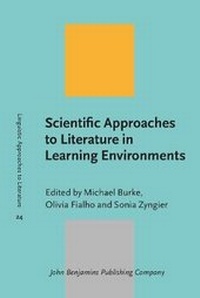
Scientific Approaches to Literature in Learning Environments
Published on 22. July 2016
Book
Hardback
309 pages
978-90-272-3413-1 (ISBN)
Description
Scientific Approaches to Literature in Learning Environments is not just about what takes place in literary classrooms. Settings do have a strong influence on student learning both directly and indirectly. These spaces may include the home, the workplace, science centers, libraries, that is, contexts that entail diverse social, physical, psychological, and pedagogical variables that facilitate learning, for example, by grouping desks in specific ways, utilizing audio, visual, and digital technologies. Scientific Approaches to Literature in Learning Environments puts together a series of empirical research studies on the different locations of teaching and learning. These studies represent literary learning environment throughout the world, including Brazil, the USA, China, Canada, Japan and several European countries such as the Netherlands, Ukraine, the UK and Malta. The studies reported describe quantitative and/or qualitative research and cover pre-primary, primary, high school, college, university, and lifelong learning environments. They refresh the enigmatic ambience that often surrounds the teaching and learning that goes on in literary studies and offer transparent, useful and replicable research and practice. Students and teachers alike are encouraged to take them and own them.
More details
Series
Language
English
Place of publication
Amsterdam
Netherlands
Target group
Professional and scholarly
Weight
650 gr
ISBN-13
978-90-272-3413-1 (9789027234131)
Copyright in bibliographic data and cover images is held by Nielsen Book Services Limited or by the publishers or by their respective licensors: all rights reserved.
Schweitzer Classification
Other editions
Additional editions
E-Book
07/2016
1st Edition
John Benjamins Publishing Company
€123.99
Available for download
Persons
Content
1. Foreword (by Miall, David S.); 2. Acknowledgements; 3. Contributors; 4. Chapter 1. Empirical approaches to the study of literature in learning environments: An overview (by Fialho, Olivia); 5. Part I. Reading processes in communities of practices; 6. Chapter 2. Learning from literature: Empirical research on readers in schools and at the workplace (by Hakemulder, Frank); 7. Chapter 3. Authorizing the reader in the classroom (by Miall, David S.); 8. Chapter 4. Transforming readings: Reading and interpreting in book groups (by Peplow, David); 9. Part II. Reading processes in EFL/L2 contexts; 10. Chapter 5. Enhancing responses to literary texts with L2 learners: An empirically derived pedagogical framework (by Vassallo, Odette); 11. Chapter 6. Empirical stylistics in an EFL teaching context: Comparing virtual and face-to-face reading responses (by Chesnokova, Anna); 12. Chapter 7. Literary themes across cultures (by Liu, Shisheng); 13. Chapter 8. Of learning and poetics: Exploring strategies used by L2 Japanese English learners (by Nishihara, Takayuki); 14. Chapter 9. Literature and the role of background knowledge for EFL learners (by Teranishi, Masayuki); 15. Part III. Creative writing, corpus, and empirical stylistics as learning tools; 16. Chapter 10. Effects of creative writing on adolescent students' literary response (by Janssen, Tanja); 17. Chapter 11. ESL students' perceptions of creative and academic writing (by Hanauer, David I.); 18. Chapter 12. Empirical stylistics as a learning and research tool in the study of narrative viewpoint (by Sotirova, Violeta); 19. Chapter 13. Point and CLiC: Teaching literature with corpus stylistic tools (by Mahlberg, Michaela); 20. Chapter 14. Literary awareness in a high-school EFL learning environment: An empirical evaluation (by Zyngier, Sonia); 21. Index