

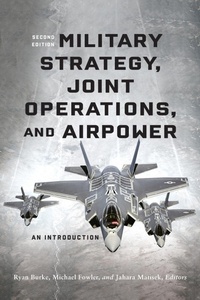
Military Strategy, Joint Operations, and Airpower
An Introduction
2nd Edition
Published on 15. July 2022
Book
Hardback
248 pages
978-1-64712-249-2 (ISBN)
Description
An essential introduction to contemporary strategy at the operational level of war, now in its second edition
Military Strategy, Joint Operations, and Airpower introduces contemporary strategy at the operational level of war, particularly as it relates to airpower. Developed as foundational reading for all US Air Force Academy cadets, Air Force ROTC students, and Officer Training School candidates, this intermediate textbook is designed to close the gap between military theory and practice. It covers strategic foundations; operational design and joint-service operations; the air, space, and cyber capabilities that comprise modern airpower; and contemporary challenges in the application of strategy.
In this second edition, each chapter has been updated and revised, and several sections have been expanded. Part 2, "Military Forces and the Joint Fight," now features separate chapters about each service. Similarly, operational design is expanded from one to four chapters to provide a more thorough step-by-step guide through the process. New chapters in this second edition include "Integrating the Instruments of Power," "The Spectrum of Conflict and Range of Military Operations," and "The Nuclear Weapons Triad and Missile Defense."
Military Strategy, Joint Operations, and Airpower's contributing authors and editors include both military practitioners and scholars of security studies, political science, and history. In addition to being required reading for US Air Force cadets, the book provides an essential overview of strategy and practice for anyone interested in modern airpower.
Military Strategy, Joint Operations, and Airpower introduces contemporary strategy at the operational level of war, particularly as it relates to airpower. Developed as foundational reading for all US Air Force Academy cadets, Air Force ROTC students, and Officer Training School candidates, this intermediate textbook is designed to close the gap between military theory and practice. It covers strategic foundations; operational design and joint-service operations; the air, space, and cyber capabilities that comprise modern airpower; and contemporary challenges in the application of strategy.
In this second edition, each chapter has been updated and revised, and several sections have been expanded. Part 2, "Military Forces and the Joint Fight," now features separate chapters about each service. Similarly, operational design is expanded from one to four chapters to provide a more thorough step-by-step guide through the process. New chapters in this second edition include "Integrating the Instruments of Power," "The Spectrum of Conflict and Range of Military Operations," and "The Nuclear Weapons Triad and Missile Defense."
Military Strategy, Joint Operations, and Airpower's contributing authors and editors include both military practitioners and scholars of security studies, political science, and history. In addition to being required reading for US Air Force cadets, the book provides an essential overview of strategy and practice for anyone interested in modern airpower.
More details
Edition
Second Edition
Language
English
Place of publication
Washington, DC
United States
Target group
College/higher education
US School Grade: From College Freshman to College Graduate Student
Edition type
Revised edition
Illustrations
Not illustrated
Dimensions
Height: 254 mm
Width: 178 mm
Weight
703 gr
ISBN-13
978-1-64712-249-2 (9781647122492)
Copyright in bibliographic data and cover images is held by Nielsen Book Services Limited or by the publishers or by their respective licensors: all rights reserved.
Schweitzer Classification
Other editions
Previous edition
Ryan Burke | Michael Fowler | Kevin McCaskey
Military Strategy, Joint Operations, and Airpower
An Introduction
Book
09/2018
Georgetown University Press
€167.41
Article exhausted; check for reprint
Persons
Ryan Burke is a professor in the Department of Military and Strategic Studies at the US Air Force Academy (USAFA) and a veteran US Marine Corps officer. He earned his PhD at the University of Delaware's Biden School of Public Policy and Administration and teaches courses on military strategy, international security, and military power projection.
Lt. Col. Michael Fowler is an associate professor in the Department of Military and Strategic Studies at USAFA. He earned his PhD at the Naval Postgraduate School, and now teaches courses in military strategy, international security, targeting, and intelligence collection.
Lt. Col. Jahara Matisek is an associate professor of military and strategic studies and research director at the Strategy and Warfare Center at USAFA. He earned his PhD in political science at Northwestern University. In 2020 he deployed as an E-11 instructor pilot, earning a Bronze Star Medal as director of operations for the 451st Expeditionary Operations Support Squadron at Kandahar Airfield, Afghanistan.
Lt. Col. Michael Fowler is an associate professor in the Department of Military and Strategic Studies at USAFA. He earned his PhD at the Naval Postgraduate School, and now teaches courses in military strategy, international security, targeting, and intelligence collection.
Lt. Col. Jahara Matisek is an associate professor of military and strategic studies and research director at the Strategy and Warfare Center at USAFA. He earned his PhD in political science at Northwestern University. In 2020 he deployed as an E-11 instructor pilot, earning a Bronze Star Medal as director of operations for the 451st Expeditionary Operations Support Squadron at Kandahar Airfield, Afghanistan.
Content
Preface: Some Perspectives on Planning and Executing Warfare
Thomas Swaim
Acknowledgments
Introduction
Ryan Burke
Part I: National Security and Defense
1. Strategic Foundations and National Security Interests
John T. Farquhar
2. Integrating the Instruments of Power
Paul Bezerra, Mark Grotelueschen, and Marybeth Ulrich
3. Spectrum of Conflict and Range of Military Operations
Danielle Gilbert and Kyleanne Hunter
Part II: Military Forces and the Joint Fight
4. The US Joint Force Structure
Buddhika Jayamaha
5. The US Army and the Land Domain
Brian Drohan
6. The US Navy and the Maritime Domain
James Holmes
7. The US Marine Corps and Expeditionary Power Projection
Ryan Burke and Kyleanne Hunter
8. The US Air Force and the Air Domain
Appendix: USAF Capabilities
Heather Venable
9. The US Space Force and the Space Domain
Michael Martindale
Part III: Synchronizing Operations
10. Special Operations: A Specialized Combatant Command
Jon McPhilamy
11. Cyberpower
Judson C. Dressler
12. Intelligence, ISR, and Strategy
Michael Fowler
13. The Nuclear Weapons Triad and Missile Defense
Frances V. Mercado
Part IV: Military Theory and Operations
14. Theory, Doctrine, and Application of Strategic Air War
John T. Farquhar
15. Contemporary Air Theory Strives for Strategic Effect
John T. Farquhar
16. Constructing a Compellence Strategy
Appendix: Typology Clarification
Michael Fowler
17. The Paradox of Irregular Warfare
John T. Farquhar
18. Airpower's Unconventional Irregular Warfare Challenge
John T. Farquhar
Part V: Planning and Design in the Contemporary Environment
19. Operational Design as a Framework for Strategic Understanding and Agility
Ryan Burke and Rob Grant
20. Framing Wicked Problems to Analyze the Operational Environment
James Davitch and Michael Fowler
21. Analyzing Centers of Gravity
Ryan Burke and Michael Fowler
22. Building Lines of Effort to Link Ends, Ways, and Means
Ryan Burke
Conclusion
Ryan Burke
List of Contributors
Index
Thomas Swaim
Acknowledgments
Introduction
Ryan Burke
Part I: National Security and Defense
1. Strategic Foundations and National Security Interests
John T. Farquhar
2. Integrating the Instruments of Power
Paul Bezerra, Mark Grotelueschen, and Marybeth Ulrich
3. Spectrum of Conflict and Range of Military Operations
Danielle Gilbert and Kyleanne Hunter
Part II: Military Forces and the Joint Fight
4. The US Joint Force Structure
Buddhika Jayamaha
5. The US Army and the Land Domain
Brian Drohan
6. The US Navy and the Maritime Domain
James Holmes
7. The US Marine Corps and Expeditionary Power Projection
Ryan Burke and Kyleanne Hunter
8. The US Air Force and the Air Domain
Appendix: USAF Capabilities
Heather Venable
9. The US Space Force and the Space Domain
Michael Martindale
Part III: Synchronizing Operations
10. Special Operations: A Specialized Combatant Command
Jon McPhilamy
11. Cyberpower
Judson C. Dressler
12. Intelligence, ISR, and Strategy
Michael Fowler
13. The Nuclear Weapons Triad and Missile Defense
Frances V. Mercado
Part IV: Military Theory and Operations
14. Theory, Doctrine, and Application of Strategic Air War
John T. Farquhar
15. Contemporary Air Theory Strives for Strategic Effect
John T. Farquhar
16. Constructing a Compellence Strategy
Appendix: Typology Clarification
Michael Fowler
17. The Paradox of Irregular Warfare
John T. Farquhar
18. Airpower's Unconventional Irregular Warfare Challenge
John T. Farquhar
Part V: Planning and Design in the Contemporary Environment
19. Operational Design as a Framework for Strategic Understanding and Agility
Ryan Burke and Rob Grant
20. Framing Wicked Problems to Analyze the Operational Environment
James Davitch and Michael Fowler
21. Analyzing Centers of Gravity
Ryan Burke and Michael Fowler
22. Building Lines of Effort to Link Ends, Ways, and Means
Ryan Burke
Conclusion
Ryan Burke
List of Contributors
Index