

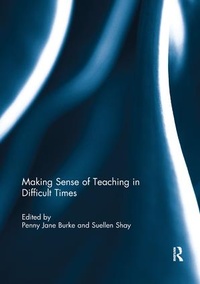
Making Sense of Teaching in Difficult Times
1st Edition
Published on 14. December 2017
Book
Paperback/Softback
140 pages
978-1-138-30627-1 (ISBN)
Description
Thinking about teaching in educational terms has become increasingly difficult because of the conceptions of higher education that predominate in both policy and public debate. Framing the benefits of higher education simply as an economic good poses particular difficulties for making educational sense of teaching. Moreover, the assumptions about social mobility, usefulness, and the economic advantages of higher education, upon which these conceptions are based, can no longer be taken for granted.
The chapters in this book all wrestle with understandings of education and teaching experiences in changing global, national, and institutional contexts. They explore questions of difference and privilege, the social transformation of teaching through transforming teachers, contestations of global citizenship and interculturality, learning and sensibilities of self-in-the-world, the relationship between programme content and student decision-making, divergent conceptions of learning in international education, and subject-centred approaches to embodied teaching. The book considers the value of disciplinary tools of analysis in addressing contextual challenges in developing societies, connections between pedagogies, autonomy and intercultural classrooms, and ways of countering the marketization of higher education through online teaching communities. This book was originally published as a special issue of Teaching in Higher Education.
The chapters in this book all wrestle with understandings of education and teaching experiences in changing global, national, and institutional contexts. They explore questions of difference and privilege, the social transformation of teaching through transforming teachers, contestations of global citizenship and interculturality, learning and sensibilities of self-in-the-world, the relationship between programme content and student decision-making, divergent conceptions of learning in international education, and subject-centred approaches to embodied teaching. The book considers the value of disciplinary tools of analysis in addressing contextual challenges in developing societies, connections between pedagogies, autonomy and intercultural classrooms, and ways of countering the marketization of higher education through online teaching communities. This book was originally published as a special issue of Teaching in Higher Education.
More details
Language
English
Place of publication
London
United Kingdom
Publishing group
Taylor & Francis Ltd
Target group
College/higher education
Professional and scholarly
Dimensions
Height: 246 mm
Width: 174 mm
Weight
260 gr
ISBN-13
978-1-138-30627-1 (9781138306271)
Copyright in bibliographic data and cover images is held by Nielsen Book Services Limited or by the publishers or by their respective licensors: all rights reserved.
Schweitzer Classification
Other editions
Additional editions
Penny Burke | Suellen Shay
Making Sense of Teaching in Difficult Times
E-Book
10/2017
1st Edition
Routledge
€40.99
Available for download
Penny Burke | Suellen Shay
Making Sense of Teaching in Difficult Times
E-Book
10/2017
1st Edition
Routledge
€40.99
Available for download
Penny Burke | Suellen Shay
Making Sense of Teaching in Difficult Times
Book
12/2015
1st Edition
Routledge
€133.69
Shipment within 10-20 days
Persons
Penny Jane Burke is Global Innovation Chair of Equity at the University of Newcastle, Australia, where she is Co-Director of the Centre of Excellence for Equity in Higher Education. She is also Professor of Education at Roehampton University, London, UK, where she is Co-Founder and Co-Director of the Paulo Freire Institute-UK, and Research in Inequalities, Societies & Education. She has published extensively in the field of equity in higher education, including Accessing Education effectively widening participation (2002),?The Right to Higher Education: Beyond widening participation (2012), and Reconceptualising Lifelong Learning: Feminist Interventions (with Sue Jackson, 2007). She is the Access and Widening Participation Network co-convenor for the Society for Research in Higher Education, and Editor of Teaching in Higher Education.
Suellen Shay is Associate Professor and Dean in the Centre for Higher Education Development at the University of Cape Town, South Africa. Her career has spanned a range of types of educational development work, including language development, curriculum development, and staff and institutional development. Her research brings the theoretical frameworks of sociology of education to higher education with specific focus on knowledge and curriculum. She is co-editor of Knowledge-building: Educational Studies in Legitimation Code Theory (with Karl Maton and Sue Hood, 2015) and has published in a range of higher education journals. She is principle investigator in a multi-institutional research project on undergraduate curriculum reform in South Africa. She is one of the executive editors of Teaching in Higher Education.?
Suellen Shay is Associate Professor and Dean in the Centre for Higher Education Development at the University of Cape Town, South Africa. Her career has spanned a range of types of educational development work, including language development, curriculum development, and staff and institutional development. Her research brings the theoretical frameworks of sociology of education to higher education with specific focus on knowledge and curriculum. She is co-editor of Knowledge-building: Educational Studies in Legitimation Code Theory (with Karl Maton and Sue Hood, 2015) and has published in a range of higher education journals. She is principle investigator in a multi-institutional research project on undergraduate curriculum reform in South Africa. She is one of the executive editors of Teaching in Higher Education.?
Content
1. Difficult times for college students of color: teaching white students about White Privilege provides hope for change 2. Teacher as learner: a personal reflection on a short course for South African university educators 3. Global citizenship, sojourning students and campus communities 4. Strategies for critiquing global citizenry: undergraduate research as a possible vehicle 5. Interdisciplinary content, contestations of knowledge and informational transparency in engineering curriculum 6. Chinese students making sense of problem-based learning and Western teaching - pitfalls and coping strategies 7. Reframing teaching relationships: from student-centred to subject-centred learning 8. A heuristic for analysing and teaching literature dealing with the challenges of social justice 9. The influence of internationalisation and national identity on teaching and assessments in higher education 10. Online teaching communities within sociology: a counter trend to the marketization of higher education