

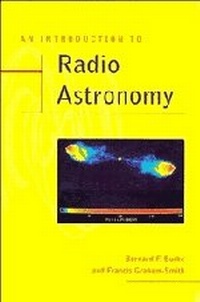
An Introduction to Radio Astronomy
Published on 5. December 1996
Book
Paperback/Softback
309 pages
978-0-521-55604-0 (ISBN)
Description
Radio astronomy uses unique observational techniques and offers the only way to investigate many phenomena in the Universe. This book, by two founders of the field, presents both a clear introduction to radio telescopes and techniques and a broad overview of the radio universe. In the first half of the book, we are shown clearly how radio telescopes work - from basic antennas and single aperture dishes through to full aperture synthesis arrays. In the second half, a wide-ranging and up-to-date review is provided of radio observations of our Milky Way galaxy, stars, pulsars, radio galaxies, quasars and the cosmic microwave background. Handy reviews of Fourier Transform theory, celestial co-ordinate systems and a historical outline of the subject are provided in appendices. Wide-ranging and clearly written, this book provides a thorough introduction to the subject for graduate students, and an invaluable overview for researchers turning to radio astronomy for the first time.
Reviews / Votes
'... this book is a clear and timely description of the current 'state of the art' on the subject ... Written by two of the world's leading radio astronomers ... the account is certainly authoritative ... there is plenty here to interest and stimulate ... If you are looking for an up-to-date review of radio astronomy, from the telescopes and techniques to the fabulous wonders of the Universe they reveal, then this is the book for you.' Geoff Macdonald, Astronomy Now 'The authors are to be praised ... a broad coverage of topics ... a comprehensive overview of the impact of radio astronomy on astrophysics.' Paul Hewett, Endeavour 'Two grand masters with insight, perspective and detailed knowledge, Bernard F. Burke and Francis Graham-Smith, have filled their sweeping An Introduction to Radio Astronomy with interesting titbits and intricate interconnections.' Carl Heiles, Physics TodayMore details
Language
English
Place of publication
Cambridge
United Kingdom
Target group
Professional and scholarly
Product notice
Paperback (trade)
Illustrations
3 Tables, unspecified; 23 Halftones, unspecified; 135 Line drawings, unspecified
Dimensions
Height: 248 mm
Width: 176 mm
Thickness: 19 mm
Weight
700 gr
ISBN-13
978-0-521-55604-0 (9780521556040)
Copyright in bibliographic data and cover images is held by Nielsen Book Services Limited or by the publishers or by their respective licensors: all rights reserved.
Schweitzer Classification
Other editions
New editions
Bernard F. Burke | Francis Graham-Smith
An Introduction to Radio Astronomy
Book
09/2009
3rd Edition
Cambridge University Press
€92.84
Article exhausted; check for reprint
Bernard F. Burke | Francis Graham-Smith
An Introduction to Radio Astronomy
Book
04/2002
2nd Edition
Cambridge University Press
€53.23
Article exhausted; check for reprint
Persons
Content
1. Introduction; 2. Radio telescopes as antennas; 3. Signal detection and noise; 4. Single-aperture radio telescopes; 5. The 2-element interferometer; 6. Aperture synthesis; 7. The absorption, amplification, refraction and attenuation of radio waves; 8. Galactic continuum radiation; 9. The interstellar medium; 10. Galactic dynamics; 11. Stars; 12. Pulsars; 13. Radio galaxies and quasars; 14. Cosmology and the cosmic microwave background; 15. Cosmology: discrete radio sources and gravitational lenses; 16. The place of radio in astronomy; Appendix A. Fourier transforms; Appendix B. Celestial coordinates, distance, and time; Appendix C. The origins of radio astronomy; Index.