

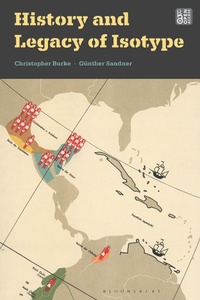
History and Legacy of Isotype
Published on 5. September 2024
Book
Paperback/Softback
208 pages
978-1-350-35906-2 (ISBN)
Description
Based on extensive archival research, this open access book provides a fresh perspective on the early history of Isotype and pictographic communication, with new information about largely unknown episodes throughout its development.
The picture-script Isotype (International System of Typographic Picture Education), previously conceived as the Vienna Method of Pictorial Statistics, evolved through numerous publications and exhibitions in the early 20th century. Christopher Burke and Guenther Sandner trace how its development responded to differing cultural and political climates, through a period when the idea of a universal language - an artificial or planned language - was linked to ideas of internationality and democratic planning. This book explores in depth, for the first time, the early picture-statistical work carried out at Austrian institutions during a new era of visual education and communication during and after World War II.
Examining the work of Isotype's initiators - Otto Neurath, the founding director of The Social and Economic Museum of Vienna, the artist Gerd Arntz, and Marie Reidemeister, who performed the role of 'transformer', a prototype of the modern information designer - this book challenges existing conceptions of an enormously influential pictographic language. Richly illustrated throughout with over 60 examples of work by key figures, this book provides a comprehensive history of Isotype and offers critical reflections on its legacy within, and relevance to, contemporary design practice.
The eBook editions of this book are available open access under a CC BY-NC 4.0 licence on bloomsburycollections.com.
The picture-script Isotype (International System of Typographic Picture Education), previously conceived as the Vienna Method of Pictorial Statistics, evolved through numerous publications and exhibitions in the early 20th century. Christopher Burke and Guenther Sandner trace how its development responded to differing cultural and political climates, through a period when the idea of a universal language - an artificial or planned language - was linked to ideas of internationality and democratic planning. This book explores in depth, for the first time, the early picture-statistical work carried out at Austrian institutions during a new era of visual education and communication during and after World War II.
Examining the work of Isotype's initiators - Otto Neurath, the founding director of The Social and Economic Museum of Vienna, the artist Gerd Arntz, and Marie Reidemeister, who performed the role of 'transformer', a prototype of the modern information designer - this book challenges existing conceptions of an enormously influential pictographic language. Richly illustrated throughout with over 60 examples of work by key figures, this book provides a comprehensive history of Isotype and offers critical reflections on its legacy within, and relevance to, contemporary design practice.
The eBook editions of this book are available open access under a CC BY-NC 4.0 licence on bloomsburycollections.com.
More details
Language
English
Place of publication
London
United Kingdom
Publishing group
Bloomsbury Publishing PLC
Target group
College/higher education
Professional and scholarly
Illustrations
160 colour illus
Dimensions
Height: 233 mm
Width: 155 mm
Thickness: 14 mm
Weight
456 gr
ISBN-13
978-1-350-35906-2 (9781350359062)
Copyright in bibliographic data and cover images is held by Nielsen Book Services Limited or by the publishers or by their respective licensors: all rights reserved.
Schweitzer Classification
Persons
Christopher Burke is a design historian and Associate Professor in the Department of Typography and Graphic Communication at the University of Reading, UK. He is Research Fellow on the project 'Isotype: Origin, Development, and Legacy', based at the University of Vienna, Austria, and he co-curated the exhibition 'Isotype: International Picture Language' at the Victoria and Albert Museum, UK. He co-edited Otto Neurath's autobiography, From Hieroglyphics to Isotype (2010), and the collection Isotype: Design and Contexts 1925 1971 (2013).
Guenther Sandner is a political scientist and historian. He is FWF Research Fellow at the Institute Vienna Circle, University of Vienna, Austria, where he leads the project 'Isotype: Origin, Development, and Legacy'. He has written numerous essays on the topics of Isotype and logical empiricism and is the author of Otto Neurath, a biography, published in 2014.
Guenther Sandner is a political scientist and historian. He is FWF Research Fellow at the Institute Vienna Circle, University of Vienna, Austria, where he leads the project 'Isotype: Origin, Development, and Legacy'. He has written numerous essays on the topics of Isotype and logical empiricism and is the author of Otto Neurath, a biography, published in 2014.
Content
Introduction
1. The Vienna Method in School
2. Branching Out
3. Pictorial Statistics in Austria During the Dictatorships
4. Isotype in Exile
5. The Austrian Social and Economic Museum After 1945
6. Following Otto Neurath: Marie Neurath and Gerd Arntz on Separate Paths
7. Rudolf Modley and the 'Americanization' of Isotype
Conclusion
Bibliography
Index
1. The Vienna Method in School
2. Branching Out
3. Pictorial Statistics in Austria During the Dictatorships
4. Isotype in Exile
5. The Austrian Social and Economic Museum After 1945
6. Following Otto Neurath: Marie Neurath and Gerd Arntz on Separate Paths
7. Rudolf Modley and the 'Americanization' of Isotype
Conclusion
Bibliography
Index