

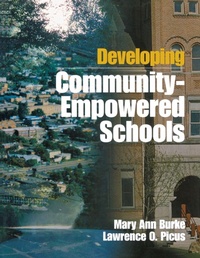
Developing Community-Empowered Schools
1st Edition
Published on 8. May 2001
Book
Paperback/Softback
128 pages
978-0-7619-7790-2 (ISBN)
Description
"Very thoughtful and practical, providing well-grounded strategies for effective implementation of community participation."
Gini Doolittle, Assistant Professor
Department of Educational Leadership, Rowan University, New Jersey
Create environments for learning through school-community partnerships!
Burke and Picus make a case for improved learning through school-community partnerships. Drawing from their twenty years of experience working with parents, community volunteers, teachers, and school site administrators, the authors present a concise, easy-to-understand approach to building and working with these powerful alliances.
Developing Community-Empowered Schools is structured to give the reader a clear overview of the necessary components and strategies to understand and develop these critical partnerships. Highlights include:
Defining community-empowered schools
Assessing your school's strengths and weaknesses
Identifying stakeholders and their roles
Establishing policies and procedures that support school and community partnerships
Empowering and training staff for effective school and community partnerships
Recruiting and training volunteers
Creating a family literacy program
Building community collaborations for added resources
Viewing schools as economic solutions to communities
Examining the future of community-empowered schools
Handy overheads, training worksheets, sample memos from teachers to students' families, and enough material for a one-day teacher-training workshop make this a practical, accessible, and valuable resource. In addition, in-depth information is provided on how to seek funding to sustain a school-based community program. Developing Community-Empowered Schools is an all-in-one guide and an essential desk-top reference for bringing all stakeholders together to create optimal learning environments.
Gini Doolittle, Assistant Professor
Department of Educational Leadership, Rowan University, New Jersey
Create environments for learning through school-community partnerships!
Burke and Picus make a case for improved learning through school-community partnerships. Drawing from their twenty years of experience working with parents, community volunteers, teachers, and school site administrators, the authors present a concise, easy-to-understand approach to building and working with these powerful alliances.
Developing Community-Empowered Schools is structured to give the reader a clear overview of the necessary components and strategies to understand and develop these critical partnerships. Highlights include:
Defining community-empowered schools
Assessing your school's strengths and weaknesses
Identifying stakeholders and their roles
Establishing policies and procedures that support school and community partnerships
Empowering and training staff for effective school and community partnerships
Recruiting and training volunteers
Creating a family literacy program
Building community collaborations for added resources
Viewing schools as economic solutions to communities
Examining the future of community-empowered schools
Handy overheads, training worksheets, sample memos from teachers to students' families, and enough material for a one-day teacher-training workshop make this a practical, accessible, and valuable resource. In addition, in-depth information is provided on how to seek funding to sustain a school-based community program. Developing Community-Empowered Schools is an all-in-one guide and an essential desk-top reference for bringing all stakeholders together to create optimal learning environments.
Reviews / Votes
"A how-to manual for educators who want to increase community involvement in their schools. The book explains the steps for creating such a (community-empowered) school. It is filled with sample worksheets, checklists, and an entire section on how to train educational staff and volunteers." -- NASSP Bulletin * NASSP Bulletin *More details
Edition
First Edition
Language
English
Place of publication
Thousand Oaks
United States
Target group
Professional and scholarly
Dimensions
Height: 280 mm
Width: 216 mm
Thickness: 7 mm
Weight
343 gr
ISBN-13
978-0-7619-7790-2 (9780761977902)
Copyright in bibliographic data and cover images is held by Nielsen Book Services Limited or by the publishers or by their respective licensors: all rights reserved.
Schweitzer Classification
Other editions
Additional editions
Mary Ann Burke | Lawrence O. Picus
Developing Community-Empowered Schools
Book
04/2001
1st Edition
SAGE Publications Inc
€64.80
Shipment within 15-20 days
Persons
Mary Ann Burke is the co-founder of the Generational Parenting Blog at genparenting.com. Dr. Burke presents effective parenting and school engagement strategies at numerous state and national parent engagement events. She creates Common Core State Standards kits and S.T.E.A.M. activities for parents to use at home and in their child's classroom to support children's literacy and academic readiness skills. Dr. Burke is an author or editor of four Corwin Press Books on parent and community engagement in schools. Mary Ann is an active grandmother of five grandchildren that include seven month old twin granddaughters, a four year old preschool grandson, a six-year-old kindergarten granddaughter, and a nine year old third grade grandson. She supports her grandchildren's literacy and academic development activity play at home and at their schools. Mary Ann is a credentialed parent educator for over thirty years in California's schools and a former adjunct professor. Dr. Burke previously led the Santa Clara County Office of Education's Parent Engagement Initiative that is a state model for best practices in parent engagement for culturally diverse families.
Lawrence O. Picus is professor of education finance and policy at the Rossier School of Education at the University of Southern California. His current research interests focus on adequacy and equity in school finance as well as efficiency and productivity in the provision of educational programs for K-12 school children. Picus is past president of the Association for Education Finance and Policy (AEFP) and is the president of the board of EdSource, a California-based education research organization. Picus is the coauthor of School Finance: A Policy Perspective (5th edition) with Allan R. Odden. He has authored, coauthored, or edited several other books including Where Does the Money Go? Resource
Allocation in Elementary and Secondary Schools (1995), In Search of More Productive Schools: A Guide to Resource Allocation in Education (2001), Developing Community-Empowered Schools (2001) coauthored with Mary Ann Burke, and Principles of School Business Administration (1995) with R. Craig Wood, David Thompson, and Don I. Tharpe. He has also published numerous articles in professional journals. Picus studies how educational resources are allocated and used in schools across the United States. He has conducted studies of the impact of incentives
on school district performance. Picus maintains close contact with the superintendents and chief business officers of school districts throughout California and the nation and is a member of a number of professional organizations dedicated to improving school district management. He is a former member of the Editorial Advisory Committee of the Association of School Business Officials International, and he has served as a consultant to the National Education Association, American Federation of Teachers, the National Center for Education Statistics, and WestEd. He served as the principal consultant for the design of school funding systems in Wyoming and Arkansas and has conducted equity, adequacy, and resource allocation studies in Arizona, Arkansas, Washington, Vermont, Oregon, South Carolina, Louisiana, Kansas,
Kentucky, Montana, New Jersey, Nebraska, Texas, North Dakota, Ohio, Wisconsin, and Maine. Picus holds a bachelor's degree in economics from Reed College and master's degrees from the University of Chicago and the Pardee RAND Graduate School. He received his PhD in public policy analysis from the Pardee RAND Graduate School.
Lawrence O. Picus is professor of education finance and policy at the Rossier School of Education at the University of Southern California. His current research interests focus on adequacy and equity in school finance as well as efficiency and productivity in the provision of educational programs for K-12 school children. Picus is past president of the Association for Education Finance and Policy (AEFP) and is the president of the board of EdSource, a California-based education research organization. Picus is the coauthor of School Finance: A Policy Perspective (5th edition) with Allan R. Odden. He has authored, coauthored, or edited several other books including Where Does the Money Go? Resource
Allocation in Elementary and Secondary Schools (1995), In Search of More Productive Schools: A Guide to Resource Allocation in Education (2001), Developing Community-Empowered Schools (2001) coauthored with Mary Ann Burke, and Principles of School Business Administration (1995) with R. Craig Wood, David Thompson, and Don I. Tharpe. He has also published numerous articles in professional journals. Picus studies how educational resources are allocated and used in schools across the United States. He has conducted studies of the impact of incentives
on school district performance. Picus maintains close contact with the superintendents and chief business officers of school districts throughout California and the nation and is a member of a number of professional organizations dedicated to improving school district management. He is a former member of the Editorial Advisory Committee of the Association of School Business Officials International, and he has served as a consultant to the National Education Association, American Federation of Teachers, the National Center for Education Statistics, and WestEd. He served as the principal consultant for the design of school funding systems in Wyoming and Arkansas and has conducted equity, adequacy, and resource allocation studies in Arizona, Arkansas, Washington, Vermont, Oregon, South Carolina, Louisiana, Kansas,
Kentucky, Montana, New Jersey, Nebraska, Texas, North Dakota, Ohio, Wisconsin, and Maine. Picus holds a bachelor's degree in economics from Reed College and master's degrees from the University of Chicago and the Pardee RAND Graduate School. He received his PhD in public policy analysis from the Pardee RAND Graduate School.
Content
Introduction
What Is a Community-Empowered School?
Who Are the Stakeholders?
Policies and Procedures That Support School and Community Partnerships
How to Empower and Train Staff for Effective School and Community Partnerships
Volunteer Strategies to Support Literary Activities
Building Community Collaborations for Added Resources
Schools as Economic Solutions to Communities
The Future of Community-Empowered Schools
What Is a Community-Empowered School?
Who Are the Stakeholders?
Policies and Procedures That Support School and Community Partnerships
How to Empower and Train Staff for Effective School and Community Partnerships
Volunteer Strategies to Support Literary Activities
Building Community Collaborations for Added Resources
Schools as Economic Solutions to Communities
The Future of Community-Empowered Schools