

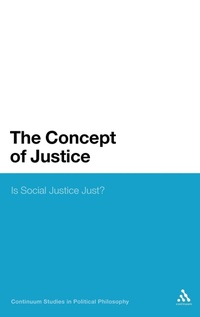
The Concept of Justice
Is Social Justice Just?
Published on 28. April 2011
Book
Hardback
256 pages
978-1-4411-6991-4 (ISBN)
Description
In The Concept of Justice, Patrick Burke explores and argues for a return to traditional ideas of ordinary justice in opposition to conceptions of "social justice" that came to dominate political thought in the 20th Century. Arguing that our notions of justice have been made incoherent by the radical incompatibility between instinctive notions of ordinary justice and theoretical conceptions of social justice, the book goes on to explore the historical roots of these ideas of social justice. Finding the roots of these ideas in religious circles in Italy and England in the 19th century, Burke explores the ongoing religious influence in the development of the concept in the works of Marx, Mill and Hobhouse. In opposition to this legacy of liberal thought, the book presents a new theory of ordinary justice drawing on the thought of Immanuel Kant. In this light, Burke finds that all genuine ethical evaluation must presuppose free will and individual responsibility and that all true injustice is fundamentally coercive.
More details
Series
Language
English
Place of publication
New York
United States
Target group
Professional and scholarly
Dimensions
Height: 240 mm
Width: 161 mm
Thickness: 18 mm
Weight
543 gr
ISBN-13
978-1-4411-6991-4 (9781441169914)
Copyright in bibliographic data and cover images is held by Nielsen Book Services Limited or by the publishers or by their respective licensors: all rights reserved.
Schweitzer Classification
Other editions
Additional editions
E-Book
02/2011
1st Edition
Bloomsbury Continuum
€42.99
Available for download
Person
Thomas Patrick Burke is President of the Wynnewood Institute and former Professor of Religion at Temple University, USA.
Content
Preface; Part I: The Question; 1. The Problem of Justice; Part II: Social Justice; 2. The Origins of Social Justice; 3. The Socialistic Conception of Social Justice; 4. Non-Discrimination; Part III: Justice; 5. The Concept of Ethics; 6. The Concept of Justice; Appendix: Kant and Hegel; Conclusion; Bibliography; Index.