

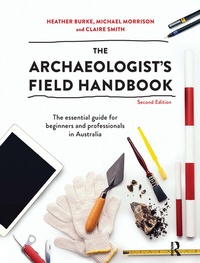
The Archaeologist's Field Handbook
The essential guide for beginners and professionals in Australia
2nd Edition
Published on 31. March 2021
Book
Hardback
536 pages
978-0-367-71969-2 (ISBN)
Description
In one volume here is everything you need to conduct fieldwork in archaeology. The Archaeologist's Field Handbook is designed for every kind of archaeological practice, from simple site recordings to professional consultancies and anyone who wants to record heritage sites responsibly.
This hands-on manual provides step-by-step instructions on how to undertake and successfully complete fieldwork in all fields of archaeology, from Indigenous to historical to landscape work. Charts, checklists, graphs, maps and diagrams clearly illustrate how to design, fund, research, map, record, interpret, photograph and write up your fieldwork.
This second edition is updated throughout and incorporates strategies for digital data capture, improved methods, recent legislation and more affordable technologies for surveying and photography. The Archaeologist's Field Handbook remains the ultimate resource for consultants, teachers, students, community groups and anyone involved in heritage fieldwork.
'An essential aid for beginners and professionals.' - Emeritus Professor John Mulvaney
'This volume has become the standard for archaeological field training ... A must for students, professionals and community groups.' - Martin Gibbs, Professor of Archaeology, University of New England
'It is absolutely the 'go to' field manual for archaeologists whatever their level within the profession.' - Jane Balme, Associate Professor of Archaeology, University of Western Australia
This hands-on manual provides step-by-step instructions on how to undertake and successfully complete fieldwork in all fields of archaeology, from Indigenous to historical to landscape work. Charts, checklists, graphs, maps and diagrams clearly illustrate how to design, fund, research, map, record, interpret, photograph and write up your fieldwork.
This second edition is updated throughout and incorporates strategies for digital data capture, improved methods, recent legislation and more affordable technologies for surveying and photography. The Archaeologist's Field Handbook remains the ultimate resource for consultants, teachers, students, community groups and anyone involved in heritage fieldwork.
'An essential aid for beginners and professionals.' - Emeritus Professor John Mulvaney
'This volume has become the standard for archaeological field training ... A must for students, professionals and community groups.' - Martin Gibbs, Professor of Archaeology, University of New England
'It is absolutely the 'go to' field manual for archaeologists whatever their level within the profession.' - Jane Balme, Associate Professor of Archaeology, University of Western Australia
More details
Edition
2nd edition
Language
English
Place of publication
London
United Kingdom
Publishing group
Taylor & Francis Ltd
Target group
Professional and scholarly
Professional Practice & Development
Dimensions
Height: 230 mm
Width: 176 mm
Weight
1150 gr
ISBN-13
978-0-367-71969-2 (9780367719692)
Copyright in bibliographic data and cover images is held by Nielsen Book Services Limited or by the publishers or by their respective licensors: all rights reserved.
Schweitzer Classification
Other editions
Additional editions
Heather Burke | Michael Morrison | Claire Smith
The Archaeologist's Field Handbook
The essential guide for beginners and professionals in Australia
Book
01/2017
2nd Edition
Allen & Unwin
€75.75
Shipment within 3-4 weeks
Persons
Heather Burke is Associate Professor in the Department of Archaeology at Flinders University, and has many years experience as a consultant archaeologist. She has participated in and directed numerous surveys and excavations for historic, prehistoric and Aboriginal sites across Australia.
Michael Morrison is a Senior Lecturer in the Department of Archaeology at Flinders University. His research focuses on Indigenous archaeology in north eastern Australia and particularly the investigation of past economic systems both in the pre-colonial and colonial periods. He has worked with a wide range of Indigenous communities on heritage management projects, both in commercial settings and in the context of community-based Indigenous land and sea management programs. He has also regularly taught courses in field and research methods, Indigenous archaeology and Indigenous heritage management at Flinders University.
Claire Smith is a Professor with the Department of Archaeology at Flinders University and a former President of the World Archaeological Congress. She is editor of the eleven-volume Encyclopedia of Global Archaeology. She specialises in rock art research and the analysis of symbolic communication and has conducted research with the remote Aboriginal community of Barunga, Northern Territory, since 1990.
Michael Morrison is a Senior Lecturer in the Department of Archaeology at Flinders University. His research focuses on Indigenous archaeology in north eastern Australia and particularly the investigation of past economic systems both in the pre-colonial and colonial periods. He has worked with a wide range of Indigenous communities on heritage management projects, both in commercial settings and in the context of community-based Indigenous land and sea management programs. He has also regularly taught courses in field and research methods, Indigenous archaeology and Indigenous heritage management at Flinders University.
Claire Smith is a Professor with the Department of Archaeology at Flinders University and a former President of the World Archaeological Congress. She is editor of the eleven-volume Encyclopedia of Global Archaeology. She specialises in rock art research and the analysis of symbolic communication and has conducted research with the remote Aboriginal community of Barunga, Northern Territory, since 1990.
Content
Figures and Tables
About The Authors
Preface
Acknowledgements
1. The Context of Archaeological Fieldwork
2. Designing Your Project
3. Maps and Navigation
4. Recording Landscapes
5. Recording Sites
6. Archaeological Surveying
7. Principles of Archaeological Photography
8. Surface Collection and Excavation
9. Recording Artefacts
10. Cultural Heritage Values and Significance
Appendix 1. The relationship between scale, measurement and the size of a feature on a drawn plan
Appendix 2. Archaeological toolkits
Appendix 3. Sample recording forms
Appendix 4. Rim diameter chart for historic ceramics
Appendix 5. Guides to dating common historical artefacts
Appendix 6. Nic Grguric's guide to dating firearms-related
Appendix 7. Guidelines for producing technical reports
References
Index
About The Authors
Preface
Acknowledgements
1. The Context of Archaeological Fieldwork
2. Designing Your Project
3. Maps and Navigation
4. Recording Landscapes
5. Recording Sites
6. Archaeological Surveying
7. Principles of Archaeological Photography
8. Surface Collection and Excavation
9. Recording Artefacts
10. Cultural Heritage Values and Significance
Appendix 1. The relationship between scale, measurement and the size of a feature on a drawn plan
Appendix 2. Archaeological toolkits
Appendix 3. Sample recording forms
Appendix 4. Rim diameter chart for historic ceramics
Appendix 5. Guides to dating common historical artefacts
Appendix 6. Nic Grguric's guide to dating firearms-related
Appendix 7. Guidelines for producing technical reports
References
Index