

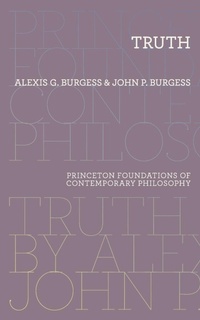
Truth
Published on 31. August 2014
Book
Paperback/Softback
176 pages
978-0-691-16367-3 (ISBN)
Description
This is a concise introduction to current philosophical debates about truth. Combining philosophical and technical material, the book is organized around, but not limited to, the view known as deflationism. In clear language, Burgess and Burgess cover a wide range of issues, including the nature of truth, the status of truth-value gaps, the relationship between truth and meaning, relativism and pluralism about truth, and semantic paradoxes from Alfred Tarski to Saul Kripke and beyond. The book provides a rich picture of contemporary philosophical theorizing about truth, one that will be essential reading for philosophy students as well as philosophers specializing in other areas.
Reviews / Votes
"Truth is remarkably succinct... Yet it covers a great amount of ground with accessible discussions of a variety of topics... [I]ntelligent and provocative."--Michael P. Lynch, Notre Dame Philosophical Reviews "Burgess and Burgess's book will be widely praised for wielding together the current approaches to truth and to paradoxes, without ceasing to be essentially introductory. Surely, this is an important achievement."--Andreas Karitzis, Metascience "Professors of philosophy, the authors have done a succinct and critical analysis of some theories of truth: deflationism, indeterminacy, insolubility, realism, and antirealism... Throughout the volume, one can see the mathematical precision of the reasoning of the concepts presented here that could be a model for all endeavours of research into complex areas of philosophy. This book could be an inspiration for further work on truth."--Prabuddha BharataMore details
Series
Language
English
Place of publication
New Jersey
United States
Target group
College/higher education
Professional and scholarly
Product notice
Paperback (trade)
Illustrations
1 table.
Dimensions
Height: 203 mm
Width: 127 mm
Thickness: 10 mm
Weight
194 gr
ISBN-13
978-0-691-16367-3 (9780691163673)
Copyright in bibliographic data and cover images is held by Nielsen Book Services Limited or by the publishers or by their respective licensors: all rights reserved.
Schweitzer Classification
Other editions
Additional editions
Alexis G. Burgess | John P. Burgess
Truth
E-Book
02/2011
1st Edition
Princeton University Press
€21.99
Available for download
Persons
Alexis G. Burgess is assistant professor of philosophy at Stanford University. He is coeditor of Metasemantics: New Essays on the Foundations of Meaning. John P. Burgess is the John N. Woodhull Professor of Philosophy at Princeton University. His books include Philosophical Logic and Fixing Frege (both Princeton).
Content
Starred (*) technical sections optional Preface xi Acknowledgments xiii CHAPTER ONE: Introduction 1 1.1 Traditional Theories 2 1.2 Contemporary Theories 4 1.3 Paradoxes 5 1.4 Plan 7 1.5 Sentences 10 1.6 Propositions 12 CHAPTER TWO: Tarski 16 2.1 "Semantic" Truth 16 2.2 Object Language vs Metalanguage 18 2.3 Recursive Definition 22 2.4* Direct Definition 24 2.5* Self-Reference 28 2.6* Model Theory 29 CHAPTER THREE: Deflationism 33 3.1 Redundancy 34 3.2 Other Radical Theories 38 3.3 Disquotation 41 3.4 Other Moderate Theories 44 3.5 Sloganeering 47 3.6 Reference 49 CHAPTER FOUR: Indeterminacy 52 4.1 Presupposition 53 4.2 Vagueness 54 4.3 Denial, Disqualification, Deviance 55 4.4 Doublespeak, Dependency, Defeatism 59 4.5 Relativity 61 4.6 Local vs Global 65 CHAPTER FIVE: Realism 68 5.1 Realism vs Deflationism 68 5.2 Correspondence Theories 70 5.3 Truthmaker Theories 72 5.4 Physicalism 74 5.5 Utility 77 5.6 Normativity 79 CHAPTER SIX: Antirealism 83 6.1 Meaning and Truth 84 6.2 Davidsonianism 87 6.3 Dummettianism vs Davidsonianism 90 6.4 Dummettianism vs Deflationism 93 6.5 Holism 96 6.6 Pluralism 97 CHAPTER SEVEN: Kripke 102 7.1 Kripke vs Tarski 103 7.2 The Minimum Fixed Point 105 7.3 Ungroundedness 107 7.4* The Transfinite Construction 109 7.5* Revision 112 7.6* Axiomatics 113 CHAPTER EIGHT: Insolubility? 116 8.1 Paradoxical Reasoning 116 8.2 "Revenge" 118 8.3 Logical "Solutions" 120 8.4 "Paraconsistency" 123 8.5 Contextualist "Solutions" 124 8.6 Inconsistency Theories 127 Further Reading 135 Bibliography 143 Index 153