

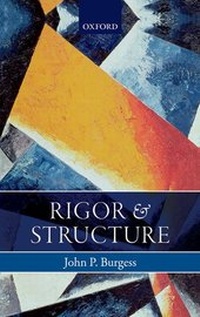
Rigor and Structure
Published on 12. February 2015
Book
Hardback
228 pages
978-0-19-872222-9 (ISBN)
Description
While we are commonly told that the distinctive method of mathematics is rigorous proof, and that the special topic of mathematics is abstract structure, there has been no agreement among mathematicians, logicians, or philosophers as to just what either of these assertions means. John P. Burgess clarifies the nature of mathematical rigor and of mathematical structure, and above all of the relation between the two, taking into account some of the latest developments in mathematics, including the rise of experimental mathematics on the one hand and computerized formal proofs on the other hand. The main theses of Rigor and Structure are that the features of mathematical practice that a large group of philosophers of mathematics, the structuralists, have attributed to the peculiar nature of mathematical objects are better explained in a different way, as artefacts of the manner in which the ancient ideal of rigor is realized in modern mathematics. Notably, the mathematician must be very careful in deriving new results from the previous literature, but may remain largely indifferent to just how the results in the previous literature were obtained from first principles. Indeed, the working mathematician may remain largely indifferent to just what the first principles are supposed to be, and whether they are set-theoretic or category-theoretic or something else. Along the way to these conclusions, a great many historical developments in mathematics, philosophy, and logic are surveyed. Yet very little in the way of background knowledge on the part of the reader is presupposed.
Reviews / Votes
This book is a delight to read... As a pioneering work in this new field, Rigor and Structure makes a solid impression. * Toby Meadows, Australasian Journal of Philosophy * John Burges' Rigor and Structure is an enjoyable read. Given the weight of its topics, it is almost breezy ... the book is overall quite thought provoking, insightful, and carefully written. It should not be overlooked by philosophers of mathematics who want to make sure that they are asking the questions that are most interesting to contemporary mathematics. * Mark Zelcer, Metascience * It will be no surprise to those familiar with Burgesss other work that this book is written with exceptional clarity. And it is packed full of Burgesss astute insights into the history of mathematics and its current practice... Overall, mathematicians and philosophers alike will gain much from Burgesss specific insights about particular parts of mathematical practice; but they will also find his larger picture of modern mathematics extremely illuminating. * Richard Pettigrew, Philosophia Mathematica * Burgess knows his subject matter well, and his clear and engaging writing makes his prose a pleasure to read. * A. C. Paseau, British Journal for the Philosophy of Science *More details
Language
English
Place of publication
Oxford
United Kingdom
Target group
College/higher education
Dimensions
Height: 222 mm
Width: 148 mm
Thickness: 20 mm
Weight
438 gr
ISBN-13
978-0-19-872222-9 (9780198722229)
Copyright in bibliographic data and cover images is held by Nielsen Book Services Limited or by the publishers or by their respective licensors: all rights reserved.
Schweitzer Classification
Other editions
Additional editions
Person
John P. Burgess joined the philosophy department at Princeton University shortly after receiving his Ph.D. in logic from Berkeley, and has remained there ever since, serving for many years as director of undergraduate studies. He is the author or co-author of seven previous books and over a hundred papers and reviews in mathematical and philosophical logic, philosophy of mathematics and of language, and history of analytic philosophy.
Content
Preface ; Acknowledgments ; 1. Rigor and Rigorization ; 2. Rigor and Foundations ; 3. Structure and Structuralism ; 4. Structure and Foundations ; Bibliography