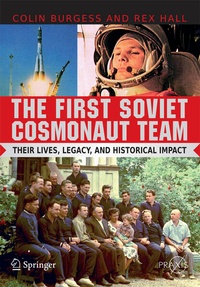
The First Soviet Cosmonaut Team will relate who these men were and offer far more extensive background stories, in addition to those of the more familiar names of early Soviet space explorers from that group. Many previously-unpublished photographs of these "missing" candidates will also be included for the first time in this book. It will be a detailed, but highly readable and balanced account of the history, training and experiences of the first group of twenty cosmonauts of the USSR. A covert recruitment and selection process was set in motion throughout the Soviet military in August 1959, just prior to the naming of America's Mercury astronauts. Those selected were ordered to report for training at a special camp outside of Moscow in the spring of 1960. Just a year later, Senior Lieutenant Yuri Gagarin of the Soviet Air Force (promoted in flight to the rank of major) was launched aboard a Vostok spacecraft and became the first person ever to achieve space flight and orbit the Earth.
Reviews / Votes
From the reviews:"In this book . Burgess (Australian spaceflight historian) and Hall (British education consultant) provide a wealth of interesting information on the first group of 20 Soviet cosmonauts. . Like the first American astronauts, the cosmonauts interacted in both a cooperative and competitive manner. . The book includes many photographs of the cosmonauts in training and in their personal lives, as well as some recent images of the few surviving members from the original group. Summing Up: Recommended. All undergraduate and public libraries." (J. Z. Kiss, Choice, Vol. 46 (10), June, 2009)"This is a much needed reference work on the early history of the Soviet cosmonaut team. The authors have done an exemplary job in putting together a vast amount of information into a coherent volume that will undoubtedly be of great use for future researchers. That the pictures in this volume are of the highest quality only adds to its value." (Asif Siddiqi, Quest, Vol. 18 (4), 2011)
Series
Edition
Language
Place of publication
Target group
Illustrations
170 s/w Abbildungen
356 p. 170 illus.
Dimensions
Height: 242 mm
Width: 170 mm
Thickness: 24 mm
Weight
ISBN-13
978-0-387-84823-5 (9780387848235)
DOI
10.1007/978-0-387-84824-2
Schweitzer Classification
David Shayler has been writing books for Springer-Praxis for over 18 years, with a total of 25 authored or coauthored titles for the series. These have ranged from various aspects of American and Russian manned spaceflight history and operations to topics on women in space, the human exploration of Mars and the development of EVA techniques and operations. He has a passion for recording the lives and careers of the world's space explorers. He has been a member of the British Interplanetary Society for over 40 years and currently is a serving Council Member. He also organized and hosted the annual Sino-Chinese Technical Forum and is currently organizing two extra Forums for next year on the topic of Space Rescue and Safety and 20 years of ISS Operations. Dave is a guest editor of the annual BIS JBIS Space Chronicle issue on Sino and Chinese Technical Forums and has contributed to a number of BIS Publications. His work has been published in the UK in Spaceflight, and Spaceflight News, and in the United States under Macmillan's Who's Who in Space trilogy as well as the Magill Science Survey and the MPress Secrets of the Universe Card Collection. A number of his titles and published articles have been referenced in other books, journals and official NASA publications.Colin Burgess's early books were on the Australian prisoner-of-war experience, before he turned his efforts to writing about his principal interest: human space exploration. Colin has written a number of books on the subject for the University of Nebraska Press and Springer-Praxis. The books he has written or coauthored for Springer-Praxis are "NASA's Scientist-Astronauts," "Animals in Space," "The First Soviet Cosmonaut Team," "Selecting the Mercury Seven," "Moon Bound," "Freedom 7," "Liberty Bell 7" "Friendship 7" and "Aurora 7." More recently, he has written about the Interkosmos program and a history of NASA's Group 5 and 7 astronauts with coauthor David Shayler.
Sparking the Space Age.- A few good Soviet men.- Russia's future spacemen.- Training days.- Selecting the first cosmonaut.- "Poyekhali": A man in space.- Vostok flights continue.- The "missing" cosmonauts: Rumour and reality.- First woman of space.- A tragedy, and Gagarin's final flight.- Pushing the limits.- Orbits of co-operation and the end of an era.