


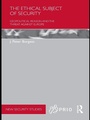
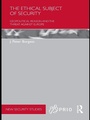
The Ethical Subject of Security
Geopolitical Reason and the Threat Against Europe
1st Edition
Published on 7. February 2011
Book
Paperback/Softback
238 pages
978-0-415-49981-1 (ISBN)
Description
While critical security studies largely concentrates on objects of security, this book focuses on the subject position from which 'securitization' and other security practices take place.
First, it argues that the modern subject itself emerges and is sustained as a function of security and insecurity. It suggests, consequently, that no analytic frame can produce or reproduce the subject in some original or primordial form that does not already reproduce a fundamental or structural insecurity. It critically returns, through a variety of studies, to traditionally held conceptions of security and insecurity as simple predicates or properties that can be associated or not to some more essential, more primeval, more true or real subject. It thus opens and explores the question of the security of the subject itself, locating, through a reconstruction of the foundations of the concept of security, in the modern conception of the subject, an irreducible insecurity.
Second, it argues that practices of security can only be carried out as a certain kind of negotiation about values. The analyses in this book find security expressed again and again as a function of value cast in terms of an explicit or implicit philosophy of life, of culture, of individual and collective anxieties and aspirations, of expectations about what may be sacrificed and what is worth preserving. By way of a critical examination of the value function of security, this book discovers the foundation of values as dependent on a certain management of their own vulnerability, continuously under threat, and thus fundamentally and necessarily insecure.
This book will be an indispensible resource for students of Critical Security Studies, Political Theory, Philosophy, Ethics and International Relations in general.
First, it argues that the modern subject itself emerges and is sustained as a function of security and insecurity. It suggests, consequently, that no analytic frame can produce or reproduce the subject in some original or primordial form that does not already reproduce a fundamental or structural insecurity. It critically returns, through a variety of studies, to traditionally held conceptions of security and insecurity as simple predicates or properties that can be associated or not to some more essential, more primeval, more true or real subject. It thus opens and explores the question of the security of the subject itself, locating, through a reconstruction of the foundations of the concept of security, in the modern conception of the subject, an irreducible insecurity.
Second, it argues that practices of security can only be carried out as a certain kind of negotiation about values. The analyses in this book find security expressed again and again as a function of value cast in terms of an explicit or implicit philosophy of life, of culture, of individual and collective anxieties and aspirations, of expectations about what may be sacrificed and what is worth preserving. By way of a critical examination of the value function of security, this book discovers the foundation of values as dependent on a certain management of their own vulnerability, continuously under threat, and thus fundamentally and necessarily insecure.
This book will be an indispensible resource for students of Critical Security Studies, Political Theory, Philosophy, Ethics and International Relations in general.
More details
Series
Language
English
Place of publication
London
United Kingdom
Publishing group
Taylor & Francis Ltd
Target group
College/higher education
Professional and scholarly
Product notice
Paperback (UK-B)
Dimensions
Height: 234 mm
Width: 156 mm
Weight
385 gr
ISBN-13
978-0-415-49981-1 (9780415499811)
Copyright in bibliographic data and cover images is held by Nielsen Book Services Limited or by the publishers or by their respective licensors: all rights reserved.
Schweitzer Classification
Other editions
Additional editions
E-Book
02/2011
Routledge
€72.49
Available for download
E-Book
02/2011
Routledge
€72.49
Available for download

Book
02/2011
1st Edition
Routledge
€223.21
Shipment within 15-20 days
Person
J. Peter Burgess is Research Professor at PRIO, the Peace Research Institute Oslo, where he leads the Security Programme and edits the interdisciplinary peer-reviewed journal Security Dialogue, and Senior Research Fellow at the Institute for European Studies of the Vrije Universiteit Brussels.
Content
Introduction: Security as Ethos and Episteme Part 1: Theory of the Ethical Subject 1. Nietzsche, or Value and the Subject of Security 2. Foucault, or Genealogy of the Ethical Subject 3. Lacan, or the Ethical Subject of the Real 4. Butler, or the Precarious Subject Part 2: Holding Together 5. Identity, Community and Security 6. Insecurity of the European Community of Values 7. Psychoanalysis of the National Thing 8. Security Clture and the New Ethos of Risk 9. Intolerable Insecurity Part 3: Geopolitical Rationalities of Europe 10. The Modernity of a Cosmopolitan Europe 11. The New Nomos of Europe 12. A Federalist Europe between Economic and Cultural Value 13. Justice in Political, Legal and Moral Community 14. War in the Name of Europe and the Legitimacy of Collective Violence. Conclusion: The Many Faces of European Security