

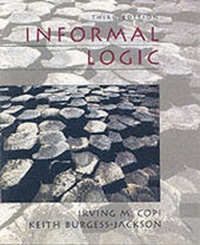
Informal Logic
3rd Edition
Published on 7. December 1995
Book
Paperback/Softback
336 pages
978-0-13-229048-7 (ISBN)
Description
Appropriate for single-semester undergraduate courses in Critical Thinking, Informal Logic, Introduction to Logic, Communication, Science and Human Values, Rhetoric and Logic.
The aim of Informal Logic, Third Edition is to teach basic critical, analytical and reasoning skills through the examination of arguments and explanations as they appear in natural language. While retaining the topical organization of the previous edition, much of the text has been rewritten to expand coverage and enhance clarity.
The aim of Informal Logic, Third Edition is to teach basic critical, analytical and reasoning skills through the examination of arguments and explanations as they appear in natural language. While retaining the topical organization of the previous edition, much of the text has been rewritten to expand coverage and enhance clarity.
More details
Other editions
Previous edition

Irving M. Copi | Keith Burgess-Jackson
Informal Logic
Book
01/1992
2nd Edition
Macmillan USA
€60.80
Article exhausted; check for reprint
Content
1. Introduction.
The nature and utility of logic. Premises and conclusions. Diagrams for single arguments. Recognizing arguments. Passages expressing several arguments. Deduction and Induction. Truth, validity, and soundness. The use of reason in problem solving.
2. Language.
Functions of language. Discourse serving multiple functions. Forms of discourse. Emotive words. Kinds of agreement and disagreement. Emotively neutral language.
3. Fallacies.
The nature and classification of fallacies. Common informal fallacies. Passages for analysis.
4. Definition.
Purposes of definition. Types of definition. Kinds of meaning. Techniques for defining. Rules for definition by genus and difference.
5. Analogy.
Uses of analogy. Evaluating analogical arguments. Refutation by logical analogy.
6. Causal Connections: Mill's Methods of Experimental Inquiry.
The nature of causation. Mill's methods. The alleged circularity of Mill's methods.
7. Science and Hypothesis.
Values and disvalues of science. Explanations: scientific and nonscientific. Evaluating scientific explanations. The detective as scientist. Scientists in action: the pattern of scientific investigation. Crucial experiments and ad hoc hypotheses. Classification as hypothesis.
Solutions to Selected Exercises.
Index.
The nature and utility of logic. Premises and conclusions. Diagrams for single arguments. Recognizing arguments. Passages expressing several arguments. Deduction and Induction. Truth, validity, and soundness. The use of reason in problem solving.
2. Language.
Functions of language. Discourse serving multiple functions. Forms of discourse. Emotive words. Kinds of agreement and disagreement. Emotively neutral language.
3. Fallacies.
The nature and classification of fallacies. Common informal fallacies. Passages for analysis.
4. Definition.
Purposes of definition. Types of definition. Kinds of meaning. Techniques for defining. Rules for definition by genus and difference.
5. Analogy.
Uses of analogy. Evaluating analogical arguments. Refutation by logical analogy.
6. Causal Connections: Mill's Methods of Experimental Inquiry.
The nature of causation. Mill's methods. The alleged circularity of Mill's methods.
7. Science and Hypothesis.
Values and disvalues of science. Explanations: scientific and nonscientific. Evaluating scientific explanations. The detective as scientist. Scientists in action: the pattern of scientific investigation. Crucial experiments and ad hoc hypotheses. Classification as hypothesis.
Solutions to Selected Exercises.
Index.