

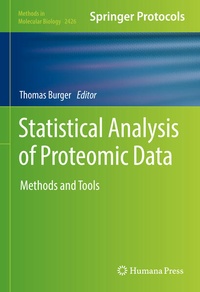
Statistical Analysis of Proteomic Data
Methods and Tools
Published on 30. October 2022
Book
Hardback
XI, 393 pages
978-1-0716-1966-7 (ISBN)
Description
This book explores the most important processing steps of proteomics data analysis and presents practical guidelines, as well as software tools, that are both user-friendly and state-of-the-art in chemo- and biostatistics. Beginning with methods to control the false discovery rate (FDR), the volume continues with chapters devoted to software suites for constructing quantitation data tables, missing value related issues, differential analysis software, and more. Written for the highly successful
Methods in Molecular Biology
series, chapters include the kind of detail and implementation advice that leads to successful results.
Authoritative and practical, Statistical Analysis of Proteomic Data: Methods and Tools serves as an ideal guide for proteomics researchers looking to extract the best of their data with state-of-the art tools while also deepening their understanding of data analysis.
Authoritative and practical, Statistical Analysis of Proteomic Data: Methods and Tools serves as an ideal guide for proteomics researchers looking to extract the best of their data with state-of-the art tools while also deepening their understanding of data analysis.
More details
Series
Edition
2022 ed.
Language
English
Place of publication
New York
United States
Target group
Professional and scholarly
Illustrations
50 s/w Abbildungen, 477 farbige Abbildungen
XI, 393 p. 527 illus., 477 illus. in color.
Dimensions
Height: 260 mm
Width: 183 mm
Thickness: 28 mm
Weight
961 gr
ISBN-13
978-1-0716-1966-7 (9781071619667)
DOI
10.1007/978-1-0716-1967-4
Schweitzer Classification
Other editions
Additional editions
Book
10/2023
Springer
€171.19
Shipment within 15-20 days
E-Book
10/2022
Humana
€160.49
Available for download
Content
Unveiling the Links between Peptide Identification and Differential Analysis FDR Controls by Means of a Practical Introduction to Knockoff Filters.- A Pipeline for Peptide Detection Using Multiple Decoys.- Enhanced Proteomic Data Analysis with MetaMorpheus.- Validation of MS/MS Identifications and Label-Free Quantification Using Proline.- Integrating Identification and Quantification Uncertainty for Differential Protein Abundance Analysis with Triqler.- Left-Censored Missing Value Imputation Approach for MS-Based Proteomics Data with Gsimp.- Towards a More Accurate Differential Analysis of Multiple Imputed Proteomics Data with mi4limma.- Uncertainty Aware Protein-Level Quantification and Differential Expression Analysis of Proteomics Data with seaMass.- Statistical Analysis of Quantitative Peptidomics and Peptide-Level Proteomics Data with Prostar.- msmsEDA and msmsTests: Label-Free Differential Expression by Spectral Counts.- Exploring Protein Interactome Data with IPinquiry: Statistical Analysis and Data Visualization by Spectral Counts.- Statistical Analysis of Post-Translational Modifications Quantified by Label-Free Proteomics Across Multiple Biological Conditions with R: Illustration from SARS-CoV-2 Infected Cells.- Fast, Free, and Flexible Peptide and Protein Quantification with FlashLFQ.- Robust Prediction and Protein Selection with Adaptive PENSE.- Multivariate Analysis with the R Package mixOmics.- Integrating Multiple Quantitative Proteomic Analyses Using MetaMSD.- Application of WGCNA and PloGO2 in the Analysis of Complex Proteomic Data.