

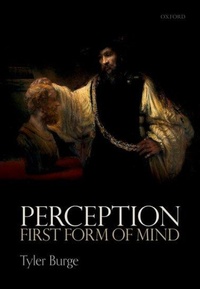
Perception: First Form of Mind
Published on 13. May 2022
Book
Hardback
898 pages
978-0-19-887100-2 (ISBN)
Description
In Perception: First Form of Mind, Tyler Burge develops an understanding of the most primitive type of mental representational: perception. Focusing on the functions and capacities of perceptual states, Burge accounts for their representational content and structure, and develops a formal semantics for them. The discussion explains the role of iconic format in the structure. It also situates the accounts of content, structure, and semantics within scientific explanations of perceptual-state formation, emphasizing formation of perceptual categorization. In the book's second half, Burge discusses what a perceptual system is. Exploration of relations between perception and other primitive capacities-conation, attention, memory, anticipation, affect, learning, and imagining-helps distinguish perceiving, with its associated capacities, from thinking, with its associated capacities. Drawing mainly on vision science, not introspection, Perception: First Form of Mind is a rigorous, agenda-setting work in philosophy of perception and philosophy of science.
More details
Language
English
Place of publication
Oxford
United Kingdom
Target group
Professional and scholarly
Dimensions
Height: 180 mm
Width: 254 mm
Thickness: 50 mm
Weight
1800 gr
ISBN-13
978-0-19-887100-2 (9780198871002)
Copyright in bibliographic data and cover images is held by Nielsen Book Services Limited or by the publishers or by their respective licensors: all rights reserved.
Schweitzer Classification
Other editions
Additional editions
Tyler Burge
Perception: First Form of Mind
E-Book
05/2022
1st Edition
OUP eBook
€24.99
Available for download
Tyler Burge
Perception: First Form of Mind
E-Book
05/2022
1st Edition
OUP eBook
€24.99
Available for download
Person
Tyler Burge is Flint Professor of Philosophy, UCLA, where has taught since 1971. He has held visiting positions at Harvard, MIT, Stanford, Munich, Bayreuth, Bologna, and Zurich. He has delivered numerous named lecture series, including the Locke Lectures, Dewey Lectures, Whitehead Lectures, Kant Lectures, Petrus Hispanus Lectures, and Nicod Lectures. His work has made contributions to philosophy of mind, philosophy of psychologyepistemology, philosophy of language, philosophy of logic, and the history of philosophy. He has published four books with OUP: Origins of Objectivity (2010) and three volumes of essays, Truth, Thought, Reason (2005), Foundations of Mind (2007), and Cognition through Understanding (2013).
Content
Preface
Part I: Perception
1: Introduction
2: Perception
3: Perceptual Constancy: A Central Psychological Natural Kind
Part II: Form
4: Some Basics about Perception and Perceptual Systems
5: Perceptual Reference Requires Perceptual Attribution
6: Form and Semantics of Perceptual Representational Contents
7: Perceptual Attributives and Referential Applications in Perceptual Constancies
8: Egocentric Indexing in Perceptual Spatial and Temporal Frameworks
9: The Iconic Nature of Perception
Part III: Formation
10: First-formed Perception
11: Intra-saccadic Perception and Recurrent Processing
12: Further Attributives: Primitive Attribution of Causation, Agency
Part IV: System
13: Perceptual-level Representation and Categorization
14: Perceptual-level Conation and Relatively Primitive, Perceptually Guided Action
15: Perceptual Attention
16: Perceptual Memory I: Shorter Term Systems
17: Perceptual Memory II: Visual Perceptual Long-Term Memory
18: Perceptual Learning, Perceptual Anticipation, Perceptual Imagining
19: Perception and Cognition
20: Conclusion
Part I: Perception
1: Introduction
2: Perception
3: Perceptual Constancy: A Central Psychological Natural Kind
Part II: Form
4: Some Basics about Perception and Perceptual Systems
5: Perceptual Reference Requires Perceptual Attribution
6: Form and Semantics of Perceptual Representational Contents
7: Perceptual Attributives and Referential Applications in Perceptual Constancies
8: Egocentric Indexing in Perceptual Spatial and Temporal Frameworks
9: The Iconic Nature of Perception
Part III: Formation
10: First-formed Perception
11: Intra-saccadic Perception and Recurrent Processing
12: Further Attributives: Primitive Attribution of Causation, Agency
Part IV: System
13: Perceptual-level Representation and Categorization
14: Perceptual-level Conation and Relatively Primitive, Perceptually Guided Action
15: Perceptual Attention
16: Perceptual Memory I: Shorter Term Systems
17: Perceptual Memory II: Visual Perceptual Long-Term Memory
18: Perceptual Learning, Perceptual Anticipation, Perceptual Imagining
19: Perception and Cognition
20: Conclusion