

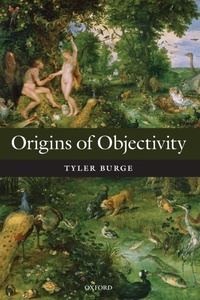
Origins of Objectivity
Published on 4. March 2010
Book
Paperback/Softback
656 pages
978-0-19-958139-9 (ISBN)
Description
Tyler Burge presents a substantial, original study of what it is for individuals to represent the physical world with the most primitive sort of objectivity. By reflecting on the science of perception and related psychological and biological sciences, he gives an account of constitutive conditions for perceiving the physical world, and thus aims to locate origins of representational mind. Origins of Objectivity illuminates several long-standing, central issues in philosophy, and provides a wide-ranging account of relations between human and animal psychologies.
Reviews / Votes
penetrating. No serious researcher in these fields can afford not to read Origins. * Robert W. Lurz, Philosophical Psychology *More details
Language
English
Place of publication
Oxford
United Kingdom
Target group
College/higher education
Professional and scholarly
Dimensions
Height: 234 mm
Width: 156 mm
Thickness: 35 mm
Weight
966 gr
ISBN-13
978-0-19-958139-9 (9780199581399)
Copyright in bibliographic data and cover images is held by Nielsen Book Services Limited or by the publishers or by their respective licensors: all rights reserved.
Schweitzer Classification
Other editions
Additional editions
Tyler Burge
Origins of Objectivity
Book
03/2010
Oxford University Press
€238.20
Shipment within 15-20 days
Person
Tyler Burge is Distinguished Professor of Philosophy at the University of California, Los Angeles. He is the author of Truth, Thought, Reason: Essays on Frege (OUP, 2005) and Foundations of Mind (OUP, 2007).
Content
Preface ; PART I ; 1. Introduction ; 2. Basic Terminology: What the Questions Mean ; 3. Anti-Individualism ; PART II ; 4. Individual Representationalism in the Twentieth Century's First Half ; 5. Individual Representationalism after Mid-Century: Preliminaries ; 6. Neo-Kantian Individual Representationalism: Strawson and Evans ; 7. Language Interpretation and Individual Representationalism: Quine and Davidson ; PART III ; 8. Biological and Methodological Backgrounds ; 9. Origins ; 10. Origins of Some Representational Categories ; 11. Glimpses Forward