

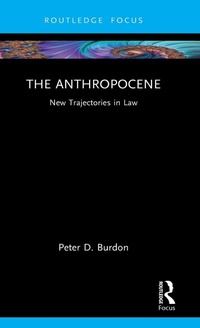
The Anthropocene
New Trajectories in Law
1st Edition
Published on 24. May 2023
Book
Hardback
110 pages
978-0-367-48665-5 (ISBN)
Description
This book introduces the concept of the Anthropocene and examines its importance for environmental legal thinking, research and practice.
Two main arguments are explored. The first is that much of the scholarship in environmental law that addresses the Anthropocene does not respond to Earth systems science or the difference in scale as we move from local to global systems. Key examples include a focus on anthropocentrism, attempts to constitutionalise environmental protections, the prevalence of legal rights and the idea of ecological integrity. The second argument is that these points of focus derive from the prevalence of idealism in environmental legal scholarship. Idealism in this context does not refer to naivety or the presentation of unrealistic goals. Rather, this book is concerned with idealism as a philosophical commitment to the power of ideas to determine reality and drive future change. As expressed in legal scholarship, this book also argues that idealism involves an abstraction from material reality and a refusal to directly engage those forces that have given rise to the Anthropocene. In response, this book uses a method of critique to uncover the presumptions and presuppositions that underlie environmental scholarship. As a counter to idealism, it also sketches out a framework for materialism in the Anthropocene.
This book's engagement with these questions will appeal to undergraduate and postgraduate students in law, politics, philosophy or the ecological humanities. It will also be of interest to academics in these disciplines and libraries around the world.
Two main arguments are explored. The first is that much of the scholarship in environmental law that addresses the Anthropocene does not respond to Earth systems science or the difference in scale as we move from local to global systems. Key examples include a focus on anthropocentrism, attempts to constitutionalise environmental protections, the prevalence of legal rights and the idea of ecological integrity. The second argument is that these points of focus derive from the prevalence of idealism in environmental legal scholarship. Idealism in this context does not refer to naivety or the presentation of unrealistic goals. Rather, this book is concerned with idealism as a philosophical commitment to the power of ideas to determine reality and drive future change. As expressed in legal scholarship, this book also argues that idealism involves an abstraction from material reality and a refusal to directly engage those forces that have given rise to the Anthropocene. In response, this book uses a method of critique to uncover the presumptions and presuppositions that underlie environmental scholarship. As a counter to idealism, it also sketches out a framework for materialism in the Anthropocene.
This book's engagement with these questions will appeal to undergraduate and postgraduate students in law, politics, philosophy or the ecological humanities. It will also be of interest to academics in these disciplines and libraries around the world.
More details
Series
Language
English
Place of publication
London
United Kingdom
Publishing group
Taylor & Francis Ltd
Target group
College/higher education
Academic, Postgraduate, and Undergraduate
Dimensions
Height: 222 mm
Width: 145 mm
Thickness: 10 mm
Weight
290 gr
ISBN-13
978-0-367-48665-5 (9780367486655)
Copyright in bibliographic data and cover images is held by Nielsen Book Services Limited or by the publishers or by their respective licensors: all rights reserved.
Schweitzer Classification
Other editions
Additional editions
Book
10/2024
1st Edition
Routledge
€33.00
Shipment within 10-20 days
E-Book
05/2023
1st Edition
Routledge
€27.49
Available for download
E-Book
05/2023
1st Edition
Routledge
€27.49
Available for download
Person
Peter D. Burdon is Associate Professor at Adelaide Law School, University of Adelaide, Australia.
Content
1. The Anthropocene Rupture 2. A New Anthropocentrism 3. Eco-Constitutionalism 4. Rights and Obligations 5. Ecological Integrity 6. Materialism in the Anthropocene