

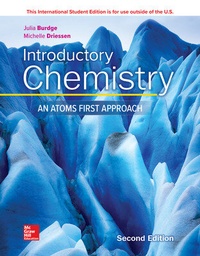
ISE Introductory Chemistry: An Atoms First Approach
2nd Edition
Published on 29. March 2019
Book
Paperback/Softback
626 pages
978-1-260-56586-7 (ISBN)
Description
From its very origin, Introductory Chemistry: An Atoms First Approach by Julia Burdge and Michelle Driessen has been developed and written using an atoms-first approach specific to introductory chemistry. It is not a pared down version of a general chemistry text, but carefully crafted with the introductory-chemistry student in mind.The ordering of topics facilitates the conceptual development of chemistry for the novice, rather than the historical development that has been used traditionally. Its language and style are student-friendly and conversational; and the importance and wonder of chemistry in everyday life are emphasized at every opportunity. Continuing in the Burdge tradition, this text employs an outstanding art program, a consistent problem-solving approach, interesting applications woven throughout the chapters, and a wide range of end-of-chapter problems.
More details
Edition
2nd edition
Language
English
Place of publication
OH
United States
Target group
College/higher education
US School Grade: From College Freshman to College Graduate Student
Illustrations
960 Illustrations
Dimensions
Height: 274 mm
Width: 216 mm
Thickness: 20 mm
Weight
1089 gr
ISBN-13
978-1-260-56586-7 (9781260565867)
Copyright in bibliographic data and cover images is held by Nielsen Book Services Limited or by the publishers or by their respective licensors: all rights reserved.
Schweitzer Classification
Persons
Dr. Julia Burdge did most of her undergraduate work at Iowa State University, completing her bachelor's degree and Master's degree in inorganic chemistry at the University of South Florida in Tampa. She earned her Ph.D. in analytical chemistry at the University of Idaho. Her Master's and doctoral research involved the development of chemotherapeutic analogs of cisplatin and the development of instruments and methods for measuring ultra-trace concentrations of atmospheric sulfur compounds. Over the past 20 years, she has taught introductory and advanced courses in every division of the undergraduate chemistry curriculum, as well as interdisciplinary courses. She also developed and taught a new introductory chemistry course for pre-service science teachers, and initiated and served as a mentor in a future faculty development program for graduate students and post-doctoral associates. She is currently affiliated with the University of Idaho.
Content
Chapter 1 Atoms and Elements
1.1 The Study of Chemistry
1.2 Atoms First
1.3 Subatomic Particles and the Nuclear Model of the Atom
1.4 Elements and the Periodic Table
1.5 Organization of the Periodic Table
1.6 Isotopes
1.7 Atomic Mass
Chapter 2 Electrons and the Periodic Table
2.1 The Nature of Light
2.2 The Bohr Atom
2.3 Atomic Orbitals
2.4 Electron Configurations
2.5 Electron Configurations and the Periodic Table
2.6 Periodic Trends
2.7 Ions: The Loss and Gain of Electrons
Chapter 3 Compounds and Chemical Bonds
3.1 Matter: Classification and Properties
3.2 Ionic Bonding and Binary Ionic Compounds
3.3 Naming Ions and Binary Ionic Compounds
3.4 Covalent Bonding and Molecules
3.5 Naming Binary Molecular Compounds
3.6 Covalent Bonding in Ionic Species: Polyatomic Ions
3.7 Acids
3.8 Substances in Review
Chapter 4 How Chemists Use Numbers
4.1 Units of Measurement
4.2 Scientific Notation
4.3 Significant Figures
4.4 Unit Conversion
4.5 Success in Introductory Chemistry Class
Chapter 5 The Mole and Chemical Formulas
5.1 Counting Atoms by Weighing
5.2 Counting Molecules by Weighing
5.3 Mass Percent Composition
5.4 Using Mass Percent Composition to Determine Empirical Formula
5.5 Using Empirical Formula and Molar Mass to Determine Molecular Formula
Chapter 6 Molecular Shape
6.1 Drawing Simple Lewis Structures
6.2 Lewis Structures Continued
6.3 Resonance Structures
6.4 Molecular Shape
6.5 Electronegativity & Polarity
6.6 Intermolecular Forces
Chapter 7 Solids, Liquids, and Phase Changes
7.1 General Properties of the Condensed Phases
7.2 Types of Solids
7.3 Physical Properties of Solids
7.4 Physical Properties of Liquids
7.5 Energy and Physical Changes
Chapter 8 Gases
8.1 Properties of Gases
8.2 Pressure
8.3 The Gas Equations
8.4 The Gas Laws
8.5 Gas Mixtures
Chapter 9 Physical Properties of Solutions
9.1 General Properties of Solutions
9.2 Aqueous Solubility
9.3 Solution Concentration
9.4 Solution Composition
9.5 Solution Preparation
9.6 Colligative Properties
Chapter 10 Chemical Reactions and Chemical Equations
10.1 Recognizing Chemical Reactions
10.2 Representing Chemical Reactions with Chemical Equations
10.3 Balancing Chemical Equations
10.4 Types of Chemical Reactions
10.5 Chemical Reactions and Energy
10.6 Chemical Reactions in Review
Chapter 11 Using Balanced Chemical Equations
</
1.1 The Study of Chemistry
1.2 Atoms First
1.3 Subatomic Particles and the Nuclear Model of the Atom
1.4 Elements and the Periodic Table
1.5 Organization of the Periodic Table
1.6 Isotopes
1.7 Atomic Mass
Chapter 2 Electrons and the Periodic Table
2.1 The Nature of Light
2.2 The Bohr Atom
2.3 Atomic Orbitals
2.4 Electron Configurations
2.5 Electron Configurations and the Periodic Table
2.6 Periodic Trends
2.7 Ions: The Loss and Gain of Electrons
Chapter 3 Compounds and Chemical Bonds
3.1 Matter: Classification and Properties
3.2 Ionic Bonding and Binary Ionic Compounds
3.3 Naming Ions and Binary Ionic Compounds
3.4 Covalent Bonding and Molecules
3.5 Naming Binary Molecular Compounds
3.6 Covalent Bonding in Ionic Species: Polyatomic Ions
3.7 Acids
3.8 Substances in Review
Chapter 4 How Chemists Use Numbers
4.1 Units of Measurement
4.2 Scientific Notation
4.3 Significant Figures
4.4 Unit Conversion
4.5 Success in Introductory Chemistry Class
Chapter 5 The Mole and Chemical Formulas
5.1 Counting Atoms by Weighing
5.2 Counting Molecules by Weighing
5.3 Mass Percent Composition
5.4 Using Mass Percent Composition to Determine Empirical Formula
5.5 Using Empirical Formula and Molar Mass to Determine Molecular Formula
Chapter 6 Molecular Shape
6.1 Drawing Simple Lewis Structures
6.2 Lewis Structures Continued
6.3 Resonance Structures
6.4 Molecular Shape
6.5 Electronegativity & Polarity
6.6 Intermolecular Forces
Chapter 7 Solids, Liquids, and Phase Changes
7.1 General Properties of the Condensed Phases
7.2 Types of Solids
7.3 Physical Properties of Solids
7.4 Physical Properties of Liquids
7.5 Energy and Physical Changes
Chapter 8 Gases
8.1 Properties of Gases
8.2 Pressure
8.3 The Gas Equations
8.4 The Gas Laws
8.5 Gas Mixtures
Chapter 9 Physical Properties of Solutions
9.1 General Properties of Solutions
9.2 Aqueous Solubility
9.3 Solution Concentration
9.4 Solution Composition
9.5 Solution Preparation
9.6 Colligative Properties
Chapter 10 Chemical Reactions and Chemical Equations
10.1 Recognizing Chemical Reactions
10.2 Representing Chemical Reactions with Chemical Equations
10.3 Balancing Chemical Equations
10.4 Types of Chemical Reactions
10.5 Chemical Reactions and Energy
10.6 Chemical Reactions in Review
Chapter 11 Using Balanced Chemical Equations
</