

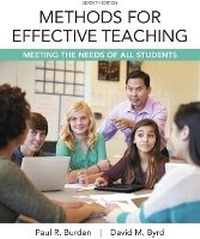
Methods for Effective Teaching
Meeting the Needs of All Students, Loose-Leaf Version
7th Edition
Published on 8. June 2015
Book
Mixed media product
408 pages
978-0-13-398669-3 (ISBN)
Description
Note: This is the loose-leaf version of Methods for Effective Teachingand does not include access to the Enhanced Pearson eText. To order the Enhanced Pearson eText packaged with the loose-leaf version, use ISBN 0134057589,
Comprehensive, research-based, and straightforward, Methods for Effective Teaching provides K-12 teachers the help they need in every aspect of their day-to-day responsibilities, from planning and choosing the right instructional strategies to delivering lessons, managing the classroom, disciplining students, assessing progress, and collaborating with colleagues and parents. All of the content presented in this straightforward guide is aligned to professional standards, including the InTASC standards, and this new, up-to-date edition covers such contemporary issues as Common Core curriculum, 21st century skills, response to intervention (RTI), data-driven decision making, classroom contextual factors, bullying, problem-based strategies, and achievement tests. Strong coverage of both teacher-centered and student-centered strategies is provided and the authors address ways to differentiate instruction, promote student thinking, and actively engage students in learning. Included are approaches for teaching English language learners, an emphasis on culturally responsive teaching, and a variety of pedagogical features to accommodate different learning styles. The Enhanced Pearson eText features embedded video.
Improve mastery and retention with the Enhanced Pearson eText*
The Enhanced Pearson eText provides a rich, interactive learning environment designed to improve student mastery of content. The Enhanced Pearson eText is:
Engaging. The new interactive, multimedia learning features were developed by the authors and other subject-matter experts to deepen and enrich the learning experience.
Convenient. Enjoy instant online access from your computer or download the Pearson eText App to read on or offline on your iPad (R) and Android (R) tablet.*
Affordable. Experience the advantages of the Enhanced Pearson eText along with all the benefits of print for 40% to 50% less than a print bound book.
*The Enhanced eText features are only available in the Pearson eText format. They are not available in third-party eTexts or downloads.
*The Pearson eText App is available on Google Play and in the App Store. It requires Android OS 3.1-4, a 7" or 10" tablet, or iPad iOS 5.0 or later.
Comprehensive, research-based, and straightforward, Methods for Effective Teaching provides K-12 teachers the help they need in every aspect of their day-to-day responsibilities, from planning and choosing the right instructional strategies to delivering lessons, managing the classroom, disciplining students, assessing progress, and collaborating with colleagues and parents. All of the content presented in this straightforward guide is aligned to professional standards, including the InTASC standards, and this new, up-to-date edition covers such contemporary issues as Common Core curriculum, 21st century skills, response to intervention (RTI), data-driven decision making, classroom contextual factors, bullying, problem-based strategies, and achievement tests. Strong coverage of both teacher-centered and student-centered strategies is provided and the authors address ways to differentiate instruction, promote student thinking, and actively engage students in learning. Included are approaches for teaching English language learners, an emphasis on culturally responsive teaching, and a variety of pedagogical features to accommodate different learning styles. The Enhanced Pearson eText features embedded video.
Improve mastery and retention with the Enhanced Pearson eText*
The Enhanced Pearson eText provides a rich, interactive learning environment designed to improve student mastery of content. The Enhanced Pearson eText is:
Engaging. The new interactive, multimedia learning features were developed by the authors and other subject-matter experts to deepen and enrich the learning experience.
Convenient. Enjoy instant online access from your computer or download the Pearson eText App to read on or offline on your iPad (R) and Android (R) tablet.*
Affordable. Experience the advantages of the Enhanced Pearson eText along with all the benefits of print for 40% to 50% less than a print bound book.
*The Enhanced eText features are only available in the Pearson eText format. They are not available in third-party eTexts or downloads.
*The Pearson eText App is available on Google Play and in the App Store. It requires Android OS 3.1-4, a 7" or 10" tablet, or iPad iOS 5.0 or later.
More details
Edition
7th edition
Language
English
Place of publication
United States
Publishing group
Pearson Education (US)
Target group
Professional and scholarly
Dimensions
Height: 276 mm
Width: 216 mm
Weight
726 gr
ISBN-13
978-0-13-398669-3 (9780133986693)
Copyright in bibliographic data and cover images is held by Nielsen Book Services Limited or by the publishers or by their respective licensors: all rights reserved.
Schweitzer Classification
Other editions
New editions
Book
08/2018
8th Edition
Pearson
€128.50
Article is exhausted; no reprint
Persons
Paul R. Burden is an assistant dean and professor in the College of Education at Kansas State University. Previously, he was a middle-level science teacher in Buffalo, New York, and later earned his doctoral degree at Ohio State University. His publications include Classroom Management (2013, John Wiley & Sons), Countdown to the First Day of School (2006, National Education Association), and Powerful Classroom Management Strategies (2000, Corwin Press). He also served for 11 years as the editor of the Journal of Staff Development. He can be contacted at Kansas State University, 18 Bluemont Hall, Manhattan, Kansas 66506; (785) 532-5595; burden@ksu.edu.
David M. Byrd is director of the School of Education at the University of Rhode Island (URI). He earned his doctoral degree at Syracuse University. He has authored over 30 articles, books, and chapters. He has served as the Association of Teacher Education's co-editor of the Teacher Education Yearbook series (2000-2006), chairperson of the Research Committee, and member of the journal board for Action in Teacher Education. Dr. Byrd can be contacted at the University of Rhode Island, 706 Chafee Hall, Kingston, Rhode Island 02881; (401) 874-5484; dbyrd@uri.edu.
David M. Byrd is director of the School of Education at the University of Rhode Island (URI). He earned his doctoral degree at Syracuse University. He has authored over 30 articles, books, and chapters. He has served as the Association of Teacher Education's co-editor of the Teacher Education Yearbook series (2000-2006), chairperson of the Research Committee, and member of the journal board for Action in Teacher Education. Dr. Byrd can be contacted at the University of Rhode Island, 706 Chafee Hall, Kingston, Rhode Island 02881; (401) 874-5484; dbyrd@uri.edu.
Content
Part I Foundations of Teaching Methods?
Chapter One: The Teacher as a Decision Maker
Part II Planning Instruction?
Chapter Two: Knowing Your Students
Chapter Three: The Fundamentals of Planning
Chapter Four: Planning Lessons and Units
Part III Selecting Instructional Strategies?
Chapter Five: Teacher-Centered Instructional Strategies
Chapter Six: Student-Centered Instructional Strategies
Chapter Seven: Strategies That Promote Understanding, Thinking, and Engagement
Part IV Managing Instruction and the Classroom?
Chapter Eight: Managing Lesson Delivery
Chapter Nine: Classroom Management
Chapter Ten: Classroom Discipline
Part V Assessing and Reporting Student Performance
Chapter Eleven: Assessing Student Performance
Chapter Twelve: Grading Systems, Marking, and Reporting
Part VI Working With Others?
Chapter Thirteen: Collaborating with Colleagues and Families
References?
Name Index
Subject Index
Chapter One: The Teacher as a Decision Maker
Part II Planning Instruction?
Chapter Two: Knowing Your Students
Chapter Three: The Fundamentals of Planning
Chapter Four: Planning Lessons and Units
Part III Selecting Instructional Strategies?
Chapter Five: Teacher-Centered Instructional Strategies
Chapter Six: Student-Centered Instructional Strategies
Chapter Seven: Strategies That Promote Understanding, Thinking, and Engagement
Part IV Managing Instruction and the Classroom?
Chapter Eight: Managing Lesson Delivery
Chapter Nine: Classroom Management
Chapter Ten: Classroom Discipline
Part V Assessing and Reporting Student Performance
Chapter Eleven: Assessing Student Performance
Chapter Twelve: Grading Systems, Marking, and Reporting
Part VI Working With Others?
Chapter Thirteen: Collaborating with Colleagues and Families
References?
Name Index
Subject Index