

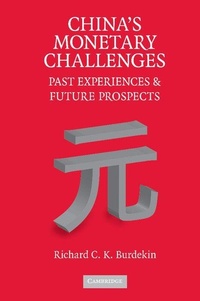
China's Monetary Challenges
Past Experiences and Future Prospects
Published on 4. October 2012
Book
Paperback/Softback
272 pages
978-1-107-40772-5 (ISBN)
Description
Despite the People's Republic of China's remarkable growth over the post-1978 reform period, questions have arisen about the sustainability of its exchange rate policy and the soundness of its financial system. This book focuses on the key monetary challenges to China's continued advancement and addresses such topical issues as the build-up of foreign exchange reserves, monetary control, credit allocation difficulties, and the expanding role of China's asset markets and stock exchanges. Current and past monetary policy strategies are examined in detail as are the banking sector reforms leading up to full foreign competition in December 2006. The analysis also assesses the People's Republic's role within Greater China (including Hong Kong and Taiwan) and the potential for future renminbi monetary hegemony within Asia. The treatment of these issues is intended to be accessible to non-economists and does not assume prior immersion in the underlying formal models.
Reviews / Votes
Review of the hardback: 'This book is insightful, comprehensive, and timely. It is a must-read for anyone interested in understanding China's monetary challenges into the 21st century. The terrific data in Burdekin's book will be particularly valuable to many readers.' James R. Barth, Auburn University Review of the hardback: 'There are many books on China, but few intelligent ones on the Chinese financial market. Richard Burdekin's work is very timely to fill the gap. For those who want to understand issues on Chinese monetary policy, equity markets, banks, and the exchange rate, this book provides comprehensive coverage.' Baizhu Chen, Gordon S. Marshall School of Business, University of Southern California Review of the hardback: 'An invaluable source of information on the evolution of China's monetary institutions from the 1930s until the present, and on the future path of reform.' James A. Dorn, Cato Institute, Washington DC and co-editor of China's Future: Constructive Partner or Emerging Threat Review of the hardback: 'Burdekin's careful research provides valuable insight into a number of current policy issues facing China and the global economy as well as illustrating several fascinating historical episodes. One finds that today is not the first time that pegging exchange rates has generated serious macroeconomic problems for China's economy.' Thomas Willet, Dean, School of Politics and Economics, Claremont Graduate UniversityMore details
Language
English
Place of publication
Cambridge
United Kingdom
Target group
Professional and scholarly
Product notice
Paperback (trade)
Dimensions
Height: 229 mm
Width: 152 mm
Thickness: 16 mm
Weight
446 gr
ISBN-13
978-1-107-40772-5 (9781107407725)
Copyright in bibliographic data and cover images is held by Nielsen Book Services Limited or by the publishers or by their respective licensors: all rights reserved.
Schweitzer Classification
Other editions
Additional editions
E-Book
09/2008
1st Edition
Cambridge University Press
€27.99
Available for download
Book
07/2008
Cambridge University Press
€83.00
Shipment within 15-20 days
Person
Content
Part I. China's Exchange Rate Regime and Monetary Policy: 1. The renminbi-US dollar exchange rate controversy; 2. China's reserve buildup and global imbalances; 3. Combating inflation and deflation; 4. People's Bank of China policy-making and external pressures (with Pierre Siklos); Part II. The Importance of International Factors, Past and Present: 5. US pressure on China and Hong Kong in the 1930s; 6. Inflation transmission to Taiwan in the 1940s (with Hsin-hui I. H. Whited); 7. WTO challenges and China's banking sector today (with Emily Kochanowicz); Part III. The People's Republic Role within Greater China and Asia: 8. Asset market expansion and Shanghai vs. Hong Kong listings of Chinese firms; 9. Economic interdependence with Taiwan (with Hsin-hui I. H. Whited); 10. Conclusions and future prospects for the renminbi.