

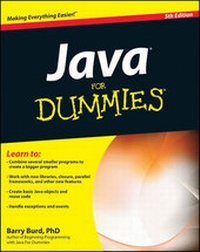
Java For Dummies
5th Edition
Published on 5. August 2011
Book
Paperback/Softback
432 pages
978-0-470-37173-2 (ISBN)
Description
The top-selling beginning Java book is now fully updated for Java 7!
Java is the platform-independent, object-oriented programming language used for developing web and mobile applications. The revised version offers new functionality and features that have programmers excited, and this popular guide covers them all. This book helps programmers create basic Java objects and learn when they can reuse existing code. It's just what inexperienced Java developers need to get going quickly with Java 2 Standard Edition 7.0 (J2SE 7.0) and Java Development Kit 7.0 (JDK 7).
* Explores how the new version of Java offers more robust functionality and new features such as closures to keep Java competitive with more syntax-friendly languages like Python and Ruby
* Covers object-oriented programming basics with Java, code reuse, the essentials of creating a Java program using the new JDK 7, creating basic Java objects, and new Eclipse features
* A companion web site offers all code from the book and bonus chapters
Written by a Java trainer, Java For Dummies, 5th Edition will enable even novice programmers to start creating Java applications quickly and easily.
Java is the platform-independent, object-oriented programming language used for developing web and mobile applications. The revised version offers new functionality and features that have programmers excited, and this popular guide covers them all. This book helps programmers create basic Java objects and learn when they can reuse existing code. It's just what inexperienced Java developers need to get going quickly with Java 2 Standard Edition 7.0 (J2SE 7.0) and Java Development Kit 7.0 (JDK 7).
* Explores how the new version of Java offers more robust functionality and new features such as closures to keep Java competitive with more syntax-friendly languages like Python and Ruby
* Covers object-oriented programming basics with Java, code reuse, the essentials of creating a Java program using the new JDK 7, creating basic Java objects, and new Eclipse features
* A companion web site offers all code from the book and bonus chapters
Written by a Java trainer, Java For Dummies, 5th Edition will enable even novice programmers to start creating Java applications quickly and easily.
More details
Edition
5., Auflage
Language
English
Place of publication
Chichester
United Kingdom
Publishing group
John Wiley and Sons Ltd
Target group
Professional and scholarly
Edition type
Revised edition
Illustrations
Illustrations
Dimensions
Height: 23.3 cm
Width: 18.7 cm
Thickness: 23 mm
Weight
625 gr
ISBN-13
978-0-470-37173-2 (9780470371732)
Schweitzer Classification
Other editions
New editions
Barry A. Burd
Java For Dummies
Book
03/2014
6th Edition
Wiley
€28.90
Article exhausted; check for reprint
Previous edition
Person
Barry Burd, PhD, is a professor of mathematics and computer science at Drew University. He frequently contributes to various online technology resources, including JavaBoutique.com, and is the author of Ruby On Rails For Dummies and the previous edition of this book.
Content
Introduction
Part I: Getting Started
Chapter 1: All about Java
Chapter 2: All about Software
Chapter 3: Using the Basic Building Blocks
Part II: Writing Your Own Java Programs
Chapter 4: Making the Most of Variables and Their Values
Chapter 5: Controlling Program Flow with Decision-Making Statements
Chapter 6: Controlling Program Flow with Loops
Part III: Working with the Big Picture: Object-Oriented Programming
Chapter 7: Thinking in Terms of Classes and Objects
Chapter 8: Saving Time and Money: Reusing Existing Code
Chapter 9: Constructing New Objects
Part IV: Savvy Java Techniques
Chapter 10: Putting Variables and Methods Where They Belong
Chapter 11: Using Arrays and Collections to Juggle Values
Chapter 12: Looking Good When Things Take Unexpected Turns
Chapter 13: Sharing Names among the Parts of a Java Program
Chapter 14: Responding to Keystrokes and Mouse Clicks
Chapter 15: Writing Java Applets
Chapter 16: Using Java Database Connectivity
Part V: The Part of Tens
Chapter 17: Ten Ways to Avoid Mistakes
Chapter 18: Ten Websites for Java
Index
Part I: Getting Started
Chapter 1: All about Java
Chapter 2: All about Software
Chapter 3: Using the Basic Building Blocks
Part II: Writing Your Own Java Programs
Chapter 4: Making the Most of Variables and Their Values
Chapter 5: Controlling Program Flow with Decision-Making Statements
Chapter 6: Controlling Program Flow with Loops
Part III: Working with the Big Picture: Object-Oriented Programming
Chapter 7: Thinking in Terms of Classes and Objects
Chapter 8: Saving Time and Money: Reusing Existing Code
Chapter 9: Constructing New Objects
Part IV: Savvy Java Techniques
Chapter 10: Putting Variables and Methods Where They Belong
Chapter 11: Using Arrays and Collections to Juggle Values
Chapter 12: Looking Good When Things Take Unexpected Turns
Chapter 13: Sharing Names among the Parts of a Java Program
Chapter 14: Responding to Keystrokes and Mouse Clicks
Chapter 15: Writing Java Applets
Chapter 16: Using Java Database Connectivity
Part V: The Part of Tens
Chapter 17: Ten Ways to Avoid Mistakes
Chapter 18: Ten Websites for Java
Index