

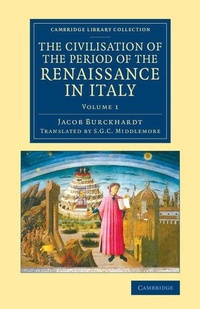
The Civilisation of the Period of the Renaissance in Italy
Published on 11. December 2014
Book
Paperback/Softback
416 pages
978-1-108-07994-5 (ISBN)
Description
On several journeys to Italy in the mid-nineteenth century, the Swiss historian Jacob Burckhardt (1818-97) saw in the figures and events of the Italian Renaissance certain traits that he believed to be mirrored in the politics of his own day, notably some aspects of 'an unbridled egoism, outraging every right, and killing every germ of a healthier culture'. Revolutionary in his all-encompassing and unflinching examination of the Italian Renaissance, Burckhardt saw developments in statecraft and war as giving rise to the more publicised artistic progress of the era. First published in 1860, this work is considered to be his magnum opus on the subject, and is here reissued in the accessible two-volume English translation of 1878 by S. G. C. Middlemore. In Volume 1, Burckhardt considers three key themes: the state as a work of art, the development of the individual, and the revival of antiquity in education and philosophy.
More details
Series
Language
English
Place of publication
Cambridge
United Kingdom
Target group
Professional and scholarly
Product notice
Paperback (trade)
Dimensions
Height: 216 mm
Width: 140 mm
Thickness: 24 mm
Weight
584 gr
ISBN-13
978-1-108-07994-5 (9781108079945)
Copyright in bibliographic data and cover images is held by Nielsen Book Services Limited or by the publishers or by their respective licensors: all rights reserved.
Schweitzer Classification
Other editions
Complete work / Part of the work
Book
12/2014
Cambridge University Press
€95.51
No shipping information available
Persons
Content
Preface; Part I. The State as a Work of Art: 1. Introduction; 2. The tyranny of the fourteenth century; 3. The tyranny of the fifteenth century; 4. The petty tyrannies; 5. The greater dynasties; 6. The opponents of tyranny; 7. The republics: Venice and Florence; 8. Foreign policy of the Italian states; 9. War as a work of art; 10. The papacy and its dangers; Part II. The Development of the Individual: 1. The Italian state and the individual; 2. The perfecting of the individual; 3. The modern idea of fame; 4. Modern wit and satire; Part III. The Revival of Antiquity: 1. Introductory remarks; 2. Rome, the city of ruins; 3. The old authors; 4. Humanism in the fourteenth century; 5. The universities and schools; 6. The furtherers of humanism; 7. The reproduction of antiquity; 8. Latin treatises and history; 9. General Latinisation of culture; 10. Modern Latin poetry; 11. Fall of the humanists in the sixteenth century.