

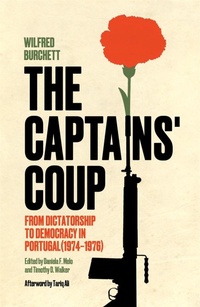
The Captains' Coup
From Dictatorship to Democracy in Portugal (1974-1976)
Published on 22. April 2025
Book
Hardback
352 pages
978-1-80429-836-7 (ISBN)
Description
Wilfred Burchett went to Lisbon in 1974 to cover the military overthrow of the fascist dictatorship that had ruled the country for nearly five decades. Burchett's on-the-ground reporting details the immediate aftermath of the coup and the civilian uprising that followed, which took its name, the Carnation Revolution, from the flowers demonstrators handed out to soldiers and placed in their rifle muzzles. The people's victory began a transition to democracy. It prompted the withdrawal of troops from Portugal's colonies, bringing independence to Guinea Bissau and soon to Angola, Mozambique and other colonial territories.
On the fiftieth anniversary of the revolution's end, The Captains' Coup offers an insightful, poignant narrative never before available in English from a journalist of international repute. The text is based on the author's original typescripts, discovered recently in the National Library of Australia.
Included are a foreword and introductory essay that explore the political and journalistic significance of Burchett's work. Illustrated by contemporary photographs and political posters, the volume is complemented by the editors' annotations, providing essential historical context.
Also included is an afterword by historian and filmmaker Tariq Ali.
On the fiftieth anniversary of the revolution's end, The Captains' Coup offers an insightful, poignant narrative never before available in English from a journalist of international repute. The text is based on the author's original typescripts, discovered recently in the National Library of Australia.
Included are a foreword and introductory essay that explore the political and journalistic significance of Burchett's work. Illustrated by contemporary photographs and political posters, the volume is complemented by the editors' annotations, providing essential historical context.
Also included is an afterword by historian and filmmaker Tariq Ali.
Reviews / Votes
There are two journalists living today who are rocklike in their integrity and in their courage. And one is Wilfred Burchett, the Australian journalist you might say is a universal journalist. He's been everywhere, and often every side calls upon him because he is right there with his information that others lack, because the information is from his own experience and being there. -- Studs Terkel Melo and Walker have performed a great service to Portuguese historiography - and the study of revolutionary processes - by resurrecting and carefully editing Wilfred Burchett's writings writings on the revolutionary period . I can certainly see myself using it with students: it encapsulates brilliantly a certain reading of the 'Carnation Revolution' and the interviews are invaluable. -- Filipe Ribeiro de Meneses, author of <i>Salazar: A Political Biography</i> The everyday lived experience of the Portuguese revolution shines through in these pages and in the voices of the key participants. Burchett's interviews with these victims of the Portuguese dictatorship are the very best and most compelling revelations of the torture, imprisonment and endless harassment and spying to which they were subjected. This is a compelling account, superbly edited by Melo and Walker . a worthy contribution to the fiftieth anniversary of the uprising in Lisbon that ended five centuries of Portuguese colonialism, led to the ending of white rule in Southern Africa, and began a process of democratisation in Spain and Greece, and eventually in Central and Eastern Europe -- Kenneth Maxwell, author of <i>The Making of Portuguese Democracy</i> This carefully edited book offers a vivid portrait of the breakdown of one of the longest right-wing European dictatorships and of its colonial empire -- Antonio Costa Pinto, author of <i>Latin American Dictatorships in the Era of Fascism</i> Walker and Melo have brought to light an invaluable first-hand account by one of the period's leading engage reporters. Burchett's journalistic eye brings to life the hopes and fears of the people he meets - activists, farmers, soldiers and fishermen - and with them the experience of the Revolution itself -- Pedro Ramos Pinto, author of <i>Lisbon Rising: Urban Social Movements in the Portuguese Revolution, 1974-1975</i>More details
Language
English
Place of publication
London
United Kingdom
Product notice
sewn/stitched
Cloth over boards
Illustrations
19 photos
Dimensions
Height: 236 mm
Width: 160 mm
Thickness: 30 mm
Weight
499 gr
ISBN-13
978-1-80429-836-7 (9781804298367)
Copyright in bibliographic data and cover images is held by Nielsen Book Services Limited or by the publishers or by their respective licensors: all rights reserved.
Schweitzer Classification
Other editions
Additional editions
Wilfred Burchett | Daniela Melo | Timothy Walker
The Captains' Coup
From Dictatorship to Democracy in Portugal (1974-1976)
E-Book
04/2025
Verso Books
€29.49
Available for download
Persons
WILFRED BURCHETT (1911-1983) has been described as 'one of the most important journalists of the twentieth century'. He was the first Western civilian reporter to enter Hiroshima after the dropping of the first atomic bomb used in warfare. His accounts of the 'atomic plague' (radiation poisoning) precipitated vehement US military denials and propelled him to international notoriety. An avowed socialist who presented stories from a non Western perspective, he reported from Russia, Vietnam, Korea, Portugal and Angola. His work demonstrates a keen understanding of modern revolutionary processes, placing him among the most impactful figures of Cold War-generation political journalism.
Timothy Walker is Professor of History at the University of Massachusetts Dartmouth, where he serves on the Executive Board of the Center for Portuguese Studies and Culture, and is graduate faculty of the Department of Portuguese. Walker is also an Affiliated Researcher of the Centro de Historia d'Aquem e d'Alem-Mar (CHAM); Universidade Nova de Lisboa, Portugal. From 1994 to 2003, he was a visiting professor at the Universidade Aberta in Lisbon. He is the recipient of a Fulbright dissertation fellowship to Portugal, and fellowships from the Portuguese Camoes Institute, the Luso-American Development Foundation, and the Calouste Gulbenkian Foundation.
Timothy Walker is Professor of History at the University of Massachusetts Dartmouth, where he serves on the Executive Board of the Center for Portuguese Studies and Culture, and is graduate faculty of the Department of Portuguese. Walker is also an Affiliated Researcher of the Centro de Historia d'Aquem e d'Alem-Mar (CHAM); Universidade Nova de Lisboa, Portugal. From 1994 to 2003, he was a visiting professor at the Universidade Aberta in Lisbon. He is the recipient of a Fulbright dissertation fellowship to Portugal, and fellowships from the Portuguese Camoes Institute, the Luso-American Development Foundation, and the Calouste Gulbenkian Foundation.