

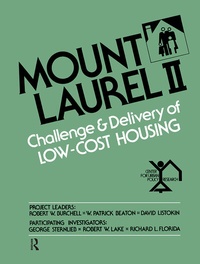
Mount Laurel II
1st Edition
Published on 30. January 1985
Book
Paperback/Softback
440 pages
978-0-88285-098-6 (ISBN)
Description
Mount Laurel II is a historic state supreme court decision which mandates that all new residential development include housing for low- and moder-ate-income families.This study provides a rational approach to low-cost housing. Methods for defining housing market areas are given, as well as demand and supply projection techniques. Housing cost reduction alternatives and allocation approaches are detailed.It elaborates step-by-step methodologies with operational baselines, data framework, and alternative approaches.* The Potential of Zoning and Subdivision Controls* What Housing is Affordable - And by Whom* Fair Share Allocation Procedures
More details
Language
English
Place of publication
Somerset
United Kingdom
Publishing group
Taylor & Francis Inc
Target group
General
Dimensions
Height: 280 mm
Width: 210 mm
Weight
453 gr
ISBN-13
978-0-88285-098-6 (9780882850986)
Copyright in bibliographic data and cover images is held by Nielsen Book Services Limited or by the publishers or by their respective licensors: all rights reserved.
Schweitzer Classification
Other editions
Additional editions
Robert Burchell | W. Patrick Beaton | David Listokin
Mount Laurel II
E-Book
01/2023
1st Edition
Routledge
€68.49
Available for download
Robert Burchell | W. Patrick Beaton | David Listokin
Mount Laurel II
E-Book
01/2023
1st Edition
Routledge
€68.49
Available for download
Persons
Robert W. Burchell, W. Patrick Beaton, David Listokin
Content
Introduction and Organa nation, Summary of Findings, 1 The Definition of a Housing Region 2 Definition of the Mount Laurel Population: Present and Prospective Housing Demand 3 Socioeconomic and Housing Characteristics of the Present and Prospective Mount-Laurel Eligible Populations 4 Present and Prospective Mount Laurel Supply 5 Demand versus Supply- Unmet Mount Laurel Housing Need 6 Bridge Mechanisms to meet the Mount Laurel Mandate 7 An Introduction to the Fair Share Concept?