

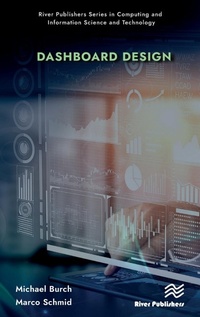
Dashboard Design
1st Edition
Published on 6. February 2024
Book
Hardback
290 pages
978-87-7004-004-4 (ISBN)
Description
Interactive visualization and visual analytics tools have been designed and developed in the past and will be developed in the future as well. In each application domain in which data is measured, generated, and recorded we see a potential candidate for an interactive visualization tool with the goal to find insights and knowledge in the data. This knowledge can be found either visually by humans' interventions or algorithmically by the machine, in the best case by applying both concepts in combination as in visual analytics. One of the easiest ways to get an interactive visualization tool running is by means of dashboards, typically implemented as webpages that can run in a web browser and are accessible online, creating some kind of web-based solution.
This book describes ways to design and implement dashboards based on the programming language Python, the graphics library Plotly, and Dash. The readers can use the provided dashboard codes as a starting point and extend the functionality and features on their desire.
Technical topics discussed in the book include:
Design in visualization
Interaction principles in information visualization
User interface design
Linking Python, Dash, and Plotly
Coding in Python
Dashboard examples with Python code.
This book describes ways to design and implement dashboards based on the programming language Python, the graphics library Plotly, and Dash. The readers can use the provided dashboard codes as a starting point and extend the functionality and features on their desire.
Technical topics discussed in the book include:
Design in visualization
Interaction principles in information visualization
User interface design
Linking Python, Dash, and Plotly
Coding in Python
Dashboard examples with Python code.
More details
Series
Language
English
Place of publication
Gistrup
Denmark
Target group
College/higher education
Professional and scholarly
Postgraduate and Professional Practice & Development
Illustrations
6 s/w Abbildungen, 2 s/w Photographien bzw. Rasterbilder, 34 Farbfotos bzw. farbige Rasterbilder, 4 s/w Zeichnungen, 17 s/w Tabellen, 1 farbige Zeichnung, 35 farbige Abbildungen
17 Tables, black and white; 1 Line drawings, color; 4 Line drawings, black and white; 34 Halftones, color; 2 Halftones, black and white; 35 Illustrations, color; 6 Illustrations, black and white
Dimensions
Height: 240 mm
Width: 161 mm
Thickness: 21 mm
Weight
637 gr
ISBN-13
978-87-7004-004-4 (9788770040044)
Copyright in bibliographic data and cover images is held by Nielsen Book Services Limited or by the publishers or by their respective licensors: all rights reserved.
Schweitzer Classification
Other editions
Additional editions
Michael Burch | Marco Schmid
Dashboard Design
E-Book
02/2024
1st Edition
Taylor & Francis
€138.99
Available for download
Michael Burch | Marco Schmid
Dashboard Design
E-Book
02/2024
1st Edition
Taylor & Francis
€138.99
Available for download
Persons
Michael Burch studied computer science and mathematics at the Saarland University in Saarbruecken, Germany. He received his PhD from the University of Trier in 2010 in the fields of information visualization and visual analytics. After 8 years of having been a PostDoc in the Visualization Research Center (VISUS) in Stuttgart, he moved to the Eindhoven University of Technology (TU/e) as an assistant professor for visual analytics. From October 2020 he has been working as a lecturer in visualization at the University of Applied Sciences in Chur, Switzerland. Michael Burch is on many international program committees and has published more than 190 conference papers and journal articles in the field of visualization. His main interests are in information visualization, visual analytics, eye tracking, and data science.
Marco Schmid studied Natural Resource Science (with specialization in Renewable Resources and Sustainable Energy) at the School of Life Sciences and Facility Management (ZHAW) in Zurich, Switzerland. During his study he worked as a scientific research assistant at the Institute of Applied Simulation at ZHAW. Then he worked for 3 years in a start-up company focused on machine learning and predictive models before he moved to the University of Applied Sciences in Chur, Switzerland in 2019 where he works as a scientific researcher. His main fields of interest are data science and software development.
Marco Schmid studied Natural Resource Science (with specialization in Renewable Resources and Sustainable Energy) at the School of Life Sciences and Facility Management (ZHAW) in Zurich, Switzerland. During his study he worked as a scientific research assistant at the Institute of Applied Simulation at ZHAW. Then he worked for 3 years in a start-up company focused on machine learning and predictive models before he moved to the University of Applied Sciences in Chur, Switzerland in 2019 where he works as a scientific researcher. His main fields of interest are data science and software development.
Content
1. Introduction 2. Creating Powerful Dashboards 3. Python, Dash, Plotly, and More 4. Coding in Python 5. Dashboard Examples 6. Challenges and Limitation 7. Conclusion