

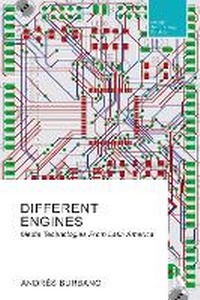
Different Engines
Media Technologies From Latin America
1st Edition
Published on 31. March 2023
Book
Hardback
220 pages
978-1-032-00111-1 (ISBN)
Description
Different Engines investigates the emergence of technologies in Latin America to create images, sounds, video games, and physical interactions. The book contributes to the construction of a historiographical and theoretical framework for understanding the work of creators who have been geographically and historically marginalized through the study of five exemplary and yet relatively unknown artifacts built by engineers, scientists, artists, and innovators. It offers a broad and detailed view of the complex and sometimes unlikely conditions under which technological innovation is possible and of the problematic logics under which these innovations may come to be devalued as historically irrelevant. Through its focus on media technologies, the book presents the interactions between technological and artistic creativity, working towards a wider understanding of the shifts in both fields that have shaped current perceptions, practices, and design principles while bringing into view the personal, social, and geopolitical singularities embodied by particular devices. It will be an engaging and insightful read for scholars, researchers, and students across a wide range of disciplines, such as media studies, art and design, architecture, cultural history, and the digital humanities.
Reviews / Votes
With a sovereign gesture, Andres Burbano puts Latin America and the Global South on the agenda of media archaeological research, at the same time opening up a perspective for them as exciting and indispensable agents in the deep-time interplay between the sciences, technology, and the arts. In his case studies, past, presences, and possible futures meet to form fascinating surprise generators.- Siegfried Zielinski, Professor Emeritus of Media Theory, Universitaet der Kuenste, Berlin, and author of Deep Time of the Media: Toward an Archaeology of Hearing and Seeing by Technical Means
With five case studies, Burbano introduces a world of Latin American innovations that could potentially alter existing histories of media. Unifying historical research with experimental design, this book is required reading for scholars and students of art, media, and design practices and histories.
- Maria Fernandez, Associate Professor of Art History, Cornell University, Ithaca, and author of Cosmopolitanism in Mexican Visual Culture
Different Engines offers fascinating insights into the history of Latin American media technology. Beyond this, Burbano proposes a promising new research approach that not only brings together ideas from STS, art history, media archaeology, and postcolonial studies, but introduces experimental interaction with historical media as an indispensable epistemological method.
- Margit Rosen, Head of Collections, Archives & Research at the Zentrum fuer Kunst und Medien, Karlsruhe (ZKM), and editor of A Little-Known Story About a Movement, a Magazine, and the Computer's Arrival in Art: New Tendencies and Bit International, 1961-1973
Different Engines: Media Technologies from Latin America constitutes the first genuine historical ontology of media artifacts from the much-ignored experience of the Global South. Whether focusing on early experimentations with analog sound and image or examining contemporary involvement with computerized media, what the author finds in these revealing Latin American cases is a lot of anticipatory, creative, and alternative technological paths that defy the conventional accounts and criteria of successful innovation. With Different Engines, Burbano emerges as the premiere decolonial and pluriversal media archaeologist in the world at present. His "experimental reconstitutions" of past experiences should become an obligatory passage point for those wishing to engage in similar reconstructions with other media or in other parts of the South. This eminently readable book will be of great value to those interested in science and technology studies, media studies, design, and cultural, decolonial and Latin American Studies.
- Arturo Escobar, Professor Emeritus of Anthropology, University of North Carolina, Chapel Hill, and author of Designs for the Pluriverse: Radical Interdependence, Autonomy, and the Making of Worlds
More details
Series
Language
English
Place of publication
London
United Kingdom
Publishing group
Taylor & Francis Ltd
Target group
College/higher education
Professional and scholarly
Academic and Postgraduate
Illustrations
30 s/w Abbildungen, 30 s/w Photographien bzw. Rasterbilder
30 Halftones, black and white; 30 Illustrations, black and white
Dimensions
Height: 234 mm
Width: 156 mm
Weight
552 gr
ISBN-13
978-1-032-00111-1 (9781032001111)
Copyright in bibliographic data and cover images is held by Nielsen Book Services Limited or by the publishers or by their respective licensors: all rights reserved.
Schweitzer Classification
Other editions
Additional editions
Book
12/2024
1st Edition
Routledge
€56.00
Shipment within 10-20 days
E-Book
03/2023
1st Edition
Routledge
€55.49
Available for download
E-Book
03/2023
1st Edition
Routledge
€55.49
Available for download
Person
Andres Burbano is Professor in the Arts and Humanities School at the Open University of Catalunya (Barcelona, Spain) and Visiting Lecturer at Donau-Universitaet (Krems, Austria). He holds a Ph.D. in Media Arts and Technology from the University of California at Santa Barbara (California, EEUU) and has developed most of his academic career in the School of Architecture and Design at Universidad de los Andes (Bogota, Colombia). Burbano works as a researcher, curator, and interdisciplinary artist. His research projects focus on media history and media archaeology in Latin America and the Global South, 3D modeling of archaeological sites, and computational technologies' historical and cultural impact. Burbano has been appointed as ACM SIGGRAPH 2024 Chair.
Content
Acknowledgements. Introduction. Part One. Chapter 1 Bioacoustics and Photography. Brazil, 1832. Chapter 2 The Color Wheel of Television History. Mexico, 1939. Chapter 3 COMDASUAR: A Very Personal Computer. Chile, 1978. Part Two. Chapter 4 Lua: The Scripting Side of the Moon. Brazil 1993. Chapter 5 Wiring: Tangible Interaction, Intangible History. Italy, Colombia 2003. Conclusions. Index.