

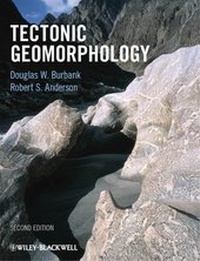
Tectonic Geomorphology
2nd Edition
Will be published approx. on 11. November 2011
Book
Paperback/Softback
460 pages
978-1-4443-3887-4 (ISBN)
Description
Tectonic geomorphology is the study of the interplay between tectonic and surface processes that shape the landscape in regions of active deformation and at time scales ranging from days to millions of years. Over the past decade, recent advances in the quantification of both rates and the physical basis of tectonic and surface processes have underpinned an explosion of new research in the field of tectonic geomorphology. Modern tectonic geomorphology is an exceptionally integrative field that utilizes techniques and data derived from studies of geomorphology, seismology, geochronology, structure, geodesy, stratigraphy, meteorology and Quaternary science. While integrating new insights and highlighting controversies from the ten years of research since the 1st edition, this 2nd edition of Tectonic Geomorphology reviews the fundamentals of the subject, including the nature of faulting and folding, the creation and use of geomorphic markers for tracing deformation, chronological techniques that are used to date events and quantify rates, geodetic techniques for defining recent deformation, and paleoseismologic approaches to calibrate past deformation.
Overall, this book focuses on the current understanding of the dynamic interplay between surface processes and active tectonics. As it ranges from the timescales of individual earthquakes to the growth and decay of mountain belts, this book provides a timely synthesis of modern research for upper-level undergraduate and graduate earth science students and for practicing geologists.
Additional resources for this book can be found at: http://www.wileycom/go/burbank/geomorphology
Reviews / Votes
"Finally, it is worth mentioning that, unusually, this book comes with an electronic supplement readily available on the web that includes all figures, plates, and tables to be used in lectures by anyone, making this book a must-have for anyone teaching tectonic geomorphology or interested in this topic. Kodama intelligently summarizes achievements in the field of sedimentary paleomagnetism, where he also plays an important role." (Pure Appl. Geophys, 1 January 2015)"In summary, Tectonic Geomorphology is a nicely written, finely illustrated, rich and, above all, thought provoking textbook. I believe it will be extremely useful not only for graduate students, but also for those more mature scientists who left school before the onset of what I consider the most exciting advancement in the Earth Sciences after Plate Tectonics." (J Seismol, 1 March 2013)
"This is an excellent second edition of Tectonic Geomorphology and is highly recommended to geologists and geomorphologists with an interest in neotectonics and landscape evolution." (Geological Journal, 29 January 2014)
"In summary, Tectonic Geomorphology is a well-thought-out and well-executed text that well serves teaching of the subject at graduate and upper levels, and it provides a valuable reference for practicing geologists." (Environmental & Engineering Geoscience, 2 May 2013)
"This is definitely a book worth taking a look at by any member; and one worth trying hard to come to terms with if aspects of this important subject really interest you." (Open University Geological Society Journal, 1 November 2012)
"Notwithstanding this, I strongly recommend to have 'Tectonic Geomorphology' on one's bookshelf. It will be of particular value to the young generation of geoscientists, wondering which research direction to go. They will get first-class food-for-thought." (Geologos, 2012)
More details
Edition
2. Auflage
Language
English
Place of publication
Hoboken
United Kingdom
Publishing group
John Wiley and Sons Ltd
Target group
College/higher education
Professional and scholarly
Product notice
Paperback (trade)
Dimensions
Height: 246 mm
Width: 189 mm
Thickness: 26 mm
Weight
916 gr
ISBN-13
978-1-4443-3887-4 (9781444338874)
Schweitzer Classification
Other editions
Additional editions
Douglas W. Burbank | Robert S. Anderson
Tectonic Geomorphology
Book
11/2011
2nd Edition
Wiley-Blackwell
€145.00
Article exhausted; check different version
Douglas W. Burbank | Robert S. Anderson
Tectonic Geomorphology
E-Book
11/2011
2nd Edition
Wiley-Blackwell
€108.99
Available for download
Douglas W. Burbank | Robert S. Anderson
Tectonic Geomorphology
E-Book
11/2011
2nd Edition
Wiley-Blackwell
€54.99
Available for download
Previous edition

Douglas W. Burbank | Robert S. Anderson
Tectonic Geomorphology
Book
12/2000
Blackwell Science Ltd
€78.81
Article exhausted; check for reprint
Persons
Douglas Burbank is a tectonic geomorphologist who investigates the growth of mountains and evolution of landscapes primarily in collisional mountain belts, ranging from New Zealand's Southern Alps to the Tien Shan and the Andes. He has focused on interactions among mountain building, erosion, climate, and deposition at time scales ranging from decades to millions of years.
Robert Anderson is a geomorphologist who has studied the processes responsible for shaping many landscapes. These include several tectonically active mountain ranges, from the Himalayas to Alaska. He has been involved deeply in the development of methods to extract timing from landscapes, focusing on the use of cosmogenic radionuclides, and consistently employs numerical models in his work.
Content
Preface to First Edition viii
Preface to Second Edition xii
1 Introduction to tectonic geomorphology 1
2 Geomorphic markers 17
3 Establishing timing in the landscape: dating methods 45
4 Stress, faults, and folds 71
5 Short-term deformation: geodesy 117
6 Paleoseismology: ruptures and slip rates 147
7 Rates of erosion and uplift 195
8 Holocene deformation and landscape responses 243
9 Deformation and geomorphology at intermediate time scales 274
10 Tectonic geomorphology at late Cenozoic time scales 316
11 Numerical modeling of landscape evolution 370
References 412
Index 444
Colour plate section appears between pages 226 and 227