

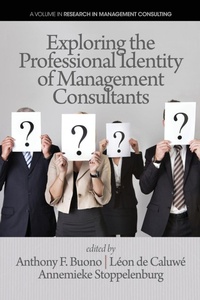
Exploring the Professional Identity of Management Consultants
Published on 5. February 2013
Book
Paperback/Softback
390 pages
978-1-62396-171-8 (ISBN)
Description
The volume is based on the presentations and discussions from the Fifth European Conference on Management Consulting sponsored by the Management Consulting Division of the Academy of Management, which took place June, 2011 at Vrije Universiteit in Amsterdam, the Netherlands. The conference theme - Exploring the Professional Identity of Management Consultants - attempted to capture the highly ambiguous social status of this young and emerging profession. Management consulting does not have professional standards or accreditation criteria like those found in medicine or law, there are low barriers to entry, and a broad range of tasks are undertaken in the name of consulting. As a result, a crucial aspect of what constitutes such a loosely defined profession is the identity of its members. The professional identity of management consultants is continuously developing through the interplay of how consultants are seen and valued by clients as well as in the larger society, and how consultancy firms and consultants identify and position themselves.
This theme includes a variety of topics, ranging from the interaction between consultants and their clients, consultant rhetoric and self-presentation, and the plethora of books, media and public discourse on consulting, to human resource policies and practices, knowledge development activities of consultancy firms, career and life stories of consultants and consultancies, and consulting associations, accreditation bodies, and education programs. All of these factors contribute, either directly or indirectly, to identity construction in the field of management consulting.
This theme includes a variety of topics, ranging from the interaction between consultants and their clients, consultant rhetoric and self-presentation, and the plethora of books, media and public discourse on consulting, to human resource policies and practices, knowledge development activities of consultancy firms, career and life stories of consultants and consultancies, and consulting associations, accreditation bodies, and education programs. All of these factors contribute, either directly or indirectly, to identity construction in the field of management consulting.
More details
Series
Language
English
Place of publication
Charlotte
United States
Publishing group
Emerald Publishing Inc
Target group
Professional and scholarly
Dimensions
Height: 234 mm
Width: 156 mm
Thickness: 22 mm
Weight
591 gr
ISBN-13
978-1-62396-171-8 (9781623961718)
Copyright in bibliographic data and cover images is held by Nielsen Book Services Limited or by the publishers or by their respective licensors: all rights reserved.
Schweitzer Classification
Other editions
Additional editions
Anthony F. Buono
Exploring the Professional Identity of Management Consultants
E-Book
01/2013
1st Edition
Information Age Publishing
from
€62.33
Available for download
Persons
Anthony F. Buono, Bentley University, USA.
Leon de Caluwe, Vrije Universiteit, Netherlands.
Annemieke Stoppelenburg, Tilburg University and SIOO, Netherlands.
Leon de Caluwe, Vrije Universiteit, Netherlands.
Annemieke Stoppelenburg, Tilburg University and SIOO, Netherlands.
Content
Introduction, Anthony F. Buono, Leon de Caluwe and Annemieke Stoppelenburg.
Chapter 1. Setting the Context: Reflections on Management Consultancy in the 21st Century, J. Strikwerda.
Section I. The Multiple Identities of Management Consultants.
Chapter 2. Consultant-Client Interaction: Shaping the Identity of Management Consultants, Anthony F. Buono and Flemming Poulfelt.
Chapter 3. What Is Professional Competence? A Study of Assessment Criteria in Eight Professional Service Sectors, Annika Schilling and Andreas Werr.
Chapter 4. Informal Client Relationship Development by Consultants: The Star Players and the Naturals, Yvette Taminiau, Liselore Berghman, and Petra den Besten.
Section II. Consultants as Agents of Change.
Chapter 5. Conceptualizing Developmental Space for Innovating Groups, Karin Derksen, Leon de Caluwe, and Robert Jan Simons.
Chapter 6. Managers' Perceptions of Organizational Change Skills: Within Their Own Organization and Those Sought from Management Consultants, Karen Somerville and Dawn-Marie Turner.
Chapter 7. Struggling to Challenge an Informal Field Order: Professional Associations as Standard Setters, Susanna Alexius and Frida Pemer.
Section III. Acquiring and Disseminating Consulting Skills.
Chapter 8. Professionalizing Practices in Advisory Work: Presenting a Conceptual Approach to Study the Relations Among Institutionalization, Reflective Learning, and Quality in Consultancy, Sonja van der Arend, Bertien Broekhans, and Sebastiaan Meijer.
Chapter 9. Teaching Consulting to Academics: Reflections on Professionals Supporting an Academic Teaching Program, Sebastiaan Meijer, Geert Roovers, Tanja Verheij, and Ivo Wenzler.
Chapter 10. Skill Acquisition of Executive Coaches: A Journey Toward Mastery, John L. Bennett and Kelly D. B. Rogers.
Chapter 11. Consultant Self-Reflecting Capabilities and Client Evaluation, Elsbeth Reitsma.
Chapter 12. Far Away, So Close? An Attempt to Cross-Fertilize Consulting and Academic Worlds-Experiences of an OD World Summit, Andras Gelei, Balazs Heidrich and Gergely Nemeth.
Section IV. Shifting Identities and Challenges in Management Consulting.
Chapter 13. A Comparative Image of Management Consulting Through the Magnifying Glass of Its Main Stakeholders, Valentin Bejan and Leon de Caluwe.
Chapter 14. Organizational Identity Change Through International Expansion: The Case of a Scandinavian Consulting Firm's Encounter with India, Flemming Poulfelt, Kare Christiansen, and Irene Skovgaard Smith.
Chapter 15. Executive Coaching: An Emerging Role for Management Consultants, John L. Bennett and Mary Wayne Bush.
Chapter 16. Moon Shots for Management: Traditional, Systemic or Complementary Consulting for Supporting Management on Their Trek to the Moon?, Andreas Drechsler, Peter Kalvelage, and Tobias Trepper.
About the Authors.
Chapter 1. Setting the Context: Reflections on Management Consultancy in the 21st Century, J. Strikwerda.
Section I. The Multiple Identities of Management Consultants.
Chapter 2. Consultant-Client Interaction: Shaping the Identity of Management Consultants, Anthony F. Buono and Flemming Poulfelt.
Chapter 3. What Is Professional Competence? A Study of Assessment Criteria in Eight Professional Service Sectors, Annika Schilling and Andreas Werr.
Chapter 4. Informal Client Relationship Development by Consultants: The Star Players and the Naturals, Yvette Taminiau, Liselore Berghman, and Petra den Besten.
Section II. Consultants as Agents of Change.
Chapter 5. Conceptualizing Developmental Space for Innovating Groups, Karin Derksen, Leon de Caluwe, and Robert Jan Simons.
Chapter 6. Managers' Perceptions of Organizational Change Skills: Within Their Own Organization and Those Sought from Management Consultants, Karen Somerville and Dawn-Marie Turner.
Chapter 7. Struggling to Challenge an Informal Field Order: Professional Associations as Standard Setters, Susanna Alexius and Frida Pemer.
Section III. Acquiring and Disseminating Consulting Skills.
Chapter 8. Professionalizing Practices in Advisory Work: Presenting a Conceptual Approach to Study the Relations Among Institutionalization, Reflective Learning, and Quality in Consultancy, Sonja van der Arend, Bertien Broekhans, and Sebastiaan Meijer.
Chapter 9. Teaching Consulting to Academics: Reflections on Professionals Supporting an Academic Teaching Program, Sebastiaan Meijer, Geert Roovers, Tanja Verheij, and Ivo Wenzler.
Chapter 10. Skill Acquisition of Executive Coaches: A Journey Toward Mastery, John L. Bennett and Kelly D. B. Rogers.
Chapter 11. Consultant Self-Reflecting Capabilities and Client Evaluation, Elsbeth Reitsma.
Chapter 12. Far Away, So Close? An Attempt to Cross-Fertilize Consulting and Academic Worlds-Experiences of an OD World Summit, Andras Gelei, Balazs Heidrich and Gergely Nemeth.
Section IV. Shifting Identities and Challenges in Management Consulting.
Chapter 13. A Comparative Image of Management Consulting Through the Magnifying Glass of Its Main Stakeholders, Valentin Bejan and Leon de Caluwe.
Chapter 14. Organizational Identity Change Through International Expansion: The Case of a Scandinavian Consulting Firm's Encounter with India, Flemming Poulfelt, Kare Christiansen, and Irene Skovgaard Smith.
Chapter 15. Executive Coaching: An Emerging Role for Management Consultants, John L. Bennett and Mary Wayne Bush.
Chapter 16. Moon Shots for Management: Traditional, Systemic or Complementary Consulting for Supporting Management on Their Trek to the Moon?, Andreas Drechsler, Peter Kalvelage, and Tobias Trepper.
About the Authors.