

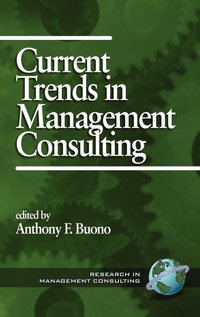
Current Trends in Management Consulting
Will be published approx. on 1. January 2001
Book
Hardback
228 pages
978-1-930608-19-1 (ISBN)
Description
Volume One in this series focuses on current trends in the management consulting industry. It is divided into three sections: (1) a look at some of the broad changes taking place in the management consulting industry, (2) an examination of recent trends and techniques in the practice of management consulting, and (3) reflections on the current state of affairs in the industry. As this brief overview has hopefully captured, the first volume in this series provides ample insight into and differing perspectives on the multi-faceted world of management consulting. Thanks are due to all the authors for their thoughtful work, good-natured colleagueship, and willingness to contribute their thoughts and insights about the consulting field. This volume would not have been possible without their efforts.
More details
Series
Language
English
Place of publication
Charlotte
United States
Publishing group
Emerald Publishing Inc
Target group
College/higher education
Professional and scholarly
Illustrations
Illustrations
Dimensions
Height: 240 mm
Width: 161 mm
Thickness: 17 mm
Weight
511 gr
ISBN-13
978-1-930608-19-1 (9781930608191)
Copyright in bibliographic data and cover images is held by Nielsen Book Services Limited or by the publishers or by their respective licensors: all rights reserved.
Schweitzer Classification
Other editions
Additional editions
Anthony F. Buono
Current Trends in Management Consulting
E-Book
10/2001
1st Edition
Information Age Publishing
from
€62.33
Available for download
Content
Introduction; Anthony F. Buono.
Part I. The Management Consulting Industry
Chapter 1. The Anatomy of Network Building in Management Consulting Firms; Kari Lilja and Flemming Poulfelt.
Chapter 2. The Role of Relational Expertise in Professional Service Delivery; Kate Walsh.
Chapter 3. Toward a Theory of Knowledge Arbitrage: Examining Management Consultants as Knowledge Arbiters and Arbitragers; Matthew Semadeni.
Part II. Trends and Techniques in Management Consulting
Chapter 4. Consulting and EQ: Enhancing Emotional Intelligence in the Workplace; Aaron Nurick.
Chapter 5. The Changing Role of Consulting in Project Management; Hans Thamhain.
Chapter 6. A System-Wide, Integrated Methodology for Intervening in Organizations: The ISEOR Approach; Henri Savall, Veronique Zardet, Marc Bonnet, and Richie Moore.
Chapter 7. New Directions in Linking Research: Employee Satisfaction as an Outcome or Predictor?; Kyle M. Lundby, Krishef J. Fenlason, and Shon M. Maguan.
Part II. Reflections on Management Consulting
Chapter 8. Change in Human Systems: From Planned Change to Guided Changing; Kenneth W. Kerber.
Chapter 9. Transforming Consulting Knowledge into Business Fads; Bertrand Venard.
Chapter 10. Are We Producing Information Age Consultants?: Reflections on U.S. Business Schools' Course Offerings; Susan M. Adams and Alberto Zanzi.
Contributors.
Part I. The Management Consulting Industry
Chapter 1. The Anatomy of Network Building in Management Consulting Firms; Kari Lilja and Flemming Poulfelt.
Chapter 2. The Role of Relational Expertise in Professional Service Delivery; Kate Walsh.
Chapter 3. Toward a Theory of Knowledge Arbitrage: Examining Management Consultants as Knowledge Arbiters and Arbitragers; Matthew Semadeni.
Part II. Trends and Techniques in Management Consulting
Chapter 4. Consulting and EQ: Enhancing Emotional Intelligence in the Workplace; Aaron Nurick.
Chapter 5. The Changing Role of Consulting in Project Management; Hans Thamhain.
Chapter 6. A System-Wide, Integrated Methodology for Intervening in Organizations: The ISEOR Approach; Henri Savall, Veronique Zardet, Marc Bonnet, and Richie Moore.
Chapter 7. New Directions in Linking Research: Employee Satisfaction as an Outcome or Predictor?; Kyle M. Lundby, Krishef J. Fenlason, and Shon M. Maguan.
Part II. Reflections on Management Consulting
Chapter 8. Change in Human Systems: From Planned Change to Guided Changing; Kenneth W. Kerber.
Chapter 9. Transforming Consulting Knowledge into Business Fads; Bertrand Venard.
Chapter 10. Are We Producing Information Age Consultants?: Reflections on U.S. Business Schools' Course Offerings; Susan M. Adams and Alberto Zanzi.
Contributors.