

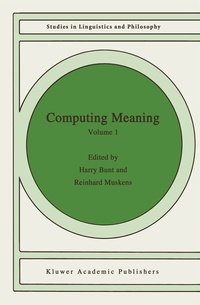
Computing Meaning
Volume 1
1st Edition
Published on 30. November 2001
Book
Paperback/Softback
VI, 363 pages
978-1-4020-0290-8 (ISBN)
Description
Computational semantics is concerned with computing the meanings of linguistic objects such as sentences, text fragments, and dialogue contributions. As such it is the interdisciplinary child of semantics, the study of meaning and its linguistic encoding, and computational linguistics, the discipline that is concerned with computations on linguistic objects.
From one parent computational semantics inherits concepts and techniques that have been developed under the banner of formal (or model-theoretic) semantics. This blend of logic and linguistics applies the methods of logic to the description of meaning. From the other parent the young discipline inherits methods and techniques for parsing sentences, for effective and efficient representation of syntactic structure and logical form, and for reasoning with semantic information. Computational semantics integrates and further develops these methods, concepts and techniques.
This book is a collection of papers written by outstanding researchers in the newly emerging field of computational semantics. It is aimed at those linguists, computer scientists, and logicians who want to know more about the algorithmic realisation of meaning in natural language and about what is happening in this field of research. There is a general introduction by the editors.
From one parent computational semantics inherits concepts and techniques that have been developed under the banner of formal (or model-theoretic) semantics. This blend of logic and linguistics applies the methods of logic to the description of meaning. From the other parent the young discipline inherits methods and techniques for parsing sentences, for effective and efficient representation of syntactic structure and logical form, and for reasoning with semantic information. Computational semantics integrates and further develops these methods, concepts and techniques.
This book is a collection of papers written by outstanding researchers in the newly emerging field of computational semantics. It is aimed at those linguists, computer scientists, and logicians who want to know more about the algorithmic realisation of meaning in natural language and about what is happening in this field of research. There is a general introduction by the editors.
Reviews / Votes
"... the editors did a good job in projecting a collection of works representing the state of the art in computational semantics. The book contains material that will be of value especially to experts in this field. However, most of the papers in the volume will also be relevant to researchers from other branches of computational linguistics who are interested in theoretical aspects of the computation of meaning in natural language."(Computational Linguistics, 27:1 (1999)
More details
Series
Edition
1999
Language
English
Place of publication
Dordrecht
Netherlands
Target group
Professional and scholarly
Research
Illustrations
VI, 363 p.
Dimensions
Height: 234 mm
Width: 156 mm
Thickness: 21 mm
Weight
565 gr
ISBN-13
978-1-4020-0290-8 (9781402002908)
DOI
10.1007/978-94-011-4231-1
Schweitzer Classification
Other editions
Additional editions
Book
11/1999
Kluwer Academic Publishers
€160.49
Shipment within 15-20 days
Content
Computational Semantics.- On Semantic Underspecification.- Dynamic and Underspecified Interpretation without Dynamic or Underspecified Logic.- Labeled Representations, Underspecification and Disambiguation.- Underspecified Semantics in HPSG.- Minimum Description Length and Compositionality.- How to Glue a Donkey to an f-Structure: Porting a 'Dynamic' Meaning Representation Language into LFG's Linear Logic Glue-Language Semantics.- Vague Utterances and Context Change.- Using Situations to Reason about the Interpretation of Speech Events.- Simulative Inference in a Computational Model of Belief.- Indefinites as Epsilon Terms: A Labelled Deduction Account.- Dynamic Skolemization.- Semantically-based Ellipsis Resolution with Syntactic Presuppositions.- Presupposition Projection as Proof Construction.- Dynamic Discourse Referents for Tense and Modals.- Linking Theory and Lexical Ambiguity: The Case of Italian Motion Verbs.- A Disambiguation Approach for German Compounds with Deverbal Head.