

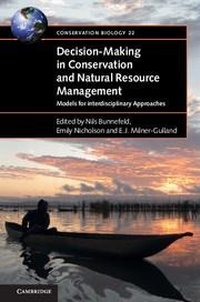
Decision-Making in Conservation and Natural Resource Management
Models for Interdisciplinary Approaches
Published on 6. July 2017
Book
Hardback
286 pages
978-1-107-09236-5 (ISBN)
Description
Making decisions about the management and conservation of nature is necessarily complex, with many competing pressures on natural systems, opportunities and benefits for different groups of people and a varying, uncertain social and ecological environment. An approach which is narrowly focused on either human development or environmental protection cannot deliver sustainable solutions. This volume provides frameworks for improving the integration of natural resource management with conservation and supporting stronger collaboration between researchers and practitioners in developed and developing countries. Novel approaches are required when ecological and social dynamics are highly interdependent. A structured, participatory, model-based approach to decision-making for biodiversity conservation has been proven to produce real-world change. There are surprisingly few successful case studies, however; some of the best are presented here, from fisheries, pest management and conservation. Researchers and practitioners need this interdisciplinary approach, focused on quantitative tools that have been tested and applied, and learning from success.
More details
Series
Language
English
Place of publication
Cambridge
United Kingdom
Target group
College/higher education
Professional and scholarly
Product notice
sewn/stitched
Cloth over boards
Illustrations
15 Tables, black and white; 6 Halftones, black and white; 29 Line drawings, black and white
Dimensions
Height: 239 mm
Width: 167 mm
Thickness: 2 mm
Weight
467 gr
ISBN-13
978-1-107-09236-5 (9781107092365)
Copyright in bibliographic data and cover images is held by Nielsen Book Services Limited or by the publishers or by their respective licensors: all rights reserved.
Schweitzer Classification
Other editions
Additional editions
Nils Bunnefeld | Emily Nicholson | E. J. Milner-Gulland
Decision-Making in Conservation and Natural Resource Management
Models for Interdisciplinary Approaches
Book
07/2017
Cambridge University Press
€62.40
Shipment within 15-20 days
Nils Bunnefeld
Decision-Making in Conservation and Natural Resource Management
Models for Interdisciplinary Approaches
E-Book
07/2017
Cambridge University Press
€35.49
Available for download
Nils Bunnefeld | Emily Nicholson | E. J. Milner-Gulland
Decision-Making in Conservation and Natural Resource Management
Models for Interdisciplinary Approaches
E-Book
06/2017
Cambridge University Press
€41.49
Available for download
Persons
Nils Bunnefeld is an Associate Professor at the University of Stirling. His research focuses on the interaction between people and nature with an emphasis on mathematical and statistical modelling. In 2016, he was awarded a 5-year European Research Council Starting Grant (ConFooBio) on resolving conflicts between food security and biodiversity conservation. Emily Nicholson is a Senior Lecturer based at Deakin University, Australia. Her research focuses on solving critical conservation problems and measuring change in biodiversity. Her work has helped to develop a new framework for assessing risks to ecosystems, the Red List of Ecosystems, adopted as the global standard by the International Union for the Conservation of Nature (IUCN). E. J. Milner-Gulland is Tasso Leventis Professor of Biodiversity at the University of Oxford. In 2014 she was awarded a Pew Marine Fellowship on the use of novel approaches to addressing marine bycatch. Her ethos is to ensure that all the research she does is addressing issues identified by practitioners, and is carried out collaboratively with end-users.
Content
1. Introduction Nils Bunnefeld, Emily Nicholson, E. J. Milner-Gulland; Part I. Approaches to Decision-Making: 2. Fisheries science and participatory management strategy evaluation: eliciting objectives, visions and system models Cathy Dichmont and Beth Fulton; 3. Rapid prototyping for decision structuring: an efficient approach to conservation decision analysis Georgia E. Garrard, Libby Rumpff, Michael C. Runge and Sarah J. Converse; 4. Understanding uptake of decision-support models in conservation and natural resource management Yung En Chee, Fiona Fidler and Bonnie Wintle; 5. Understanding human wellbeing for conservation: a locally driven, mixed methods approach Emily Woodhouse, Katherine M. Homewood, Emilie Beauchamp, Tom Clements, J. Terrence McCabe, David Wilkie and E. J. Milner-Gulland; Part II. Challenges in Implementation: 6. Implementing decision analysis tools for invasive species management Joslin L. Moore, Charlie Pascoe, Elaine Thomas and Marie Keatley; 7. Using management strategy evaluation as a framework for improving conservation under uncertainty: the case of the Serengeti ecosystem Ana Nuno, Nils Bunnefeld and E. J. Milner-Gulland; 8. The use of quantitative models in the harvest management of wild ungulates, carnivores and small game - using Norway as a case study Erlend B. Nilsen; 9. Linking global biodiversity indicators with global conservation policy Emily Nicholson, Beth Fulton and Ben Collen; 10. Synthesis: moving forward together E. J. Milner-Gulland, Emily Nicholson and Nils Bunnefeld.