

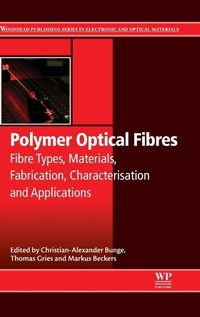
Polymer Optical Fibres
Fibre Types, Materials, Fabrication, Characterisation and Applications
Published on 15. September 2016
Book
Hardback
436 pages
978-0-08-100039-7 (ISBN)
Description
Polymer Optical Fibres: Fibre Types, Materials, Fabrication, Characterization, and Applications explores polymer optical fibers, specifically their materials, fabrication, characterization, measurement techniques, and applications. Optical effects, including light propagation, degrading effects of attenuation, scattering, and dispersion, are explained. Other important parameters like mechanical strength, operating temperatures, and processability are also described. Polymer optical fibers (POF) have a number of advantages over glass fibers, such as low cost, flexibility, low weight, electromagnetic immunity, good bandwidth, simple installation, and mechanical stability.
More details
Series
Language
English
Place of publication
Cambridge
United Kingdom
Publishing group
Elsevier Science & Technology
Target group
Professional and scholarly
Product notice
Laminated cover
Dimensions
Height: 236 mm
Width: 154 mm
Thickness: 27 mm
Weight
824 gr
ISBN-13
978-0-08-100039-7 (9780081000397)
Copyright in bibliographic data and cover images is held by Nielsen Book Services Limited or by the publishers or by their respective licensors: all rights reserved.
Schweitzer Classification
Other editions
Additional editions
Christian-Alexander Bunge | Markus Beckers | Thomas Gries
Polymer Optical Fibres
Fibre Types, Materials, Fabrication, Characterisation and Applications
E-Book
08/2016
Woodhead Publishing
€165.00
Available for download
Persons
Prof. Christian-Alexander Bunge works in the Institute for Communications Technology at University of Applied Sciences Leipzig (HfTL), on microstructured and solid polymer fibers, in optical, acoustic, magnet, and mechanical sensor technologies and optical communications. HfTL specialises in ICT and is organised in cooperation with Deutsche Telekom AG. Mr Markus Beckers works in the ITA. RWTH Aachen is ranked no. 1 University for technology in Germany and ITA is in a top international position in polymer fibre production and application research. It specialises in process upscaling and product development close to market. Thomas Gries is Professor and Director of the Institut fuer Textiltechnik of RWTH Aachen University, Germany. His achievements are commendable, and his contributions to the field of textile technology and fibre based composites have had a profound impact. Furthermore, his leadership in transforming the Institut fuer Textiltechnik into a comprehensive provider of textile innovation, digitalisation and sustainability initiatives underscores his dedication to pushing the boundaries of textile technology. His involvement in textile recycling, decarbonisation, biotransformation and efforts to enhance energy and material efficiency further solidifies his status as an undisputed leader in the field. Contact e-mail: thomas.gries@ita.rwth-aachen.de
Content
1. Introduction - why we made this book
2. Basics of light guidance
3. Basic principles of optical fibres
4. Special fibres and components
5. Materials, chemical properties and analysis
6. Fabrication techniques for polymer optical fibres
7. Mechanical properties of polymer-optical fibres
8. Polymer-optical fibres for data transmission
9. Applications of polymer-optical fibres in sensor technology, lighting and further applications
10. Polymer-optical fibre (POF) integration into textile fabric structures
11. Overview of the POF market
2. Basics of light guidance
3. Basic principles of optical fibres
4. Special fibres and components
5. Materials, chemical properties and analysis
6. Fabrication techniques for polymer optical fibres
7. Mechanical properties of polymer-optical fibres
8. Polymer-optical fibres for data transmission
9. Applications of polymer-optical fibres in sensor technology, lighting and further applications
10. Polymer-optical fibre (POF) integration into textile fabric structures
11. Overview of the POF market