

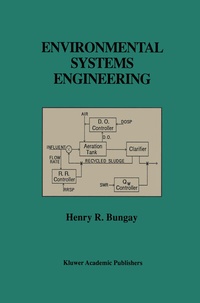
Environmental Systems Engineering
Published on 31. October 1997
Book
Hardback
XIII, 209 pages
978-0-7923-8049-8 (ISBN)
Description
Environmental Systems Engineering
explains how to use new computerized tools to tackle problems in systems engineering.
This book covers: expert systems, fuzzy logic, networks, process dynamics, control and statistical approaches to systems analysis. Computer simulation, mathematical models, and newer methods that apply artificial intelligence and neural networks to environmental problems are emphasized.
Each book topic is supported by an interactive web site featuring computer graphics, teaching games and navigational aids. Topics are developed through the use of computer exercises using practical problems as examples.
This book covers: expert systems, fuzzy logic, networks, process dynamics, control and statistical approaches to systems analysis. Computer simulation, mathematical models, and newer methods that apply artificial intelligence and neural networks to environmental problems are emphasized.
Each book topic is supported by an interactive web site featuring computer graphics, teaching games and navigational aids. Topics are developed through the use of computer exercises using practical problems as examples.
More details
Edition
1998 ed.
Language
English
Place of publication
New York
United States
Target group
College/higher education
Professional and scholarly
Research
Illustrations
XIII, 209 p.
Dimensions
Height: 241 mm
Width: 160 mm
Thickness: 17 mm
Weight
512 gr
ISBN-13
978-0-7923-8049-8 (9780792380498)
DOI
10.1007/978-1-4615-5507-0
Schweitzer Classification
Other editions
Additional editions
Henry R. Bungay
Environmental Systems Engineering
E-Book
12/2012
Springer
€96.29
Available for download
Henry R. Bungay
Environmental Systems Engineering
Book
11/2012
Springer
€106.99
Shipment within 7-9 days
Content
1. Introduction.- Systems engineering.- Biological concepts.- Programming for systems applications.- Old reliable languages.- Newer languages.- Equation solvers.- 2. SIMULATION.- SIMBAS, SIMulation in BASic.- Guide for writing simbas programs.- Dissolved oxygen sag curve.- Tricks with simbas.- 3. Process Dynamics.- Dynamic analysis.- Forcing functions.- Controllers.- Distance-velocity lag.- Templates for graphical design or analysis.- Stability.- Linearity.- Open- and closed-loop responses.- Bode diagrams in matlab.- Feedforward control.- Programs for dynamic analysis.- 4. Databases.- Database management.- Spreadsheets.- Electronic databases.- 5. COMPUTER MODELS.- Philosophy.- Curve fitting.- Growth-rate relationships.- Clemson model of activated sludge.- Partial differential equations.- Plume models for air pollution.- Estuarine contaminant simulator.- Fugacity approach.- Observers.- Cellular automata models.- Conclusions.- 6. Hydraulic Networks.- Network principles.- Pipe networks.- More complicated networks.- Software for processes.- 7. Neural Networks.- How many boxes and hidden layers?.- Neural algorithms.- Commercial shells for neural networks.- Discussion.- Bioprocess monitoring and control.- Public domain programs.- 8. Expert Systems.- Common expert systems.- Advanced features of expert systems.- Commercial programs for expert systems.- Applications.- 9. Fuzzy Logic.- Fuzzy operations.- Fuzzy truth.- Fuzzy controllers.- Fuzzy approaches to state estimation.- A little more theory.- 10. Statistical Approaches.- Definitions.- Distributions.- Process performance.- Statistical features of spreadsheets.- Time series analysis.- Extreme value problems.- Independent variables.- Optimization.- Appendices A. Running Dos Programs.- B. INTRODUCTION TO A SPREADSHEET.- C. MATLAB PIPE NETWORK PROGRAM.