

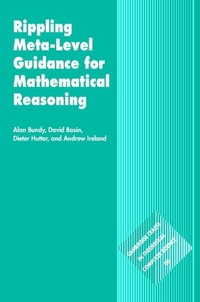
Rippling: Meta-Level Guidance for Mathematical Reasoning
Meta-Level Guidance for Mathematical Reasoning
Published on 30. June 2005
Book
Hardback
216 pages
978-0-521-83449-0 (ISBN)
Description
Rippling is a radically new technique for the automation of mathematical reasoning. It is widely applicable whenever a goal is to be proved from one or more syntactically similar givens. It was originally developed for inductive proofs, where the goal was the induction conclusion and the givens were the induction hypotheses. It has proved to be applicable to a much wider class of tasks, from summing series via analysis to general equational reasoning. The application to induction has especially important practical implications in the building of dependable IT systems, and provides solutions to issues such as the problem of combinatorial explosion. Rippling is the first of many new search control techniques based on formula annotation; some additional annotated reasoning techniques are also described here. This systematic and comprehensive introduction to rippling, and to the wider subject of automated inductive theorem proving, will be welcomed by researchers and graduate students alike.
More details
Series
Language
English
Place of publication
Cambridge
United Kingdom
Target group
Professional and scholarly
Illustrations
1 Line drawings, unspecified; 10 Line drawings, color
Dimensions
Height: 235 mm
Width: 157 mm
Thickness: 16 mm
Weight
473 gr
ISBN-13
978-0-521-83449-0 (9780521834490)
Copyright in bibliographic data and cover images is held by Nielsen Book Services Limited or by the publishers or by their respective licensors: all rights reserved.
Schweitzer Classification
Other editions
Additional editions
Alan Bundy | David Basin | Dieter Hutter
Rippling: Meta-Level Guidance for Mathematical Reasoning
Meta-Level Guidance for Mathematical Reasoning
E-Book
09/2005
1st Edition
Cambridge University Press
€91.99
Available for download
Persons
Content
Preface; 1. An introduction to rippling; 2. Varieties of rippling; 3. Productive use of failure; 4. A formal account of rippling; 5. The scope and limitations of rippling; 6. From rippling to a general methodology; 7. Conclusions; Appendix 1. An annotated calculus and a unification algorithm; Appendix 2. Definitions of functions used in this book; Bibliography; Index.